
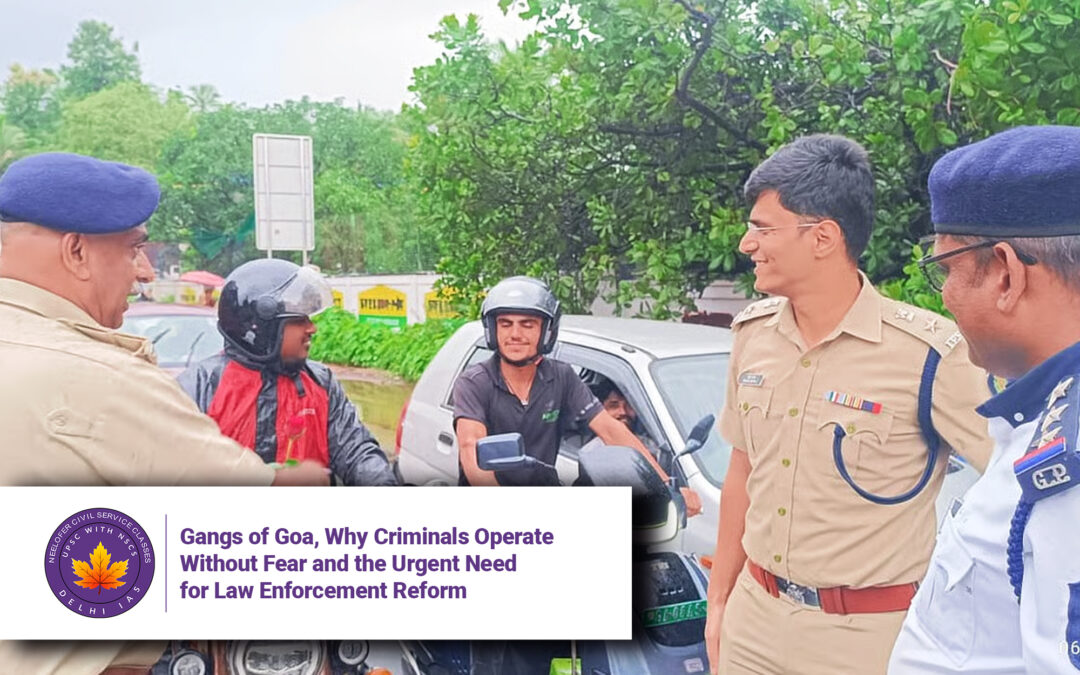
Gangs of Goa, Why Criminals Operate Without Fear and the Urgent Need for Law Enforcement Reform
Why in News?
The recent violent gang attack on the busy Colva–Margao road in Goa has exposed the alarming decline in law enforcement’s effectiveness in dealing with organised crime. A gang of 15 armed assailants carried out a brazen, open attack using pistols, swords, iron rods, and glass bottles, severely injuring two victims. The incident, which unfolded in broad daylight on a busy public road, has reignited concerns over public safety, law enforcement’s preparedness, and systemic corruption in policing.
Introduction
For decades, Goa has been synonymous with beaches, nightlife, and tourism. However, beneath the surface of its scenic beauty lies a disturbing reality — the rise of fearless organised gangs. These criminal groups no longer confine their activities to dark alleys or hidden spaces; instead, they execute violent operations in broad daylight, demonstrating a complete lack of fear towards law enforcement.
The latest attack in Colva–Margao is not an isolated case. It is part of a pattern where gangs operate with open defiance, often in areas patrolled by the police, highlighting systemic loopholes and deep-rooted issues in governance and policing. This incident is a wake-up call — not only about public safety in Goa but also about the structural failures that allow such criminal networks to flourish.
The Incident in Detail
On a busy Tuesday morning, around 15 armed individuals travelling in multiple cars ambushed the occupants of a targeted vehicle. The attackers unleashed violence with pistol shots, swords, iron rods, and glass bottles. The brutality was so severe that it nearly killed two of the victims.
What was even more shocking was not just the method of attack, but the confidence with which it was carried out. There were no police officers on the scene, no immediate safeguards, and no visible deterrents. The attackers operated in a manner that made it clear they did not fear intervention or capture.
Law Enforcement’s Ineffectiveness
Police officials often claim high crime detection rates. However, this incident shows that such statistics mean little when criminals can roam openly, armed and dangerous, without fear of being stopped. Even the police nakabandhi (checkpoints) that are sometimes set up after attacks are proving ineffective. In this case, despite the heightened security that should follow such incidents, the gang was reportedly spotted at a restaurant until early morning, only a few meters from a police station — with police officers as passive spectators.
This incident underscores that the problem is not just about one attack but about a failing system. Whether due to lack of manpower, poor planning, or deliberate inaction, law enforcement is falling short of its primary duty: to protect citizens.
Root Causes of the Problem
-
Neglect of Law and Order on the Coast
-
For years, authorities have turned a blind eye to violations in liquor outlets, beach shacks, and night hangouts. This neglect has created fertile ground for gangs to operate, recruit, and expand.
-
Illegalities go unchecked, leading to a culture where criminals see Goa as a safe haven.
-
-
Exploitation of Legal Loopholes
-
Gangs make use of gaps in regulations to set up meeting points and safe houses, knowing police presence in these areas is either absent or ineffective.
-
-
Possible Police Complicity
-
Repeatedly, gangs have been able to operate in full view of law enforcement. This has led to strong public suspicion that some officers may be complicit or under political pressure to ignore certain crimes.
-
-
Corruption and Political Protection
-
When criminals have the backing of powerful political or business interests, police action becomes selective. Certain groups may receive protection from raids or arrests in exchange for money or influence.
-
Changing Nature of Organised Crime in Goa
Organised crime in Goa has evolved from being clandestine to being aggressively public. The modern-day gangs do not just operate in secrecy — they now launch planned attacks in open spaces, irrespective of time or place.
For example:
-
A few years ago, a youth was stripped naked and beaten along the same Colva–Margao route in the early morning hours. That gang, too, had spent the night at a local restaurant before committing the crime.
-
Now, criminals no longer fear using heavy weaponry like firearms and swords in public, a sign that the rule of law is being eroded.
This transformation of gang behaviour signals a dangerous future where violence becomes normalised in daily life.
Impact on Public Safety and Tourism
Goa’s economy is heavily dependent on tourism. Incidents like this not only put locals at risk but also tarnish the state’s global reputation as a safe holiday destination. The fear of being caught in gang violence discourages tourists, impacts businesses, and reduces investor confidence.
Residents now live with the reality that heavily armed criminals can appear at any time — in markets, on highways, or even near police stations — with little chance of being stopped in time.
The Police’s Role and Public Perception
The current perception among citizens is grim:
-
Police either cannot or will not act decisively against gang violence.
-
In some cases, officers may be involved in protecting criminal elements.
-
Checkpoints and patrols are often symbolic rather than preventive.
This erosion of trust is dangerous. Once the public loses confidence in law enforcement, the foundations of a safe society crumble.
Need for Urgent Action
1. Overhaul Policing Practices
-
Adopt intelligence-led policing to track and monitor gang movements before crimes occur.
-
Increase visible patrolling in high-risk areas like Colva, Margao, and other popular nightlife zones.
2. Break Political–Criminal Nexus
-
Enforce strict legal consequences for any politician or business figure found shielding criminals.
3. Strengthen Legal Framework
-
Close loopholes in licensing, liquor sales, and coastal regulations that gangs exploit.
4. Public–Police Cooperation
-
Create anonymous reporting systems for locals to share gang-related information without fear of retaliation.
5. Accountability and Transparency
-
Implement independent oversight committees to investigate allegations of police inaction or complicity.
Conclusion
The Colva–Margao gang attack is more than just another violent crime — it is a symptom of deep-rooted problems in Goa’s governance and law enforcement. Criminals are operating with open defiance, and citizens are paying the price for a system that appears unwilling or unable to protect them.
If Goa is to retain its image as a peaceful tourist haven, immediate reforms are necessary. From policing to political accountability, the state must act decisively to dismantle organised crime networks before they embed themselves even deeper into society.
5 Key Questions & Answers
Q1: What happened during the recent gang attack in Goa?
A: Around 15 armed assailants attacked a targeted car on the Colva–Margao road using pistols, swords, iron rods, and glass bottles, severely injuring two people. The attack took place in broad daylight, and the attackers escaped without police intervention.
Q2: Why are gangs in Goa not afraid of law enforcement?
A: The lack of effective policing, political interference, corruption, and legal loopholes have emboldened gangs to operate openly without fear of arrest or punishment.
Q3: How has organised crime in Goa changed in recent years?
A: Gangs have moved from operating in secrecy to executing bold, public attacks. They now plan operations during both day and night, often in busy public spaces.
Q4: What role does police complicity play in gang violence?
A: There is growing suspicion among the public that certain police officers either protect gangs or deliberately ignore their activities due to political or financial influence.
Q5: What measures are needed to restore safety and public trust in Goa?
A: Goa must overhaul its policing strategy, strengthen legal frameworks, dismantle the political–criminal nexus, and improve public–police cooperation to ensure accountability and safety.

