
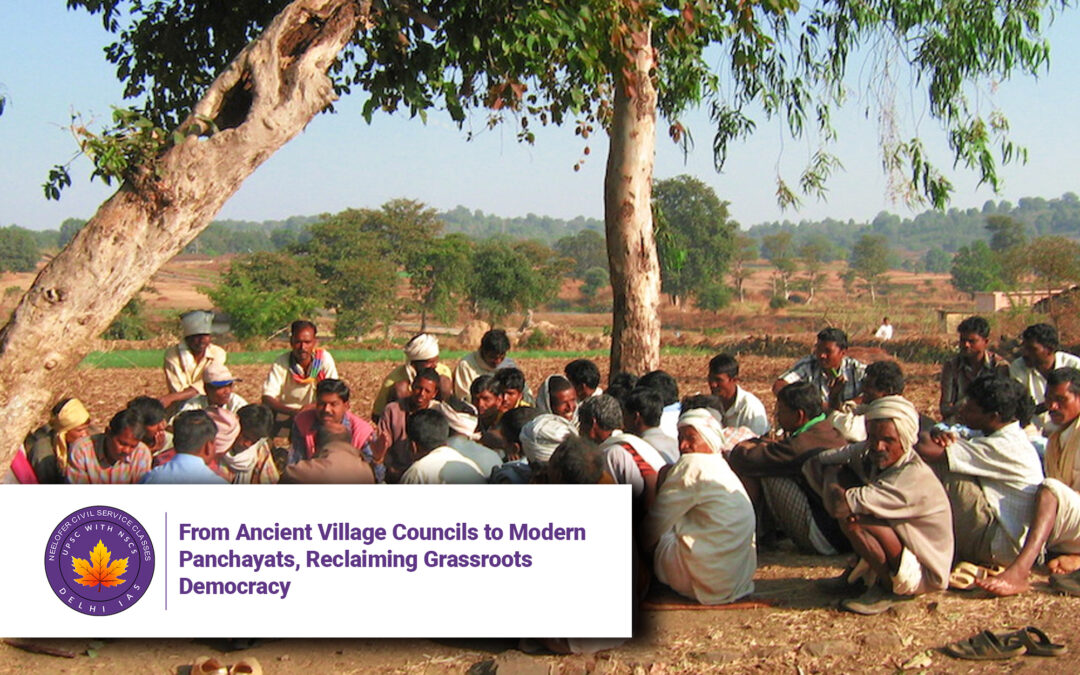
From Ancient Village Councils to Modern Panchayats, Reclaiming Grassroots Democracy
Why in News?
The journey of India’s local self-governance—from ancient councils like Sabhas and Samitis to the constitutionally enshrined Panchayati Raj system—has once again become the focus of national attention. Recent debates surrounding digital governance, financial decentralisation, grassroots empowerment, and corruption have reignited the call to revamp and reinforce the Panchayati Raj system as a truly participatory democratic institution. As India advances towards a digital and decentralised future, ensuring that its democratic roots remain intact at the village level is now more urgent than ever. 
Ancient Roots of Local Self-Governance
India’s tradition of self-governance at the village level dates back to ancient times. Village councils such as Sabhas and Samitis held pivotal decision-making powers. The “Panch Parameshwar” or council of five elders administered local governance based on consensus. Kautilya’s Arthashastra refers to the Gramikas—village heads responsible for law enforcement, tax collection, and land administration.
This decentralized model was built on shared community engagement, proximity-based decision-making, and a deep sense of public responsibility. However, these institutions eroded significantly under colonial rule. British policies replaced autonomous village institutions with centralized mechanisms, especially for tax collection. This fundamentally weakened grassroots democracy and led to a governance vacuum that lasted long after independence.
The Constitutional Revival of Panchayati Raj
The idea of reinstituting grassroots governance formally took shape post-independence. The Balwantrai Mehta Committee (1957) strongly recommended a three-tier Panchayati Raj structure—Village (Gram Panchayat), Block (Panchayat Samiti), and District (Zila Parishad). This recommendation laid the foundation for the 73rd and 74th Constitutional Amendments (1992-93), which granted constitutional status to Panchayats and Urban Local Bodies respectively.
These amendments introduced mandatory elections every five years, reservation of seats for women and marginalized communities, and financial devolution. The provisions intended to make the Panchayat system a functional institution of self-governance, empowering communities to plan and implement development at the local level.
Challenges to the Panchayati Raj System
1. Electoral Disruptions and Democratic Erosion
Despite constitutional mandates, several states have frequently disrupted elections or manipulated electoral boundaries. In states like Assam and Manipur, undemocratic delays in elections have been observed, undermining citizens’ democratic rights. The appointment of special officers in place of elected bodies for prolonged periods has also weakened grassroots representation and hampered rural development.
In Madhya Pradesh, Panchayat elections were cancelled due to the State Election Commission’s conflict with delimitation decisions in Scheduled Areas. Such actions suggest that administrative convenience often takes precedence over democratic mandates.
2. Corruption, Misgovernance, and Judicial Interventions
Corruption and lack of transparency have become major concerns within Panchayati Raj institutions. In the north-western region of India, a Sarpanch was found to have embezzled ₹79 lakh by fabricating documents of non-existent development projects like solar lamps and toilets. In eastern tribal areas, officials have been suspended for transferring public money into private accounts.
Inadequate audits, weak grievance mechanisms, and collusion between officials and contractors have facilitated financial misappropriation. Furthermore, interventions by higher judiciary—including the Supreme Court and High Courts—have sometimes overridden democratic processes under the guise of maintaining order or constitutional propriety, further distorting the autonomy of local self-governance.
3. Administrative and Infrastructure Gaps
Poor roads, broken sanitation systems, and insufficient water supply in many Panchayat-ruled villages highlight the administrative incapacity of these bodies. In Nagpur, a Zilla Panchayat faced allegations of hoarding nutrition funds meant for malnourished children. In several districts, rural health centres remained under-equipped, revealing the severe gaps in local planning and execution.
The Way Forward: Strengthening Panchayati Raj Institutions
A reinvigorated Panchayati Raj system must focus on decentralised democracy, fiscal empowerment, technological integration, and capacity building. Key recommendations include:
1. Fiscal Federalism and Financial Devolution
Local self-governments must have access to untied funds—money not earmarked for specific schemes—to meet community-specific priorities. Delays in fund transfers, excessive bureaucratic control, and lack of independent financial planning have crippled many Panchayats.
Financial devolution must be accompanied by mandatory audits, transparent budgeting, and proactive disclosure of expenses to citizens. The 15th Finance Commission recommended a ₹1.5 lakh crore allocation to local bodies, but effectiveness depends on its timely and uncorrupted disbursement.
2. Legal and Administrative Empowerment
Panchayats should be granted powers to make binding decisions on local matters without interference from higher state officials. Legal backing must also protect Panchayat representatives from arbitrary removal and ensure their decisions are respected. Effective grievance redressal mechanisms must be established, including ombudsmen and local Lokpal-like bodies.
3. Digital Transformation for Better Governance
Technology can transform Panchayati Raj institutions into efficient, transparent service providers. Platforms such as mobile tracking apps, real-time dashboards, and biometric authentication can reduce leakages, improve targeting of welfare benefits, and prevent corruption.
However, this requires significant investment in digital infrastructure, especially in remote and tribal areas. Training Panchayat members in the use of digital tools and ensuring technical support will be key to successful implementation.
4. Grassroots Capacity Building
Continuous training and awareness programmes are essential for both elected Panchayat members and rural citizens. NGOs and civil society groups must be involved to educate communities about their rights, duties, and development schemes. Special attention must be given to marginalized groups, including women, tribals, and Dalits, to ensure inclusive governance.
Initiatives like Rashtriya Gram Swaraj Abhiyan (RGSA) have begun this process in states like Jharkhand and Chhattisgarh. However, expansion and regular monitoring of these capacity-building efforts are necessary for long-term results.
5. Promoting Social Accountability
Social audits, public hearings (Jan Sunwais), and citizen report cards must be institutionalized to promote accountability. Technology-enabled grievance platforms, along with community-based monitoring, will help ensure that development funds reach their intended beneficiaries.
Panchayats should also be encouraged to collaborate with local schools, SHGs, and cooperatives to strengthen social networks and build trust.
Reclaiming the Spirit of Grassroots Democracy
India’s democracy must thrive not only in Parliament but also in its Panchayats. Despite constitutional provisions, Panchayati Raj institutions continue to face obstacles from both state and central governments. The recent National Family Health Survey (NFHS-5) data shows that states like Bihar and Rajasthan have witnessed a decline in women’s representation in local governance due to unclear rules and limited enforcement of gender quotas.
States like Madhya Pradesh and Odisha have diluted the rule of law by allowing indirect elections and reducing Gram Sabha power. These practices contradict the very essence of decentralized democracy.
For Panchayati Raj to be genuinely transformative, it must be insulated from political manipulation. Gram Sabhas must be empowered to question decisions, approve development plans, and monitor implementation. Local democracy should become the core of India’s development story, not an afterthought.
Conclusion
From the Panch Parameshwar to the Gram Sabha, India’s tradition of local self-governance has deep and rich roots. But these roots can only bear fruit if they are nourished with empowerment, transparency, and genuine autonomy. The Panchayati Raj system must evolve—not just in letter, but in spirit—to meet the aspirations of 21st-century India.
As India embraces digital governance, decentralized planning, and social equity, the Panchayat must no longer be viewed as a subsidiary institution but as a pillar of democratic governance. Reclaiming and reforming the Panchayati Raj system is not just a constitutional responsibility—it is a moral imperative.
Q&A Corner
Q1. What are the historical roots of Panchayati Raj in India?
Ancient India had decentralized local governance through institutions like Sabhas and Samitis. Village councils handled taxation, law enforcement, and land administration, forming the foundation for the modern Panchayati Raj system.
Q2. What was the role of the 73rd Amendment?
It gave constitutional status to Panchayati Raj institutions, mandated elections every five years, and introduced reservations for women and marginalized communities. It aimed to make local governance more democratic and participatory.
Q3. What are the biggest challenges to the Panchayati Raj system?
Key challenges include election disruptions, corruption, misgovernance, judicial overreach, insufficient financial devolution, and lack of digital infrastructure.
Q4. How can Panchayats be made more effective?
By ensuring financial autonomy, leveraging technology for transparency, increasing citizen participation, and providing training to elected representatives.
Q5. Why is grassroots democracy important for India?
Because the real test of democracy lies not just in Parliament, but in how empowered the common citizen feels in shaping local development. Strong Panchayats ensure that the benefits of democracy and development reach the last mile.

