
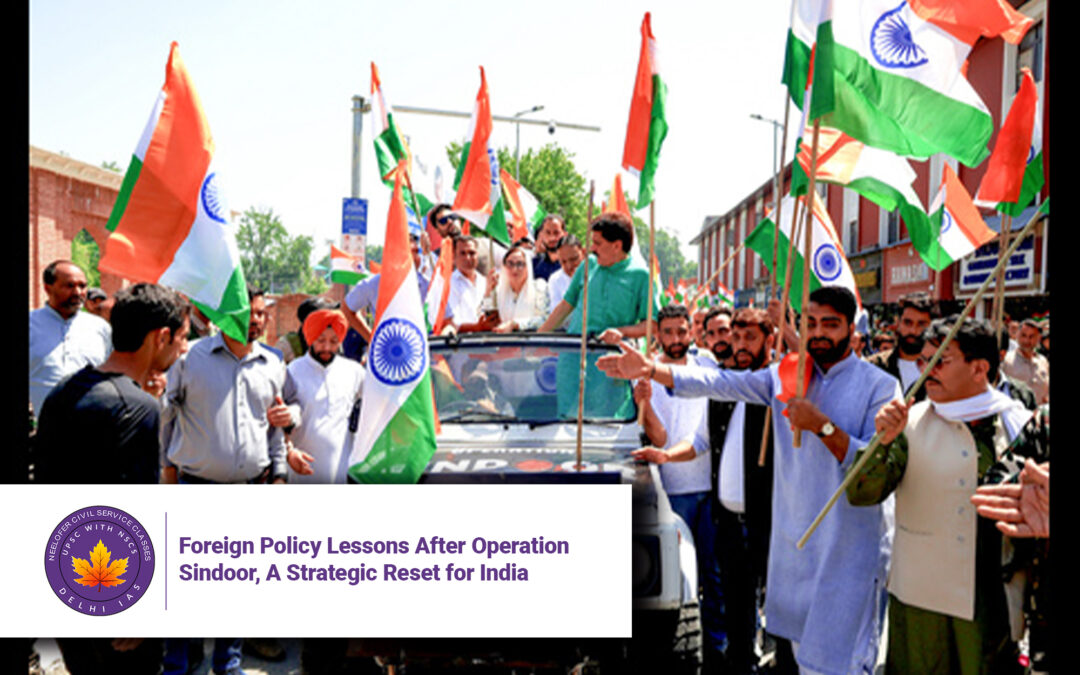
Foreign Policy Lessons After Operation Sindoor, A Strategic Reset for India
Why in News?
The conclusion of Operation Sindoor in Jammu & Kashmir and the bordering regions of Pakistan has prompted reflection on India’s evolving foreign policy, security doctrines, and international partnerships. 
Introduction
Operation Sindoor marked a critical military action taken by India to neutralize terror threats and secure its borders. With the dust now settling, India faces the task of re-evaluating its strategic posture and geopolitical alignments. It is essential not only to examine Pakistan’s response but also to draw broader foreign policy lessons that will strengthen India’s position in an increasingly complex world.
Key Issues and Background
1. Lessons from Pakistan’s Reaction
-
Pakistan has responded with familiar denials and diplomatic narratives, offering no substantive shift in behavior.
-
India must realize that Pakistan is unlikely to reform unless internal chaos or economic compulsion forces it.
2. Arab-Muslim World Dynamics
-
Despite religious solidarity with Pakistan, many Arab and Muslim-majority countries have shown greater alignment with India.
-
These nations prefer predictable and stable partners, prioritizing economic and diplomatic cooperation over ideological ties.
The Core of the Concern
1. Redefining India’s Alliances
-
The operation has made it evident that India cannot rely on outdated friendships.
-
A shift is needed towards issue-based and pragmatic partnerships rather than emotional or historical ties.
2. Understanding China and the West
-
China continues to back Pakistan, both diplomatically and economically, despite Pakistan’s instability.
-
In contrast, Western countries (UK, Europe, US) have shown more sympathy toward India’s actions, provided they are transparent and justifiable.
Key Observations
-
The U.S. under Donald Trump was clear in prioritizing American interests over Pakistan.
-
Many West Asian countries, including UAE and Saudi Arabia, have tilted toward India due to its economic strength and anti-radicalization efforts.
-
Global powers now demand high-quality diplomatic engagement—India must maintain clarity in its intentions, focusing on peace and stability.
Challenges and the Way Forward
Challenges
-
Balancing hardline security actions with diplomatic engagement.
-
Preventing alienation of traditional allies while embracing new partnerships.
-
Managing China’s continued strategic backing of Pakistan.
Steps Forward
-
Continue building ties with the Gulf States, Europe, and Indo-Pacific allies.
-
Maintain moral credibility through humanitarian actions alongside military operations.
-
Push for a realistic and interest-based foreign policy, avoiding ideological rigidity.
Conclusion
Operation Sindoor is a turning point—not just militarily but diplomatically. It signals the need for India to make bold, informed decisions that blend strength with wisdom. The world is watching India’s choices, and only those rooted in realism and consistency will build lasting respect.
5 Questions and Answers
Q1. What triggered the foreign policy debate post Operation Sindoor?
A: The conclusion of Operation Sindoor, a military operation in Jammu & Kashmir, prompted analysis of Pakistan’s unchanged response and broader strategic shifts for India.
Q2. How has Pakistan responded to Operation Sindoor?
A: With traditional denial and rhetoric, showing little intent to reform or acknowledge internal issues.
Q3. What shift is seen among Arab-Muslim nations?
A: Many are aligning more with India due to its stable leadership, economic growth, and rejection of radicalism, despite religious commonality with Pakistan.
Q4. How does the West view India’s recent actions?
A: Countries like the US, UK, and EU generally support India when it acts with responsibility and strategic clarity.
Q5. What should be India’s foreign policy approach moving forward?
A: India must pursue pragmatic, interest-based relationships, focus on economic diplomacy, and ensure consistent strategic messaging.

