
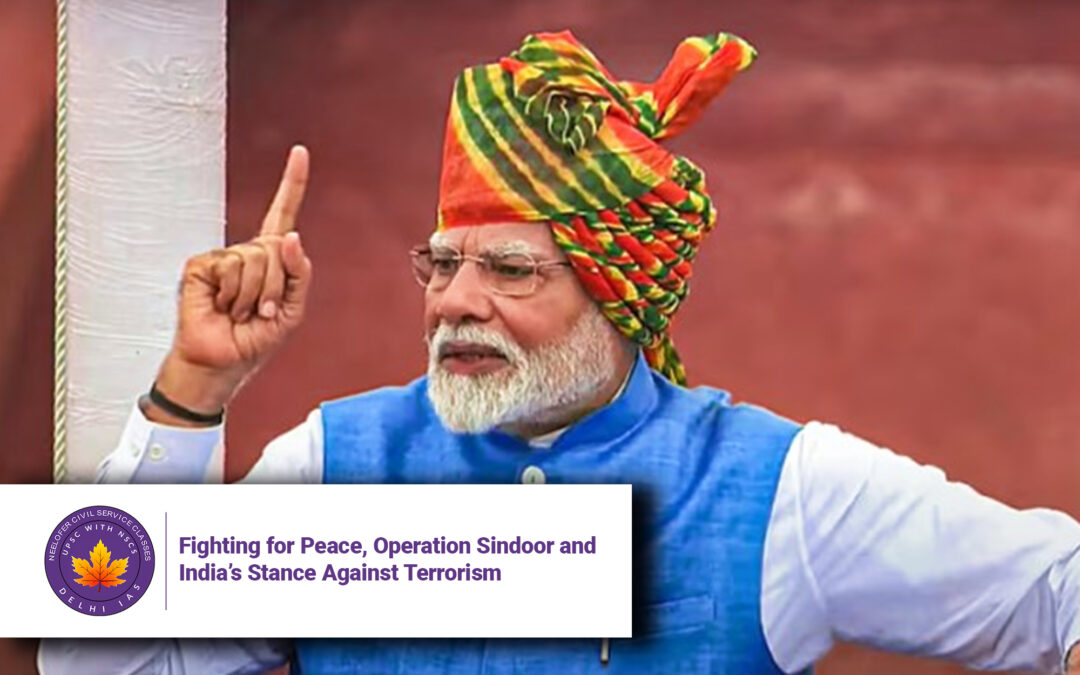
Fighting for Peace, Operation Sindoor and India’s Stance Against Terrorism
Why in News?
India launched Operation Sindoor on May 7 as a response to terror hideouts in Pakistan. This event has reignited the discourse around India’s long-standing struggle against Pakistan-sponsored terrorism and the geopolitical dynamics of South Asia. 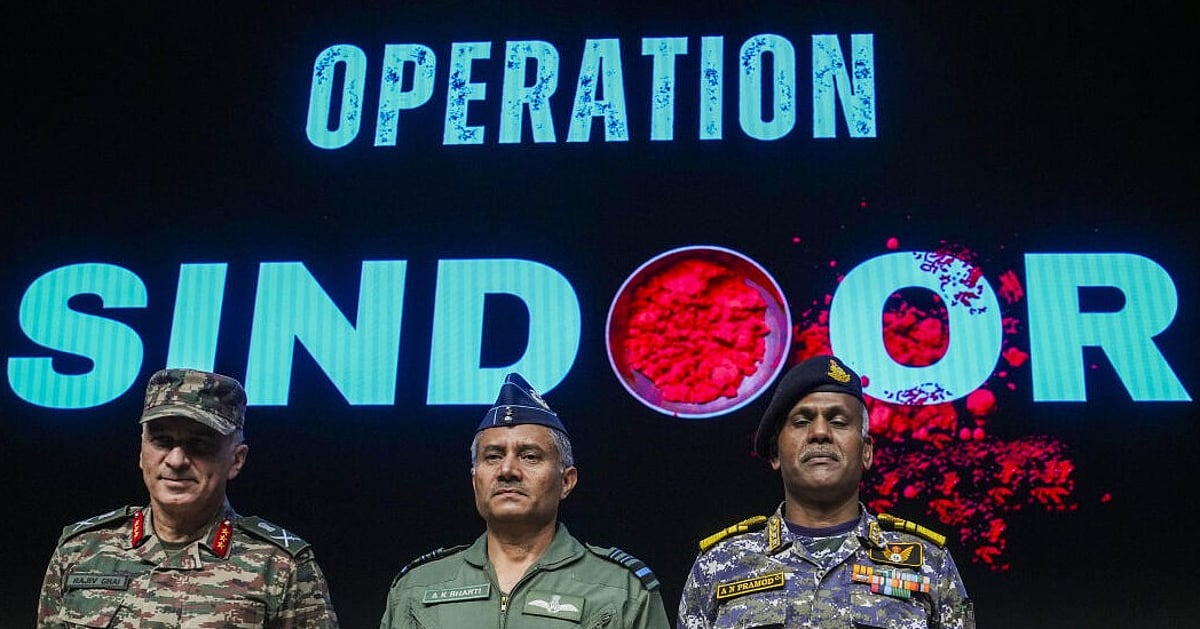
Introduction
Operation Sindoor marks another chapter in India’s battle against terrorism emanating from Pakistan. Though this mission was declared successful, the broader war on terrorism is far from over. With India’s firm resolve, the country aims not only to safeguard its borders but also to convey a clear message: sponsoring terror will no longer be tolerated.
Key Issues and Background
Historic Hostility and Terror Tactics
Since the 1980s, Pakistan has shifted from direct military engagement to sponsoring proxy wars through terrorist organizations. Events like the Kargil War, the attack on Parliament, and 26/11 are manifestations of this strategy. Operation Sindoor is the latest response to these recurring provocations.
Geopolitical Divide and Ideological Clashes
India and Pakistan remain divided not just by borders but by contrasting ideologies. While India celebrates its diversity through cultural and religious pluralism, Pakistan often propagates an exclusive Islamic identity. Prominent Pakistani thinkers and leaders like Maulana Maududi and Zia-ul-Haq reinforced a narrow vision of Islamization.
Peace and Betrayal
Despite repeated peace initiatives—from the Shimla Agreement to Agra Summit and Vajpayee’s Lahore bus ride—Pakistan has often reciprocated with betrayal, evident in acts like Kargil (1999) and continued infiltration.
The Core of the Concern
A Pattern of Terror Sponsorship
Pakistan’s deep state continues to invest in terrorism as a geopolitical tool, hoping to “bleed India with a thousand cuts.” However, such strategies have not only failed but have also hurt Pakistan’s international credibility and internal stability.
Operation Sindoor’s Symbolism
This latest strike signifies India’s zero-tolerance policy toward terrorism. It also reflects a shift from reactive diplomacy to strategic assertiveness.
Key Observations
-
India’s patience has limits; the new doctrine focuses on proactive defense.
-
The cost of nurturing terrorism is now proving detrimental to Pakistan itself.
-
India’s emphasis is now on long-term peace, achieved through firmness, not appeasement.
-
Strategic strikes like Operation Sindoor are not just military but diplomatic statements.
Challenges and the Way Forward
Challenges
-
Balancing diplomacy with deterrence.
-
Countering international narratives that sympathize with Pakistan’s portrayal as a victim.
-
Managing internal and external political pressures during such operations.
Way Forward
-
Continue international advocacy to isolate terrorist networks diplomatically.
-
Strengthen domestic counter-terrorism measures.
-
Promote peace through powerful deterrence, as advocated by Prime Minister Modi’s doctrine.
Conclusion
India’s fight against terrorism has entered a decisive phase. Operation Sindoor underscores that the cost of harboring terror will be high for Pakistan. True peace will only emerge when terrorism is eradicated as a strategic tool. India, while always ready for peace, is now equally prepared to defend it—with strength.
5 Questions and Answers
Q1. What was the objective of Operation Sindoor?
A: Operation Sindoor aimed to destroy terror hideouts in Pakistan and send a strong message against the sponsorship of terrorism.
Q2. How has Pakistan historically responded to India’s peace overtures?
A: Pakistan has often responded to India’s peace efforts with betrayal, as seen in the Kargil conflict after the Lahore Declaration and continued terrorist attacks.
Q3. What ideological difference is highlighted between India and Pakistan?
A: India promotes cultural and religious pluralism, while Pakistan has historically embraced an exclusivist Islamic ideology.
Q4. Why is sponsoring terror a self-destructive exercise for Pakistan?
A: Terrorism has not only failed to weaken India but has also damaged Pakistan’s economy, global reputation, and internal stability.
Q5. What shift does Operation Sindoor represent in India’s defense policy?
A: It represents a move from passive diplomacy to assertive and proactive defense strategies against terrorism.

