
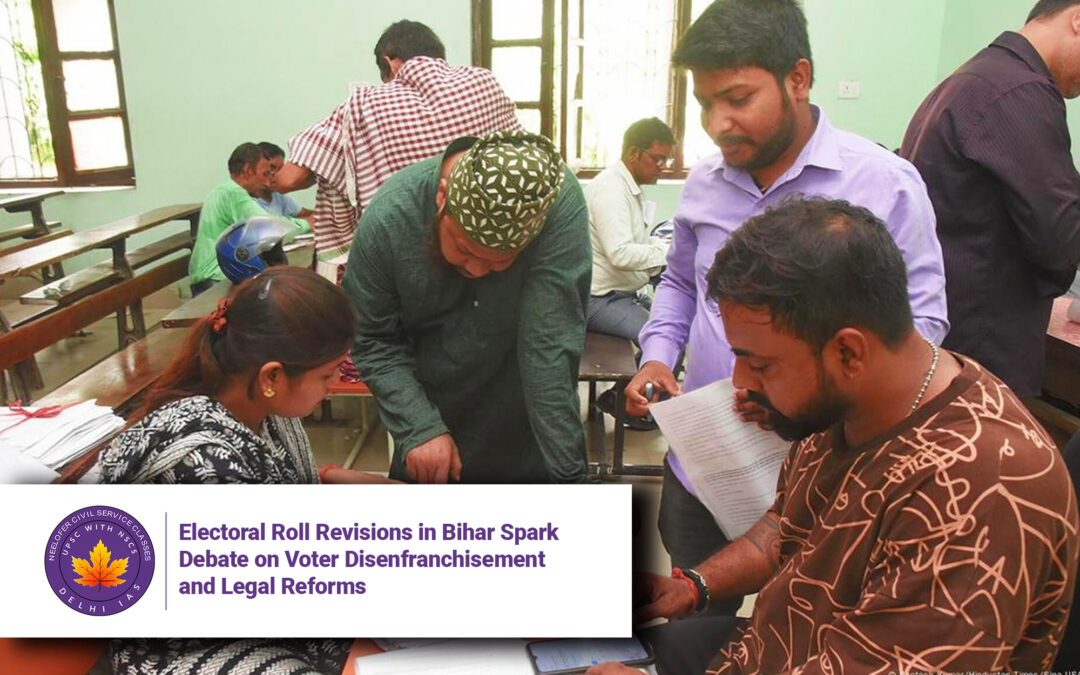
Electoral Roll Revisions in Bihar Spark Debate on Voter Disenfranchisement and Legal Reforms
Why in News?
As the Election Commission of India (ECI) nears the end of the first phase of its Special Intensive Revision of electoral rolls in Bihar (August 1, 2025), a heated political and legal debate has emerged. Concerns have been raised about voter deletions, disenfranchisement of migrants, and the inadequacy of India’s electoral framework to address the realities of internal migration.
Introduction 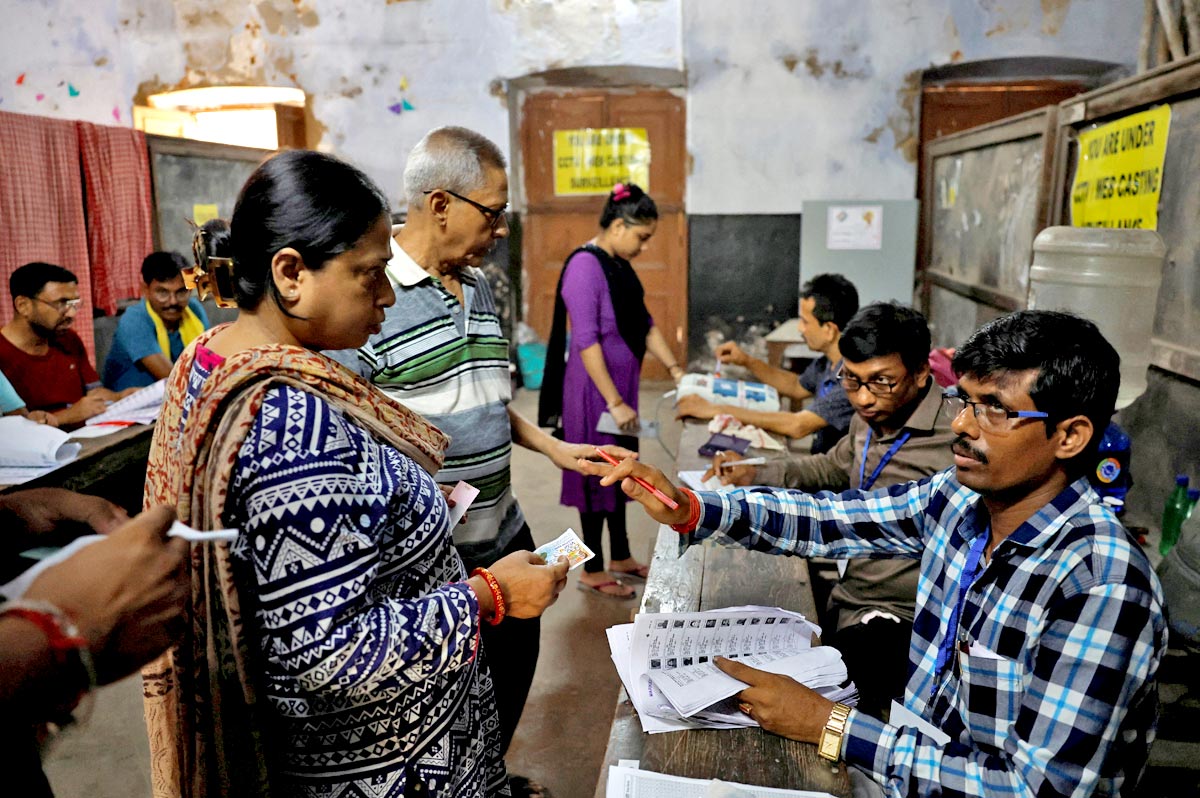
India’s electoral architecture, built on the principle of fixed residency, is facing intense scrutiny. Bihar’s recent voter roll revision has triggered national conversations about the disenfranchisement of migrant citizens. Over 1.2 million names were deleted for non-residency, exposing a growing mismatch between India’s internal migration patterns and its outdated electoral laws.
Key Issues and Institutional Concerns
1. Outdated Legal Framework
-
The Representation of the People Act, 1950 was designed during a time when the population was largely sedentary. Today, over 37% of India’s population consists of internal migrants, and in Bihar, 36% of households report at least one migrant.
-
The law’s rigid residency criteria exclude many from the rolls despite their Indian citizenship.
2. Citizenship vs Residency Confusion
-
Citizenship is a legal status under the Constitution and the Citizenship Act.
-
Residency, used as the criterion for voter eligibility in a constituency, is conditional and contextual.
-
The confusion between these two concepts has led to exclusion of millions who live and work outside their home constituencies.
3. Structural Disenfranchisement of the Poor
-
Migrant workers often live in a liminal state between villages and industrial zones, making them ineligible under current rules.
-
Most deletions occurred in out-migration districts like Gopalganj and Sitamarhi, where 5–7% of voter names were removed.
Global Comparisons and Suggested Reforms
-
USA: Offers absentee ballots and mail-in voting for non-resident citizens.
-
Philippines: Allows over 1.8 million overseas voters to participate with turnout over 60%.
-
Australia: Uses mobile polling stations in remote communities to achieve over 90% turnout.
These examples show that high voter inclusion is possible without compromising electoral integrity. The ECI cannot change the law, but it must advocate for reform and pilot inclusive solutions such as remote voting and mobile enrolment centers.
Challenges and the Way Forward
-
Lack of Outreach: Over 60% of voters in Bihar were unaware of claims and objections mechanisms.
-
Structural Exclusion: Migrants and poor communities face systemic barriers to participation.
-
Political Apathy: Political actors often use disenfranchisement for mobilisation rather than reform.
Recommendations:
-
Pilot alternative enrolment models.
-
Strengthen outreach and awareness.
-
Push for legal reform to align electoral laws with migration realities.
Conclusion
India’s electoral laws need urgent reform to match the demographic shifts brought by internal migration. The Bihar case has highlighted a systemic issue of disenfranchisement masked as procedural legality. For democracy to be inclusive, the focus must shift from paperwork to participation.
Q&A Section
Q1. Why are names being deleted from electoral rolls in Bihar?
A: Over 1.2 million names were removed due to non-residency during the Special Revision exercise, particularly affecting migrant-heavy districts.
Q2. What is the core legal problem with India’s current voter eligibility system?
A: It uses residency, not citizenship, as the basis for constituency voting, excluding many internal migrants.
Q3. How are other countries handling voting rights for non-resident citizens?
A: Countries like the US, Philippines, and Australia use absentee ballots, mobile stations, and outreach efforts to include remote or migrant voters.
Q4. What percentage of Bihar’s population is affected by internal migration?
A: About 36% of households report at least one migrant, with 20% of the working-age population living outside the State.
Q5. What reforms are being suggested to the Election Commission of India?
A: To pilot remote enrolment, improve outreach, advocate for legal changes, and ensure migrant workers are not disenfranchised.

