
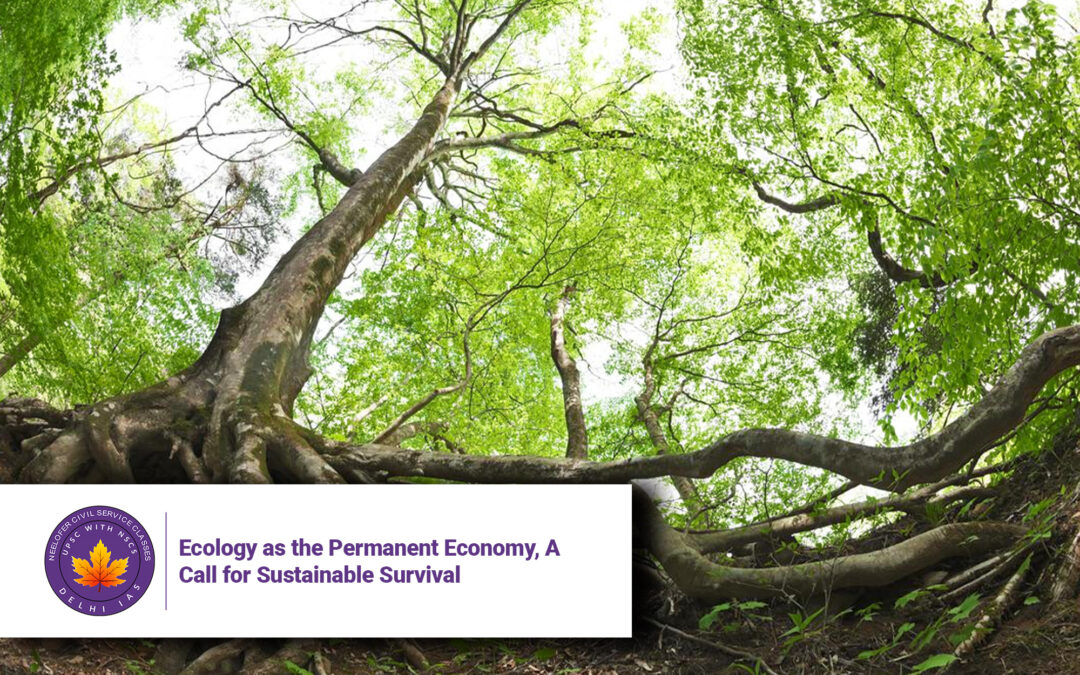
Ecology as the Permanent Economy, A Call for Sustainable Survival
Why in News?
With rising global concerns over biodiversity loss, climate change, and unsustainable development, the idea that “Ecology is the permanent economy,” popularised by environmentalist Sunderlal Bahuguna, has gained renewed relevance. The concept urges nations to rethink the connection between ecological health and economic progress. 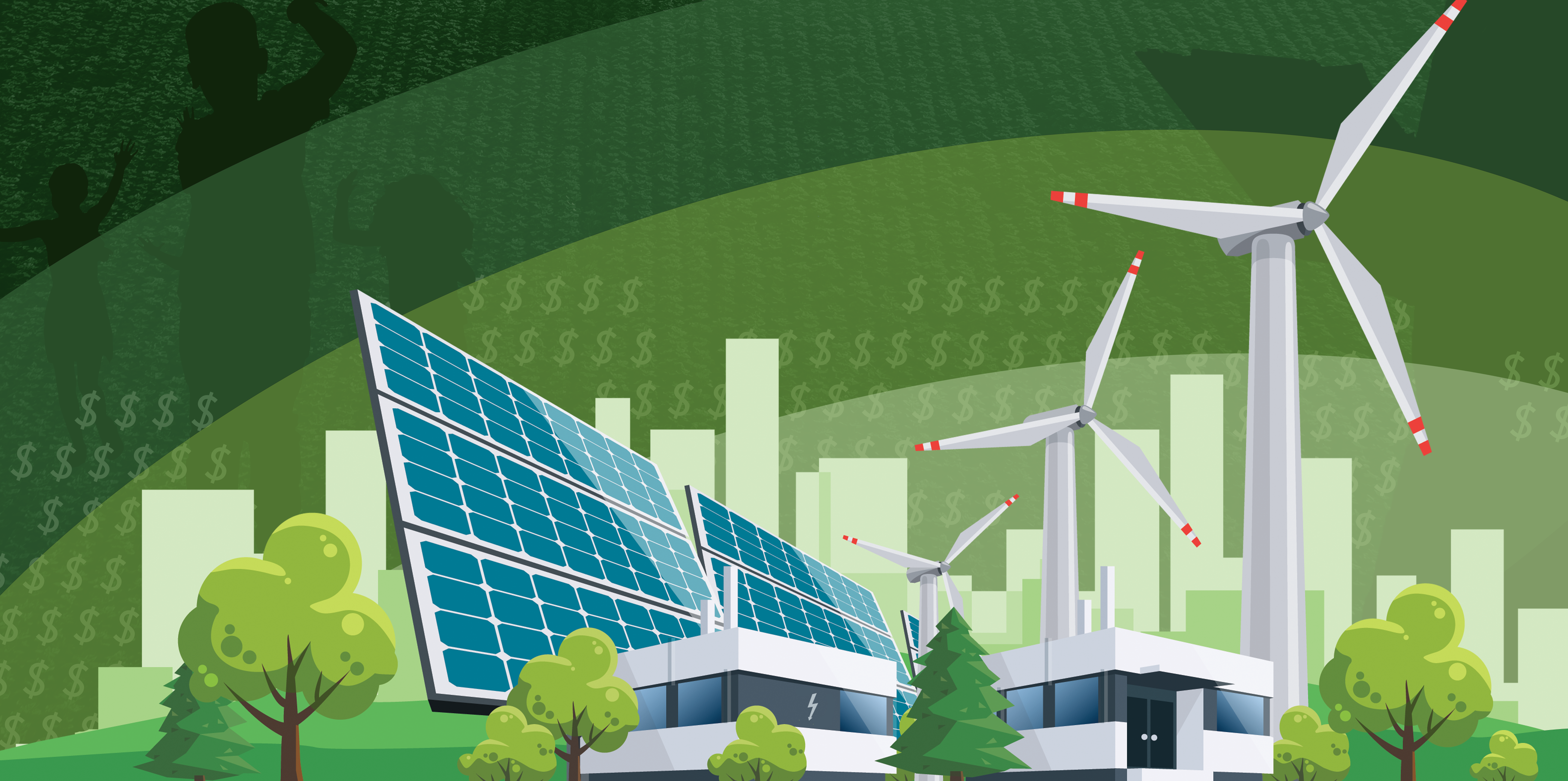
Introduction
The economic growth of nations is deeply tied to natural resources. But without preserving these resources, such growth is unsustainable. In this context, recent scientific insights and global biodiversity reports have prompted environmental experts to re-evaluate our development models and reaffirm the principle that human survival and economic resilience are rooted in ecological balance.
Key Ideas and Background
1. Striking the Right Balance
At the heart of modern science is the effort to understand nature’s complexity. Through observation and modelling, we learn how climate change, resource depletion, and biodiversity loss threaten both human life and economic stability. A balance between conservation and development is essential for sustainable progress.
2. Historical Disconnect from Nature
Human civilisation evolved with increasing disconnect from nature, focusing solely on individual gain and short-term needs. This shift led to ecological exploitation—a model that favors profit over long-term planetary health. The result? A deepening ecological crisis.
3. Climate Crisis and Biological Strain
Rapid industrialization, overpopulation, and resource competition have accelerated environmental damage. Today’s development strategies place unsustainable strain on ecosystems, and this in turn jeopardizes the very survival of species, including humans. The recent IPBES reports warn of biodiversity collapse unless urgent action is taken.
4. Rethinking Human Development
Humanity must now move from reactive conservation to proactive planetary sustainability. This includes adopting nature-friendly lifestyles, redesigning development models, and re-integrating emotional connections with nature into our policies.
5. The Core Message: Ecology = Economy
Reframing ecology as the true economy encourages long-term stewardship over short-term gain. Acknowledging this helps secure climate resilience, ecological health, and economic security for future generations.
Conclusion
“Ecology is the permanent economy” is more than a slogan—it is a scientific truth and moral responsibility. In a world dominated by consumption and competition, understanding and respecting the ecological foundations of life is not optional; it is essential. Only by reconnecting with nature can humanity secure a sustainable future.
5 Questions and Answers
Q1. What does the phrase “Ecology is the permanent economy” imply?
Answer: It implies that ecological health is the foundation of all sustainable economic activity, and without conserving natural resources, economic development is unsustainable.
Q2. Why has human civilisation become disconnected from nature?
Answer: Over time, humans shifted from community-based survival to individual-centric resource use, driven by competition and short-term exploitation, distancing society from its ecological roots.
Q3. How has development contributed to the ecological crisis?
Answer: Industrialisation, population growth, and unsustainable consumption have accelerated biodiversity loss and climate change, threatening ecological balance and human survival.
Q4. What is the solution to the current ecological crisis according to the article?
Answer: The solution lies in reframing human development to prioritize nature, adopting sustainable practices, reconnecting emotionally with the environment, and making conservation proactive rather than reactive.
Q5. What is the moral responsibility highlighted in the article?
Answer: The article emphasizes that recognising and respecting ecology as the base of human existence is both a scientific necessity and a moral duty in addressing climate and biodiversity challenges.

