
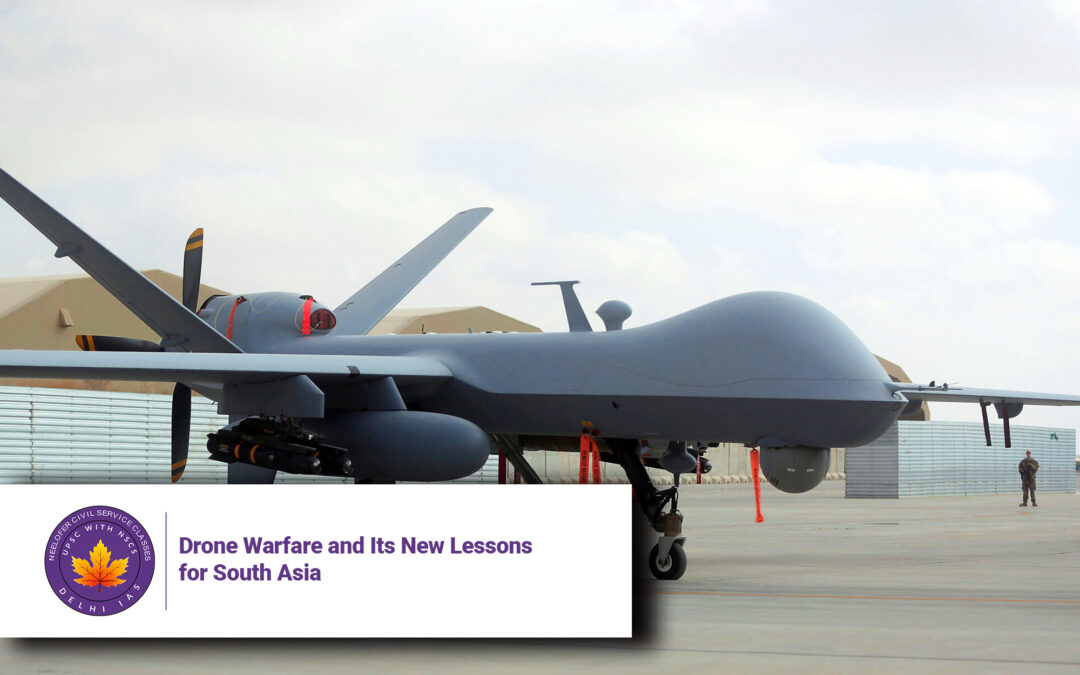
Drone Warfare and Its New Lessons for South Asia
Why in News?
The recent military escalation between India and Pakistan in May introduced South Asia’s first recorded drone warfare episode. Following India’s Operation Shatru, launched in response to a terrorist attack in Jammu, Pakistan retaliated using unmanned drones and loitering munitions, marking a historic shift in regional conflict dynamics. 
Introduction
For the first time, drone warfare has become a central element in Indo-Pak military tensions. While previous conflicts revolved around conventional artillery and ground strikes, the use of drones, loitering munitions, and counter-drone systems marks a new technological and strategic evolution in regional warfare.
Key Issues and Background
-
The Nature of Operation Shatru and Pakistan’s Response
-
India launched Operation Shatru on May 1, targeting terror networks across the Line of Control.
-
Pakistan responded with drone-based attacks on Indian assets and civilian regions.
-
Despite attempts to scale down violence, Pakistan violated the truce just hours after agreeing to dialogue.
-
-
Drone Warfare: First-Time Deployment
-
Drones like Shahed-136 (Iranian), Bayraktar TB-2 (Turkish), and indigenous Indian UAVs were observed.
-
Loitering munitions and kamikaze drones were used to damage radars, air control systems, and logistics hubs.
-
India employed anti-drone systems to intercept UAVs and protect strategic locations.
-
-
The Shift in Warfare Strategy
-
Traditional warfare in the region has involved infantry, artillery, and fighter aircraft.
-
Drone warfare introduces low-cost, high-precision, hard-to-detect capabilities, changing the nature of escalation and deterrence.
-
-
Global Influence on South Asian Conflict
-
Turkey showed symbolic support to Pakistan by providing drones.
-
India received global intelligence inputs and deployed systems from Israel and other allies.
-
International players closely watched the developments, particularly due to the rapid escalation potential.
-
-
Need for Strategic Adaptation
-
The article emphasizes that India needs to invest in:
-
Indigenous drone production.
-
Better counter-drone technologies.
-
Cyber defense and satellite-based surveillance to neutralize future threats.
-
-
Future wars will be multi-domain, involving space, AI, and robotic weapons.
-
Five Key Takeaways
-
Drone warfare is now a reality in South Asia, no longer limited to global conflicts.
-
Conventional weapons are not enough—the future lies in unmanned, intelligent systems.
-
Counter-drone systems and radar jamming will be essential defense tools.
-
India must indigenize its drone ecosystem to avoid dependency on foreign tech.
-
International diplomacy and alliances remain critical in managing rapid technological escalation.
Challenges and the Way Forward
Challenges:
-
Inadequate indigenous production of advanced drones and loitering munitions.
-
Risk of uncontrolled escalation due to unmanned aerial combat.
-
Vulnerability of radar and communication infrastructure.
Way Forward:
-
Rapid development of drone swarms, anti-drone lasers, and electronic warfare systems.
-
Establish a dedicated drone warfare command within the Indian armed forces.
-
Collaborate with private industry and startups under ‘Make in India’ to boost self-reliance.
Conclusion
The South Asian battlefield has evolved. The use of drones in India-Pakistan conflict marks a paradigm shift in warfare that demands both strategic foresight and technological preparedness. Nations must now prepare for multi-layered, unmanned combat where the next war might be fought in the sky, but without a pilot in sight.
Q&A Section
1. What was unique about the recent India-Pakistan conflict?
It was the first time in the region that drones and loitering munitions were used extensively, marking the start of drone warfare in South Asia.
2. What are loitering munitions?
They are drones designed to hover over a target area and strike once a target is identified. They are sometimes called “kamikaze drones.”
3. How did India defend itself against these drones?
India used radar-guided anti-drone systems, deployed special electronic warfare units, and activated air defense protocols.
4. Why is this development important for India?
It shows that traditional warfare methods are no longer enough. India must quickly adapt to drone-based warfare to protect its military assets and borders.
5. What should India do next according to the article?
Invest in homegrown drone technology, enhance cyber-defense and anti-drone capabilities, and form new doctrines to handle multi-domain modern warfare.

