
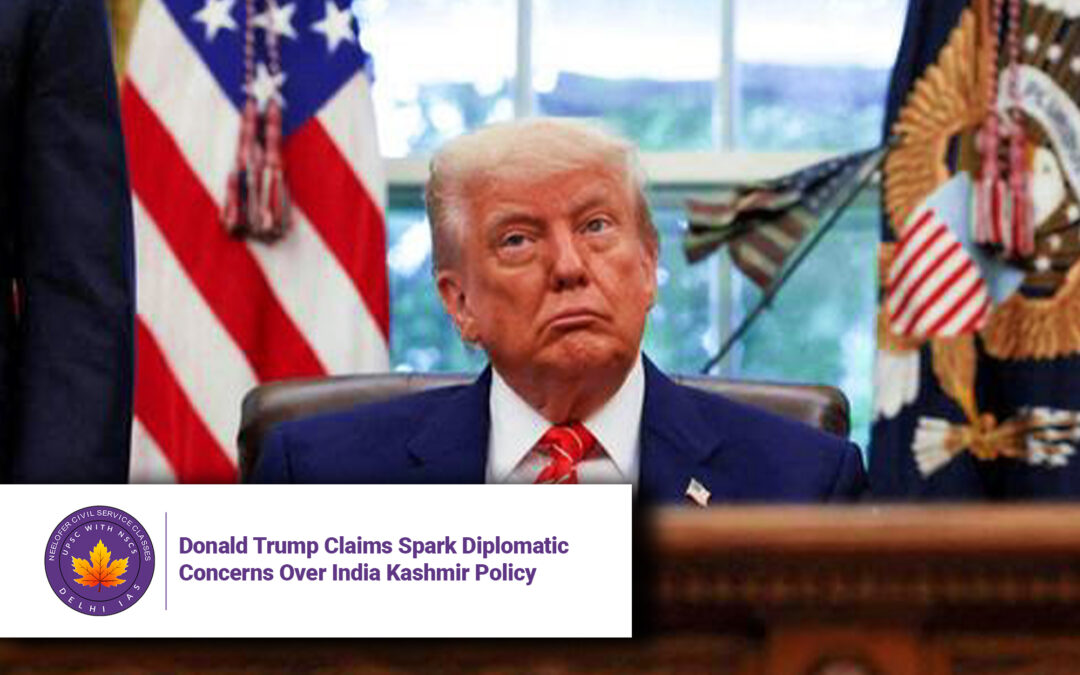
Donald Trump Claims Spark Diplomatic Concerns Over India Kashmir Policy
Why in News?
Former U.S. President Donald Trump has repeatedly claimed that he mediated between India and Pakistan to prevent a “nuclear conflict,” a statement that has caused diplomatic tension and drawn strong rebuttals from India’s Ministry of External Affairs (MEA). His assertions challenge India’s long-standing position on bilateralism in resolving the Kashmir dispute, raising concerns over international misrepresentation. 
Introduction
Trump’s remarks about allegedly brokering peace between India and Pakistan following Operation Sindoor have raised eyebrows in New Delhi. India has categorically denied any third-party mediation, reiterating its sovereign stance on the Kashmir issue. These exaggerated claims not only threaten India’s diplomatic narrative but also trivialize the gravity of cross-border terrorism.
Key Issues and Background
-
Trump’s Nuclear Conflict Claim
-
Trump stated multiple times that he stopped India and Pakistan from entering a nuclear war post-May 10 ceasefire agreement.
-
India found this puzzling and misleading, as the ceasefire was facilitated through military-to-military communication between the Directors General of Military Operations (DGMO) from both sides.
-
-
India’s Official Response
-
The MEA refuted Trump’s claim, asserting that talks took place directly via military channels after Pakistan proposed a ceasefire post-Operation Sindoor.
-
Officials, including PM Modi, S. Jaishankar, and NSA Ajit Doval, had already informed the U.S. of India’s position and actions.
-
-
Violation of India’s Kashmir Policy
-
Trump’s offer to mediate in Kashmir goes against India’s “long-standing principle” of not accepting third-party mediation on internal issues.
-
Equating India and Pakistan’s roles in the conflict further undermines India’s policy of treating Kashmir as a non-international matter.
-
-
Questionable Narrative and Timing
-
Trump’s repeated statements about helping avert a nuclear war by threatening to suspend trade raise concerns about misrepresenting facts.
-
His failure to mention terrorism, and suggestion of a “dinner” between Modi and Shehbaz Sharif, seemed to oversimplify a serious diplomatic crisis.
-
-
Implications for U.S.-India Relations
-
India must evaluate whether this was merely “Trump being Trump” or a strategic signal from the U.S. on regional involvement.
-
The remarks have not only contradicted India’s policy but have also raised questions about New Delhi’s credibility on the global stage.
-
Five Key Takeaways
-
Donald Trump’s statements challenge India’s bilateral approach to Kashmir.
-
The MEA has firmly denied any third-party mediation claims.
-
Such exaggerated claims risk trivializing India’s national security concerns, especially on terrorism.
-
U.S. silence on cross-border terrorism and repeated emphasis on “nuclear war” plays into Pakistan’s narrative.
-
India must clearly articulate that its Kashmir stance is non-negotiable, especially to global powers and partners.
Challenges and the Way Forward
Challenges:
-
Maintaining India’s sovereign stance amid external pressure or misstatements.
-
Preventing international misrepresentation of sensitive issues like Kashmir.
-
Responding diplomatically without straining Indo-U.S. ties.
-
Managing domestic and global perception about India’s position.
-
Preserving India’s credibility as a responsible nuclear power.
Way Forward:
-
Reiterate India’s non-acceptance of third-party involvement in Kashmir.
-
Communicate clearly through official and diplomatic channels.
-
Engage with U.S. policymakers to prevent such misinterpretations in the future.
-
Use international forums to reinforce India’s stand on cross-border terrorism.
-
Coordinate with strategic partners like Quad members to ensure policy alignment.
Conclusion
Donald Trump’s repeated and exaggerated claims of mediation have not only disrupted India’s Kashmir narrative but also risk setting a troublesome precedent in global diplomatic discourse. India must remain firm in asserting that Kashmir is an internal issue, and peace talks, if any, will be held bilaterally with Pakistan. Strong messaging and diplomatic clarity are essential to defend India’s sovereignty and strategic credibility.
Q&A Section
1. What did Donald Trump claim about India and Pakistan?
He claimed he prevented a “nuclear war” between India and Pakistan by mediating a ceasefire on May 10, which India denies.
2. Why did India reject Trump’s mediation claim?
India maintains that ceasefire talks occurred directly between military officials and not through any third-party mediation, in line with its bilateral policy on Kashmir.
3. What is India’s “long-standing” Kashmir policy?
India believes Kashmir is a bilateral issue between India and Pakistan and does not accept any foreign mediation or interference.
4. How has Trump’s statement affected India-U.S. ties?
His remarks have caused concern in New Delhi, as they misrepresent India’s stance and raise questions about its credibility on the global stage.
5. What should India do in response?
India should reinforce its Kashmir stance through diplomatic channels, engage the U.S. more proactively, and ensure that its sovereignty is not misrepresented internationally.

