
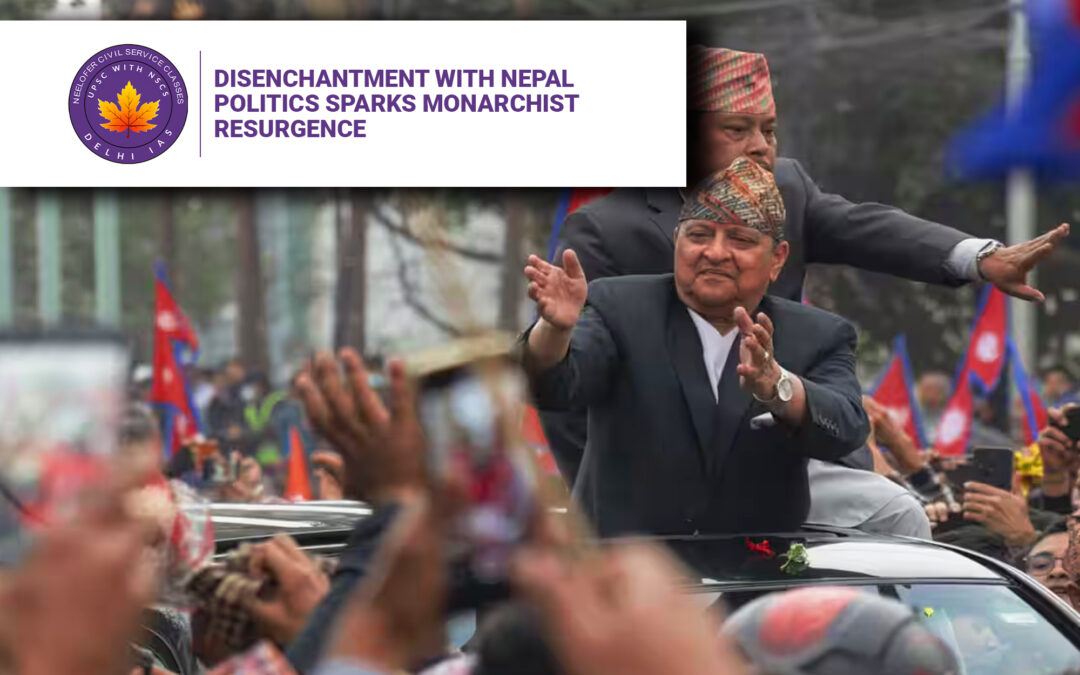
Disenchantment with Nepal Politics Sparks Monarchist Resurgence
Why in News?
Recent violent protests in Kathmandu, leaving two dead and several injured, have highlighted a resurgent pro-monarchy movement in Nepal. Spearheaded by the fringe royalist Rastriya Prajatantra Party, the unrest underscores growing public disillusionment with the current political leadership and institutions. 
Introduction
Nepal, a country that abolished its monarchy in 2008 to become a federal democratic republic, is witnessing renewed demands for the return of the monarchy. These calls are not rooted in nostalgia but in widespread frustration with ineffective democratic governance, corruption, and broken promises of inclusive development.
Key Issues Highlighted
-
Recent Violent Protests
-
Arson, looting, and violence in Kathmandu were led by royalist fringe groups.
-
Public anger is being hijacked by reactionary forces seeking to reverse Nepal’s democratic gains.
-
-
Historical Context
-
Nepal’s break from monarchy came after years of discontent and a major turning point—the 2001 royal massacre at Narayanhiti Palace.
-
King Gyanendra Shah’s subsequent power grab and crackdown on democratic forces triggered a national backlash.
-
-
Republican Transition
-
A Constituent Assembly (CA) was formed, and in 2008, it passed a near-unanimous resolution declaring Nepal a federal democratic republic.
-
The 2015 Constitution reaffirmed Nepal’s commitment to democracy despite political instability.
-
-
Current Democratic Disillusionment
-
Chronic governance failures, opportunism, and self-serving leadership have plagued the post-monarchy system.
-
The hopes of inclusive development and justice envisioned by the CA remain largely unfulfilled.
-
-
Warning Against Regressive Politics
-
The editorial warns that a return to monarchy is not a solution, but a symptom of democratic decay.
-
It urges accountability for violence and a renewed commitment to parliamentary democracy.
-
Five Key Observations
-
The pro-monarchist surge is rooted in democratic disappointment, not ideological loyalty to monarchy.
-
Nepal’s republic was born of a long democratic struggle, not sudden impulse.
-
Poor governance and lack of accountability are giving space for reactionary forces to rise.
-
The Constitutional framework is strong, but implementation and political maturity are lagging.
-
The solution lies in reforming democracy, not retreating into monarchy.
Challenges and the Way Forward
-
Crisis of Credibility: Both ruling and opposition parties must regain public trust.
-
Rising Reactionary Forces: The state must not allow violent or fringe ideologies to dominate public discourse.
-
Inclusive Development: The ideals of the CA—justice, equity, and inclusion—must be genuinely pursued.
-
Need for Strong Governance: A responsive and accountable leadership is essential to curb discontent.
-
Upholding the Republic: Efforts should focus on strengthening democratic institutions, not romanticising the past.
Conclusion
Nepal stands at a critical juncture, where the only sustainable way forward is to renew and reform its democratic republic. The surge in royalist sentiment must be seen as a wake-up call for political parties to deliver on their promises and reaffirm their commitment to a just, inclusive, and democratic future.
Q&A Section
Q1. What triggered the recent pro-monarchist protests in Nepal?
The protests were driven by public disillusionment with the political system, which was exploited by fringe royalist groups like the Rastriya Prajatantra Party.
Q2. What was the significance of the 2001 royal massacre?
The Narayanhiti Palace massacre irreparably damaged the monarchy’s image and played a crucial role in Nepal’s eventual shift toward republicanism.
Q3. When was Nepal officially declared a democratic republic?
In 2008, the Constituent Assembly passed a resolution declaring Nepal a federal democratic republic, later reaffirmed by the 2015 Constitution.
Q4. Why are monarchist sentiments gaining ground again?
Because of poor governance, corruption, and lack of development, many citizens feel that democracy has failed to deliver, making regressive ideologies seem appealing.
Q5. What solution does the article propose to counter this reactionary trend?
The article calls for swift accountability for violence, and for all political actors to renew commitment to responsive and ethical democratic governance.

