
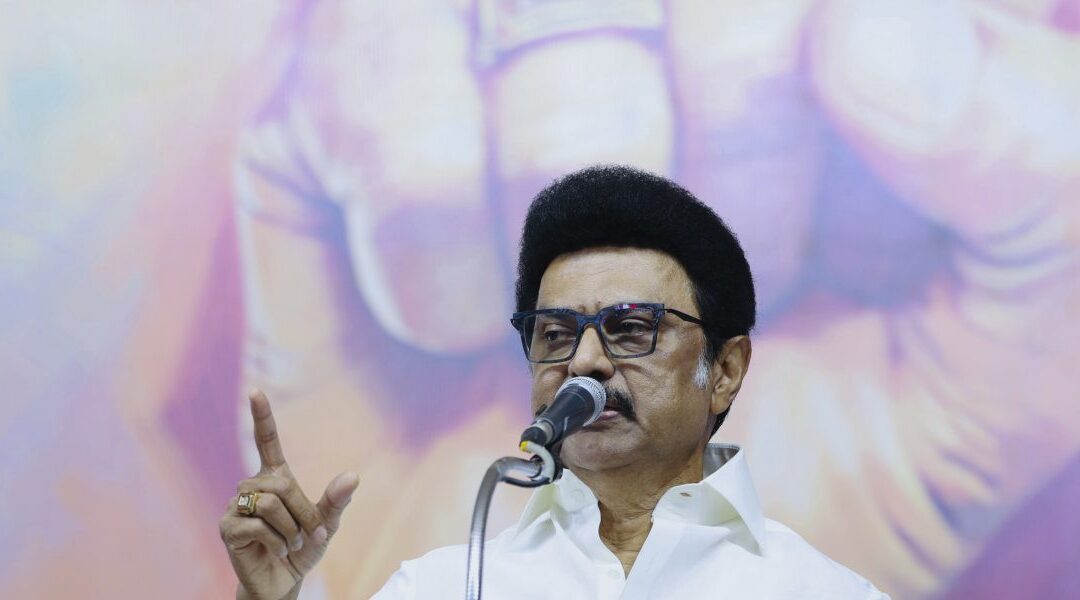
Delimitation Debate Gains Momentum, CM Stalin’s Bold Move Sparks Nationwide Discourse
Why in News?
Tamil Nadu Chief Minister and DMK President M.K. Stalin has raised serious concerns over the issue of delimitation, urging the Union government to address the interests of southern states. His call for a joint action committee has set the stage for what promises to be a crucial political debate on India’s parliamentary representation.
Introduction
The contentious issue of delimitation—the redrawing of constituency boundaries and the redistribution of Lok Sabha (LS) seats—has re-emerged at the forefront of national discourse. CM Stalin’s recent move has brought renewed attention to the demographic and political challenges posed by the looming 2026 freeze deadline, particularly for the southern states. 
Key Features
Constitutional Mandate for Delimitation
- As per Article 82 of the Indian Constitution, after each census, the allocation of LS seats among states must be readjusted based on changes in population.
- Previous delimitations were conducted in 1952, 1962, and 1972. After the 1971 census, a freeze was imposed on altering seat allocations to stabilize population growth measures.
- The 84th Constitutional Amendment (2002) extended the freeze until 2026, after being initially extended in 2001 under Prime Minister Atal Bihari Vajpayee.
Regional Concerns and Disparities
- Southern states like Tamil Nadu, Kerala, Andhra Pradesh, Telangana, and Karnataka have made significant efforts in reducing fertility rates through education, healthcare, and gender empowerment initiatives.
- Ironically, these states now face the prospect of losing parliamentary seats due to their successful population control measures.
- A report by the Carnegie Endowment for International Peace notes that states like Uttarakhand, Punjab, Himachal Pradesh, West Bengal, Odisha, Kerala, Andhra Pradesh, Telangana, and Tamil Nadu may lose up to 26 LS seats in total.
Implications of the 2026 Census
- The freeze on delimitation ends in 2026. Without an extension via constitutional amendment, the new census will dictate the redistribution of LS seats.
- This raises the question of whether India needs more seats in the LS. Although the population has doubled since 1976, growing from 637 million to 1.45 billion, the LS still has 543 seats.
Specific Impacts or Effects
Population Projections and Seat Allocation
- India’s population is expected to peak at 1.7 billion by 2060 before declining.
- Projections indicate that the population will grow only by 20% over the next 35 years, suggesting limited need for a large-scale increase in LS seats.
Potential Political Tensions
- Delimitation may increase northern states’ representation at the expense of the south.
- CM Stalin’s push for a joint action committee reflects fears of southern states being politically marginalized.
Challenges and the Way Forward
Challenges
- Balancing regional representation in the LS while honoring population data.
- Addressing the north-south divide over political power and resource allocation.
- Ensuring fair and inclusive discussions before implementing delimitation.
Steps Forward
- Establishing a Delimitation Commission, as proposed by the Union government, to provide an impartial approach.
- Engaging all political parties in debate and consensus-building, as initiated by CM Stalin.
Conclusion
The call for delimitation has sparked significant debate about the future of India’s representative democracy. As the 50-year freeze nears its end, CM Stalin’s proactive stance has brought southern concerns into the national spotlight. The coming months will be crucial in determining whether India can balance demographic realities with equitable representation.
Questions and Answers
1. What triggered the current debate on delimitation?
The upcoming end of the 50-year freeze on the delimitation process in 2026.
2. What is Article 82 of the Indian Constitution about?
It mandates the readjustment of LS seats after each census based on population changes.
3. Which southern states are concerned about losing LS seats?
Tamil Nadu, Kerala, Andhra Pradesh, Telangana, and Karnataka.
4. Why are these states at risk of losing seats?
Their successful population control measures have led to slower population growth compared to northern states.
5. What does the Carnegie Endowment report say?
That nine states could lose between one and eight LS seats, with five southern states possibly losing 26 seats in total.
6. What happened to the LS seats between 1950 and 2025?
India’s population grew significantly, but LS seats only increased slightly from 521 to 543.
7. What is the population projection for India by 2060?
India’s population is expected to peak at 1.7 billion and then decline.
8. What is CM Stalin’s proposed solution?
Setting up a joint action committee of southern states to ensure their interests are protected.
9. What is the Union government’s stance?
Home Minister Amit Shah has said delimitation won’t adversely affect state interests but hasn’t clarified the methodology.
10. Why is this debate important?
It determines the future of parliamentary representation and the balance of political power in India.

