
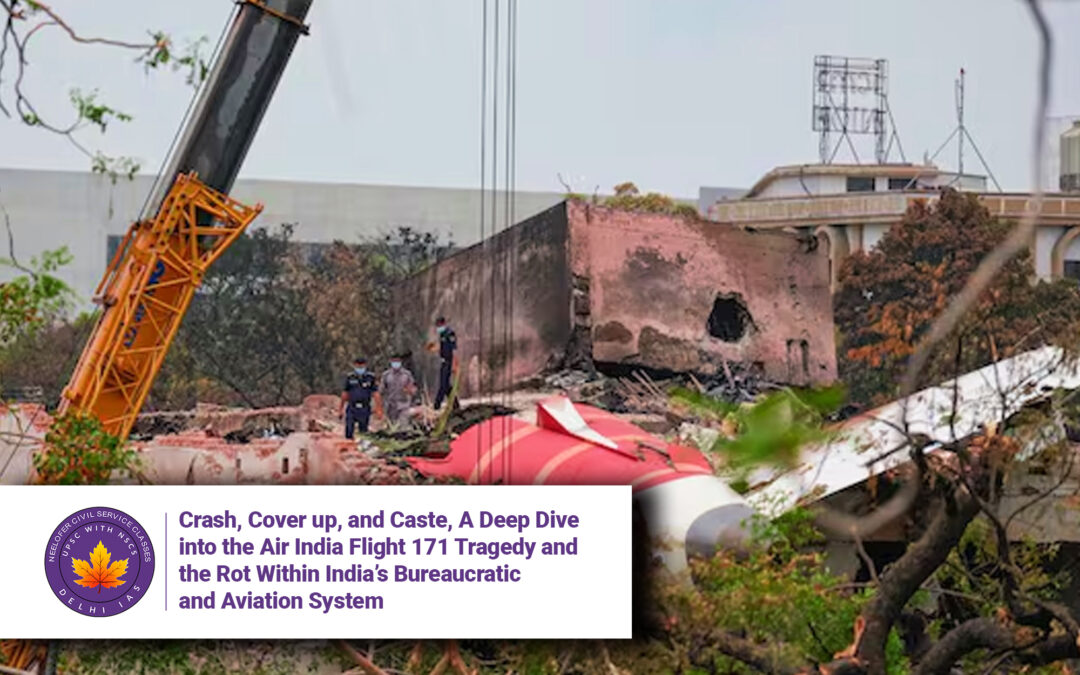
Crash, Cover up, and Caste, A Deep Dive into the Air India Flight 171 Tragedy and the Rot Within India’s Bureaucratic and Aviation System
Why in News?
The recent tragic crash of Air India Flight 171 in Ahmedabad, which claimed over 170 lives, has brought India’s aviation safety and bureaucratic inefficiency under intense national and international scrutiny. The preliminary report by the Aircraft Accident Investigation Bureau (AAIB) has raised more troubling questions than it has answered, stirring debates around red tape, cover-ups, political distractions, and the deep-seated rot in India’s administrative and aviation sectors. 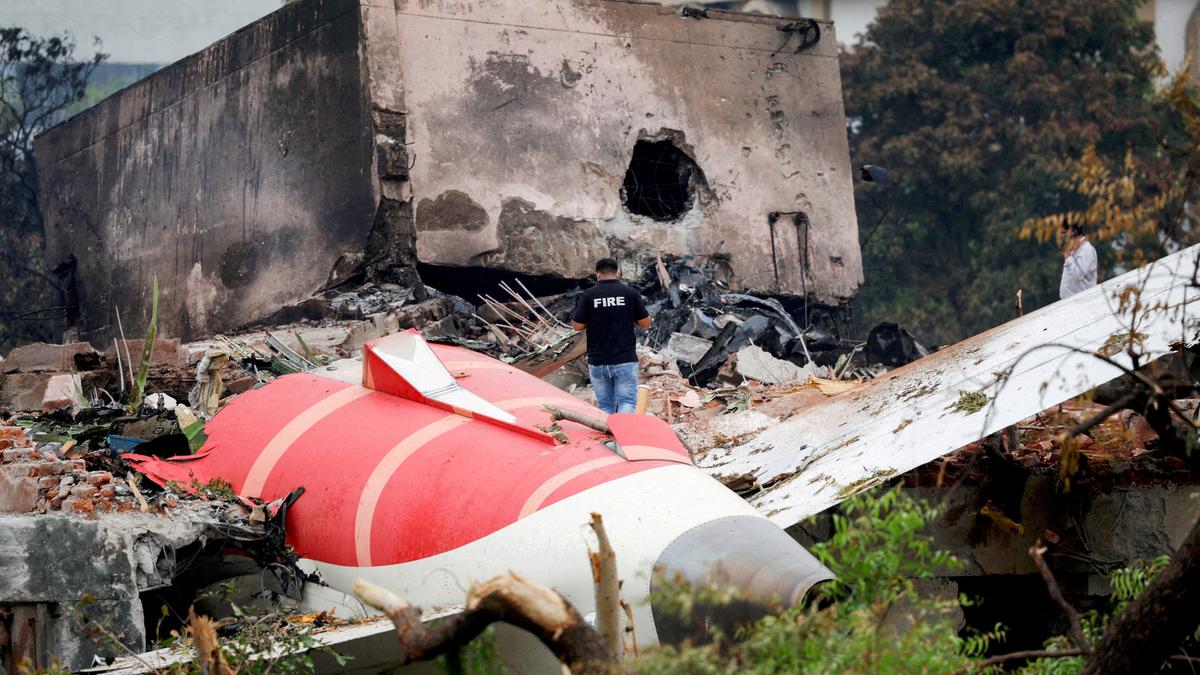
Introduction
India has always prided itself on rapid progress, from space exploration to digitization and infrastructure development. However, the tragic crash of Air India Flight 171 reveals a darker underbelly — the opaque, inefficient, and often unaccountable machinery of Indian bureaucracy. This incident does not only highlight aviation safety lapses but also exposes an alarming culture of silence, blame-shifting, political opportunism, and institutional apathy.
While Prime Minister Narendra Modi’s slogan “Sabka Saath, Sabka Vikas” aims at inclusive governance, the country is repeatedly forced to reckon with the bureaucracy’s inability to act decisively, transparently, and swiftly during crises. In this case, that failure may have cost over 170 innocent lives.
Key Issues
-
Opaque Investigation and Red Tape
The Aircraft Accident Investigation Bureau (AAIB), tasked with finding the cause of the crash, has come under fire for releasing a preliminary report that skirts critical issues. The report attributes the crash to pilot error, yet suspiciously fails to include testimony or evidence from any experienced pilots on the investigative panel. Even more concerning is the complete omission of technical failures, mechanical faults, or procedural lapses that could have contributed to the accident.
The decision to exclude experienced voices and downplay more probable causes has led to accusations of a cover-up. Aviation experts have pointed out that shutting off both engine fuel controls manually within 10 seconds — as the report claims — is not only improbable but virtually impossible. This suggests the possibility of a deeper, more systemic failure that the report either missed or deliberately omitted.
-
Media Narrative and Political Distractions
Following the crash, government communication was slow and ambiguous, with no clear directives issued. The Directorate General of Civil Aviation (DGCA) delayed its statements, waiting days even after the AAIB’s preliminary report was published. While survivors and victims’ families waited for answers, the government remained tight-lipped.
Meanwhile, the Congress party remained largely silent, except for a bizarre comment by Rahul Gandhi accusing the crash narrative of being caste-based — a political diversion that contributed little to the national discourse and shifted focus from genuine accountability.
The opposition, often quick to attack the ruling government on economic and social issues, failed to mount serious questions regarding aviation safety, pilot training standards, or maintenance protocols. Their silence — alongside the ruling party’s sluggish response — highlights a bipartisan failure in holding regulatory agencies accountable.
-
Negligence and Institutional Apathy
The airline involved, operating a Boeing 787 Dreamliner, has had a troubling safety history in India. Despite previous warnings, technical issues, and flight irregularities, the DGCA failed to implement any corrective directives. Even after the AAIB’s report was published on July 11, the DGCA waited until July 14 to issue a weak follow-up — timed suspiciously to fall over a weekend and possibly avoid intense media scrutiny.
Additionally, both the DGCA and the Civil Aviation Ministry failed to act promptly, delaying urgent investigations and public safety directives. The reluctance to issue fleet-wide checks or updates further emphasizes the lack of seriousness in handling aviation safety.
-
Silence on Key Evidence
The report is particularly conspicuous for its silence on cockpit voice recordings. In almost all international aviation accidents, cockpit recordings serve as a pivotal piece of evidence. Their absence from the public report has triggered suspicion among experts and victims’ families alike.
Was the audio tampered with? Did it contain information that contradicted the official version? Or worse, has it been deliberately buried to protect high-level officials or the airline’s reputation?
-
Pilot Profiles and Accountability
The pilots at the center of this tragic incident — Captain Sumeet Sabharwal, First Officer Clive Kundera, and Flight Engineer Anil Khan — were seasoned professionals with thousands of hours of flying experience. The report’s subtle attempt to blame them for an improbable sequence of technical errors has been met with disbelief.
Many have questioned how a crew with over 30,000 combined flying hours could suddenly become incompetent in a span of 10 seconds. The suggestion of human error without presenting alternative explanations or technical findings reeks of institutional scapegoating.
-
International Standards Ignored
India’s investigative and regulatory bodies have long been criticized for falling short of international standards. This tragedy only amplifies that reputation. In most global aviation frameworks, investigation reports are peer-reviewed, made transparent, and followed by immediate policy changes or safety upgrades.
In India, however, the bureaucracy’s inertia ensures that investigations become prolonged paper trails, rarely resulting in actionable changes or accountability. The current system reinforces public distrust and creates a culture where lives are lost and questions remain unanswered.
Alternative Approaches
To truly address the concerns raised by the Air India Flight 171 crash, India must adopt a more robust and transparent investigative process. Key reforms may include:
-
Inclusion of independent aviation experts (including international voices) in accident investigations.
-
Public release of cockpit voice recordings and black box data.
-
Mandatory timelines for regulatory bodies like DGCA to issue directives post-investigation.
-
Setting up an autonomous aviation safety body insulated from political and bureaucratic influence.
-
Real-time communication protocols with victims’ families during and after a crash.
Challenges and the Way Forward
Bringing such reforms is not without challenges. Bureaucratic culture in India is notoriously resistant to change. Every ministry, department, and regulator operates in silos, guarded by outdated protocols and a reluctance to be held accountable.
The nexus of government, media, and political interests makes transparency difficult. Reports are often massaged to suit narratives, and whistleblowers face professional and personal threats.
Political interference further complicates reforms. Instead of focusing on factual accountability, parties on both sides exploit tragedies for political mileage — as seen in Rahul Gandhi’s caste-based comment. This dilutes the core issue and trivializes the pain of victims.
Yet, there is hope. The rising public demand for transparency, driven by digital access to information and growing civil society activism, may push the government to act. Social media, independent journalism, and international pressure could play crucial roles in holding India’s aviation authorities accountable.
Conclusion
The crash of Air India Flight 171 is not just a tragic accident — it is a symptom of a deeper, systemic problem within India’s aviation and bureaucratic setup. The lack of urgency, the evasion of responsibility, and the failure to ensure transparency represent not just a governance issue but a humanitarian one.
If India genuinely seeks to become a global aviation hub and maintain the trust of its citizens, the first step must be introspection. The system must be overhauled, not just cosmetically but structurally. Accountability must replace red tape. Truth must prevail over cover-ups.
And above all, the innocent lives lost must not become just another statistic buried in bureaucratic files.
Five Questions and Answers
-
What is the main concern raised by the Air India Flight 171 crash?
The primary concern is the lack of transparency, accountability, and urgency shown by India’s aviation authorities in investigating and responding to the crash. The preliminary report appears to deflect blame toward the pilots without exploring more probable technical or systemic failures. -
Why is the AAIB’s preliminary report being criticized?
The report is criticized for lacking experienced voices, ignoring cockpit voice recordings, and attributing an improbable manual shutdown of both engines to the pilots. It fails to explore alternative causes like mechanical or software failure. -
What was the response of political parties to the incident?
Both the ruling government and the opposition displayed inadequate responses. The government delayed public communication and corrective measures, while the opposition focused on irrelevant political commentary rather than demanding accountability. -
What reforms are needed in India’s aviation safety mechanisms?
Reforms include transparent investigations, international expert involvement, real-time communication protocols, immediate policy updates post-crash, and the formation of an independent aviation safety body. -
How does this incident reflect broader issues in Indian bureaucracy?
The crash highlights India’s systemic bureaucratic apathy — from red tape and inefficiency to lack of accountability and political interference. These problems are not limited to aviation but extend across multiple governance sectors.

