
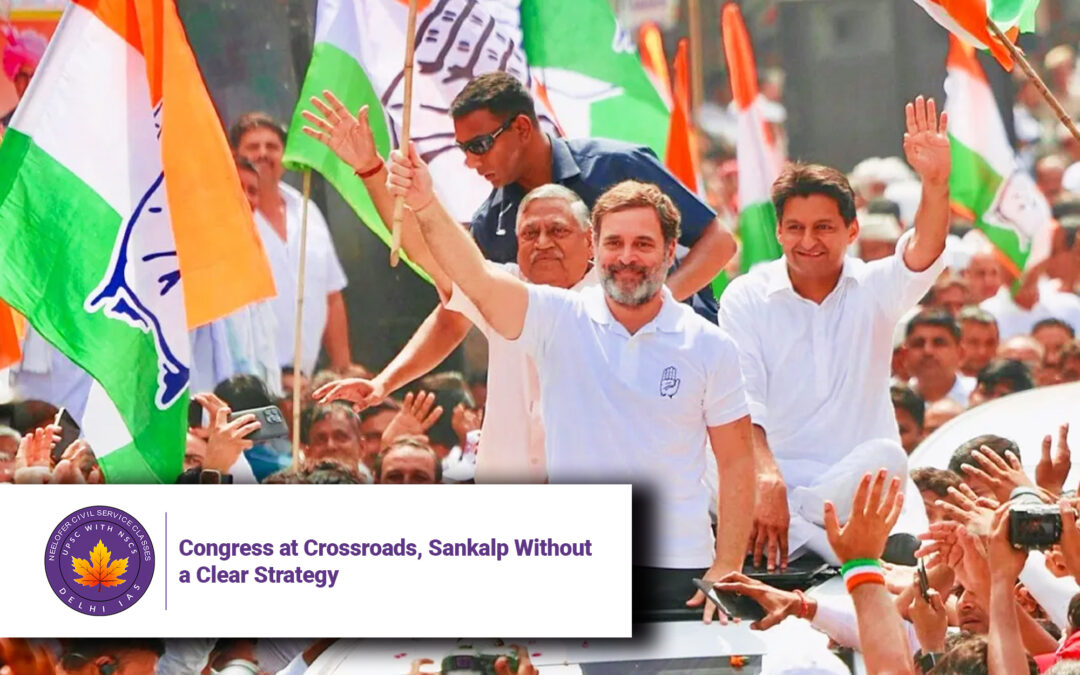
Congress at Crossroads, Sankalp Without a Clear Strategy
Why in News?
As the Indian National Congress gathered in Ahmedabad to mark the birth anniversary of Sardar Vallabhbhai Patel and the death anniversary of Indira Gandhi, political analysts observed that the party remains directionless despite ambitious resolutions like Nyaypath: Sankalp, samarpan aur sangharsh (Path of Justice: Resolve, Commitment, Struggle). 
Introduction
With over 150 senior and mid-level leaders attending, the Congress event aimed to project unity and revival. However, beneath the optics lies a deeper ideological and strategic void. Rahul Gandhi’s continued reluctance to lead from the front and the party’s failure to frame a coherent counter-narrative to the BJP has raised serious concerns about its future.
Key Issues and Institutional Concerns
1. Leadership Paralysis
Rahul Gandhi remains central yet detached—vocal about key issues like inequality and authoritarianism, but unwilling to assume full leadership. This has led to confusion among party workers and weak strategic mobilization.
2. Ideological Drift
Congress lacks a clear ideological compass. It oscillates between soft Hindutva, left-leaning populism, and secularism without firm conviction. This inconsistency hampers its ability to connect with voters.
3. Electoral Decline
While Congress governs three states directly (Karnataka, Himachal Pradesh, and Telangana), it failed to convert moral wins into electoral ones in states like Gujarat and Uttar Pradesh. Its poor performance in 2019 Lok Sabha elections (52 seats) highlighted its diminishing footprint.
4. Coalition Challenges
In the INDIA bloc, Congress is often overshadowed by regional parties like DMK, AAP, and TMC. These allies are more agile and regionally relevant, while Congress struggles with internal cohesion.
Challenges and the Way Forward
-
Narrative Building: Congress must define what it stands for—beyond just opposing BJP.
-
Leadership Clarity: Rahul Gandhi or an alternative leader must decisively take charge.
-
Structural Reforms: Revamp internal party machinery to be more grassroots-oriented.
-
Consistent Messaging: Avoid confusing voter bases with mixed ideological signals.
-
Strategic Alliances: Engage more constructively with INDIA bloc allies without ego clashes.
Conclusion
Unless the Congress reclaims its ideological space and leadership decisiveness, it risks fading into political irrelevance. The 2024 Lok Sabha elections will be critical—not just for the Congress, but for Indian democracy at large. A robust opposition is essential, and Congress must decide if it wants to be a serious contender or a symbolic presence.
Q&A Section
Q1. What was the main theme of the Congress event held in Ahmedabad?
The theme was Nyaypath: Sankalp, Samarpan aur Sangharsh—Justice, Resolve, Commitment, and Struggle.
Q2. Why is the Congress facing an ideological crisis?
The party lacks a consistent ideological direction, swinging between secularism, populism, and soft Hindutva without clarity.
Q3. What has been Rahul Gandhi’s role in the current Congress strategy?
Rahul Gandhi critiques BJP’s policies but remains reluctant to lead assertively, creating leadership paralysis within the party.
Q4. What are the Congress party’s electoral challenges?
Despite wins in a few states, Congress has failed to convert popular support into Lok Sabha victories and often loses ground to regional allies and BJP.
Q5. What must the Congress do to stay relevant in the 2024 elections?
It must present a clear ideology, strengthen its leadership, build stronger alliances, and offer a credible alternative to BJP’s narrative.
