
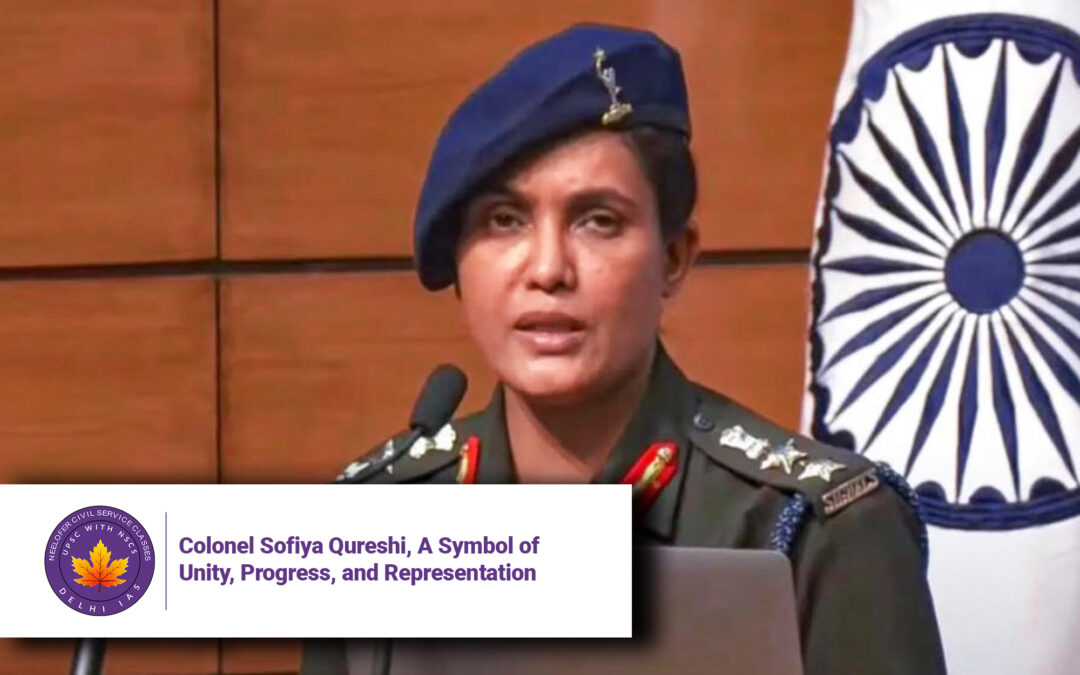
Colonel Sofiya Qureshi, A Symbol of Unity, Progress, and Representation
Why in News? 
Colonel Sofiya Qureshi’s prominent role in the aftermath of Operation Sindhuraad has brought her to national attention, sparking wider discussions around gender representation, minority identity, and the evolving image of leadership in India’s armed forces.
Introduction
Colonel Sofiya Qureshi’s name rose to prominence amid national military action when she was introduced at a press briefing by the Defence Minister. As the only woman officer named in the official narrative of Operation Sindhuraad, her presence on the national stage is more than symbolic—it represents a powerful shift in how India perceives patriotism, professionalism, and inclusion.
Key Background and Issues
-
A Historic Appearance
-
Colonel Qureshi’s mention came just days after India’s military response to cross-border terrorism.
-
Her image, in uniform, leading from the front, challenged many societal and political stereotypes.
-
-
Symbol Beyond the Uniform
-
Colonel Qureshi’s presence served as a visual rebuttal to dominant narratives that often marginalize Muslim and women identities in nationalistic discourse.
-
Her image offered an alternative representation of patriotism—not rooted in any one identity, but inclusive and plural.
-
-
Political and Cultural Ripples
-
In a deeply polarized atmosphere, her appearance held potential to unify a fragmented national imagination, especially in regions like Jammu & Kashmir where issues of trust and representation run deep.
-
She challenged both far-right propaganda and tokenistic inclusion from liberal spaces by simply doing her job with dignity and excellence.
-
-
Role of Imagery in Public Discourse
-
In the era of social media and visual messaging, images often communicate more than words.
-
The image of Colonel Qureshi became a silent, yet powerful, counter to bigotry and exclusion, showing that military service and patriotism have no religious or gender bounds.
-
-
The BJP’s Complex Relationship with Inclusion
-
While the current ruling party has often been accused of majoritarian tendencies, showcasing Qureshi at a pivotal national moment appeared to signal a shift or an exception—perhaps calculated, perhaps authentic.
-
The real test will be whether this is a one-time symbol or the beginning of broader systemic change.
-
Key Observations
-
Colonel Qureshi’s image blended courage, dignity, and representation.
-
Her presence challenged both hyper-nationalism and tokenism.
-
It spotlighted the possibilities for a more inclusive armed force and society.
-
It sent a message to both critics and supporters of India’s national security framework.
-
It emphasized that Muslims, women, and minorities are part of India’s collective strength.
Challenges and the Way Forward
Challenges:
-
Avoiding the tokenization of minority icons.
-
Ensuring that women and minority officers are promoted equally in terms of roles and recognition.
-
Countering politicization of representation.
Way Forward:
-
Institutionalize diverse representation, not just for optics.
-
Encourage media and official agencies to highlight merit-based stories.
-
Invest in inclusive recruitment and promotion pathways within the forces.
Conclusion
Colonel Sofiya Qureshi represents much more than military leadership. She stands at the intersection of identity, professionalism, and patriotism. Her image provides hope—not just as a symbol of resistance or pride, but as an emblem of what a truly inclusive India could look like when judged by merit, not by background.
Q&A Section
1. Who is Colonel Sofiya Qureshi?
She is a senior officer in the Indian Army who gained national attention during the press briefing after Operation Sindhuraad for her role in the operation, representing both gender and religious diversity.
2. Why is her image considered powerful?
Because it breaks stereotypes—showing a Muslim woman leading in a traditionally male-dominated and nationalist space like the Indian Army, without needing any label of exception.
3. What message does her presence send?
It shows that patriotism and military excellence are not tied to religion, gender, or political leanings. It affirms the idea of unity in diversity.
4. How does her appearance challenge politics?
It subtly critiques both majoritarian politics and liberal tokenism. It redefines what it means to serve the nation through genuine action, not posturing.
5. What is needed to make her presence more than symbolic?
Structural changes are necessary—equal opportunities for all, inclusive policies in institutions, and consistent celebration of diverse achievements based on merit.

