
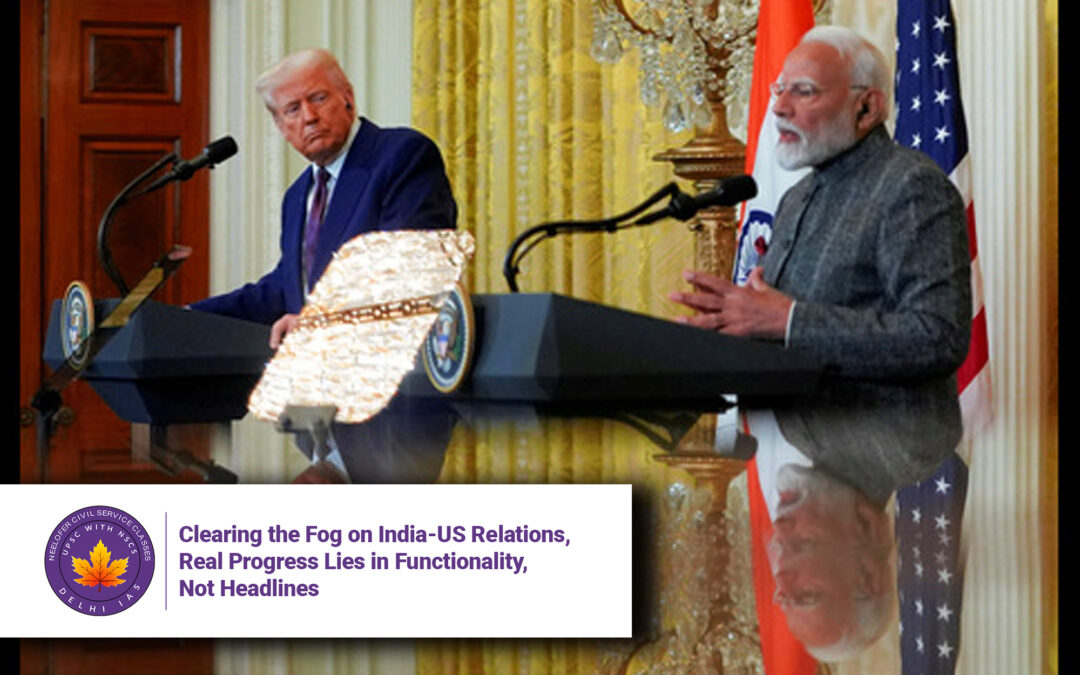
Clearing the Fog on India-US Relations, Real Progress Lies in Functionality, Not Headlines
Why in News?
Despite loud headlines, fiery tweets, and attention-grabbing diplomacy, the actual state of India-US relations remains grounded in a framework of practical, strategic, and institutional cooperation. A joint vision outlined by Prime Minister Narendra Modi and then-President Donald Trump continues to define the contours of this evolving partnership.
Introduction
The strategic partnership between India and the United States has seen many shifts, often influenced by changes in leadership and geopolitical interests. While media focuses on sensational political rhetoric, the core of the relationship thrives through structured institutional mechanisms. These mechanisms are designed to create deliverables in defense, trade, technology, and regional security, especially under the broader umbrella of the Indo-Pacific strategy. 
Key Developments
-
Beyond the Optics of Leadership
-
Modi’s engagements with Trump may have appeared personal, but they were rooted in strategic calculations to institutionalize cooperation across multiple sectors.
-
Even with shifts in the US administration, the foundational aspects of the partnership remain stable.
-
-
TRUST & Institutional Mechanisms
-
TRUST (Trade and Technology Strategic Dialogue) is one of several structures created to track and monitor deliverables in India-US ties.
-
These structures help depoliticize cooperation, ensuring continuity even amid political change.
-
-
Defense & Technology Collaboration
-
Cooperation in emerging tech like Artificial Intelligence (AI), semiconductors, and 5G are central pillars.
-
The US and India share mutual concerns over China’s tech rise, adding urgency to their collaboration.
-
-
The Quad & Indo-Pacific Stability
-
India’s growing role in the Quad, along with cooperation in maritime security and logistics, solidifies its strategic position in the Indo-Pacific.
-
While QUAD receives high-level visibility, it is the supporting functional links that drive long-term results.
-
-
Challenges of Bureaucratic Lag
-
While policy enthusiasm exists on both sides, practical progress often stalls due to bureaucratic delays and misalignment of short-term national interests.
-
Political optics must give way to deeper commitments and administrative agility.
-
Challenges and the Way Forward
Challenges:
-
Bureaucratic inertia within both governments slows down implementation of signed initiatives.
-
Strategic divergences on issues like data regulation, tariffs, and intellectual property occasionally create friction.
-
Domestic political compulsions in the US and India influence long-term consistency.
Way Forward:
-
Strengthen working-level bilateral engagements and follow-up mechanisms.
-
Focus on joint innovation programs and supply chain resilience (especially in semiconductors).
-
Ensure that Quad and Indo-Pacific cooperation remains inclusive and rules-based.
-
Shield deliverables from political rhetoric and press attention to allow slow but steady growth.
5 Q&A Section
Q1. What is the current state of India-US relations?
While headlines may suggest ups and downs, the real progress in India-US relations is steady and functional, driven by institutional structures rather than political theatrics.
Q2. What is TRUST, and why is it important?
TRUST is a bilateral framework created to ensure consistent monitoring of deliverables in trade and technology sectors. It depoliticizes the relationship and maintains accountability.
Q3. How are India and the US cooperating on technology?
Both nations are deeply engaged in areas like AI, semiconductors, quantum computing, and cybersecurity—critical to countering strategic competition from China.
Q4. What role does the Quad play in India-US ties?
The Quad complements India-US ties by fostering multilateral defense and regional cooperation. However, India’s bilateral relations with the US remain independently strong.
Q5. What are the biggest challenges ahead?
Political unpredictability and bureaucratic inertia threaten to slow progress. Both nations need to focus on administrative clarity and long-term goals rather than reactive policymaking.
Conclusion
India-US relations are no longer about flashy visits or photo ops. The real strength of this partnership lies in its quiet but consistent institutional architecture. If nurtured carefully, this alliance can define the global strategic order for decades to come—provided both sides continue to invest in substance over symbolism.

