
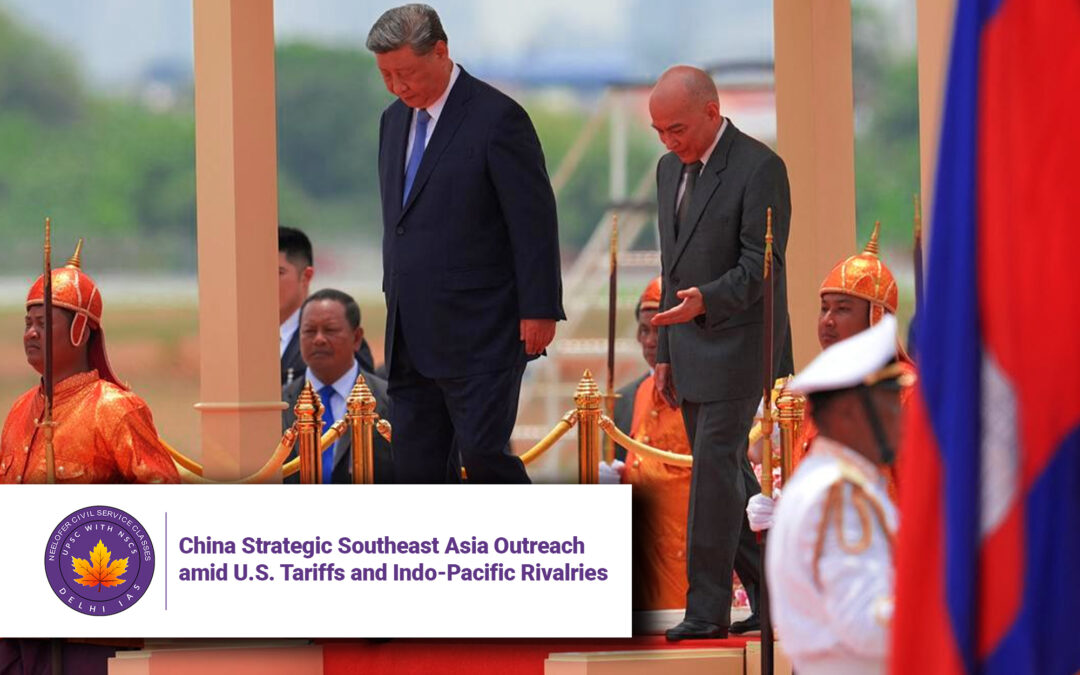
China Strategic Southeast Asia Outreach amid U.S. Tariffs and Indo-Pacific Rivalries
Why in News?
Chinese President Xi Jinping’s three-nation tour of Southeast Asia (Vietnam, Malaysia, and Cambodia from April 14–18, 2025) has marked a significant shift in Beijing’s foreign diplomacy. Amid intensifying U.S.-China tensions and heavy American tariffs, China is deepening ties with ASEAN nations to position itself as a reliable economic and strategic partner. 
Introduction
China is reorienting its foreign policy and trade strategy to navigate the dual pressures of U.S. tariffs and growing Indo-Pacific competition. The visit to Southeast Asia is not just economic outreach—it’s a geopolitical maneuver to strengthen Beijing’s regional leadership and offer an alternative to U.S.-led influence in Asia.
Key Issues and Background
1. Buffer Against U.S. Trade War
-
The U.S., under Trump-era policies, has imposed tariffs up to 145% on Chinese exports.
-
Cambodia faces combined tariffs of up to 59%, while Vietnam and Malaysia face 46% and 24% respectively.
-
China’s outreach aims to insulate itself from these pressures by turning to Southeast Asia for trade, investment, and political alignment.
2. Economic Agreements and Infrastructure Push
-
In Vietnam, Xi signed 45 cooperation agreements with a focus on clean energy and regional security.
-
In Cambodia, 30+ agreements were signed in areas like AI, digital economy, and agriculture. China reaffirmed its role as Cambodia’s largest investor.
-
China’s BRI (Belt and Road Initiative) continues to be the vehicle through which these partnerships are deepened.
3. Political Signalling and Soft Power
-
Beijing is also using these visits to contrast its model of state-led development with the U.S. model of liberal democracy and market-driven aid.
-
While the U.S. emphasizes security alliances (like QUAD, AUKUS), China promotes infrastructure, investments, and connectivity.
4. Competition with the U.S. Indo-Pacific Strategy
-
The U.S.’s Indo-Pacific Economic Framework (IPEF) is seen as offering limited incentives.
-
China seeks to portray itself as a more dependable, action-oriented partner, especially in trade and development financing.
The Core of the Concern
China’s Southeast Asia diplomacy is a calculated effort to undermine U.S. influence by offering an alternative model of engagement that prioritizes economic deliverables, less political interference, and strategic cooperation. This dual-track strategy—resisting Western isolation while expanding regional ties—is China’s way of preserving its global clout.
Key Observations
-
Beijing’s Southeast Asia tour is meant to project normalcy and strategic maturity amid global pressures.
-
The visits show that China is not isolated—it is actively shaping the regional order.
-
ASEAN is emerging as the new battleground for influence between the U.S. and China.
Conclusion
China’s diplomatic push in Southeast Asia is more than trade diplomacy—it’s part of a larger struggle for regional influence in the Indo-Pacific. As Washington pursues alliances to counter Beijing, China is investing in soft power and strategic cooperation. The success of this outreach will depend on how Southeast Asia balances between these two superpowers.
5 Questions and Answers
Q1. Why did President Xi Jinping visit Vietnam, Malaysia, and Cambodia in April 2025?
Answer: To promote economic partnerships, counter U.S. tariff pressure, and enhance China’s influence in Southeast Asia.
Q2. How is the U.S.-China trade war affecting China’s strategy?
Answer: With high U.S. tariffs and financial decoupling, China is turning to Southeast Asia to create new trade corridors and investment partners.
Q3. What are the key outcomes of the Southeast Asia tour?
Answer: Over 75 bilateral agreements were signed across energy, AI, agriculture, and infrastructure; reaffirming China’s position as a key investor.
Q4. How does China’s approach differ from the U.S. in the Indo-Pacific?
Answer: China focuses on development, connectivity, and economic deliverables; the U.S. emphasizes security alliances and market-based access.
Q5. What is the larger goal of China’s Southeast Asia outreach?
Answer: To position itself as an indispensable economic and political partner in Asia while countering U.S.-led containment strategies.

