
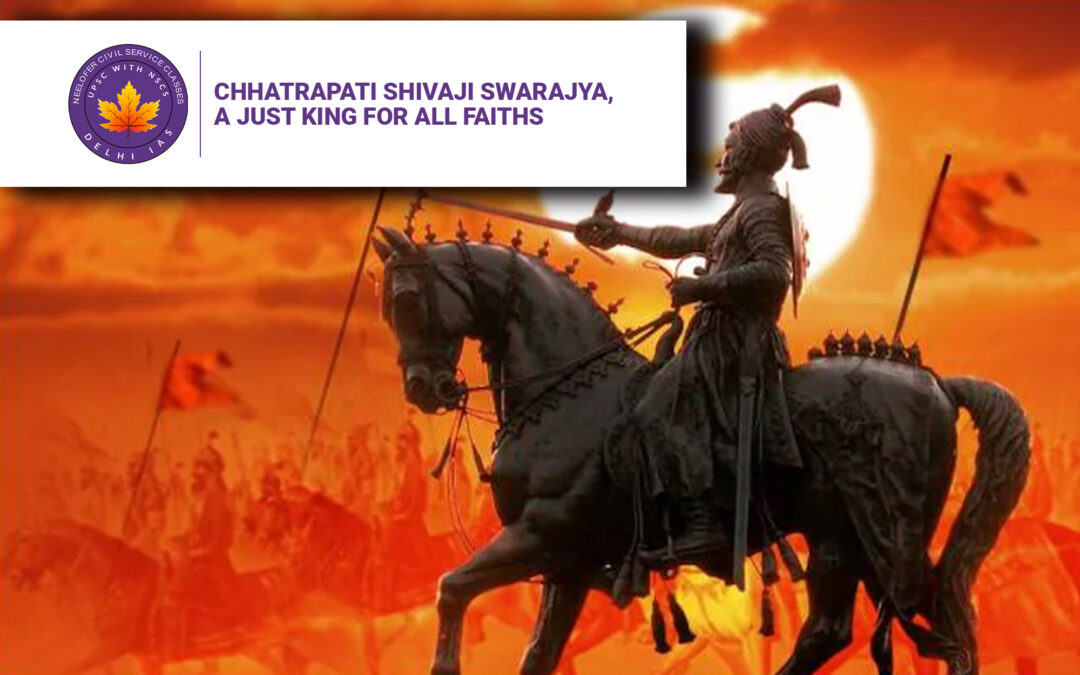
Chhatrapati Shivaji Swarajya, A Just King for All Faiths
Why in News?
As debates around secularism, religious tolerance, and historical narratives grow louder in contemporary India, the legacy of Chhatrapati Shivaji Maharaj continues to inspire admiration for his inclusive governance and visionary leadership. His progressive rule stood in stark contrast to both the rigid orthodoxy of Hindu elites and the fundamentalism of Islamic rulers like Aurangzeb.
Introduction 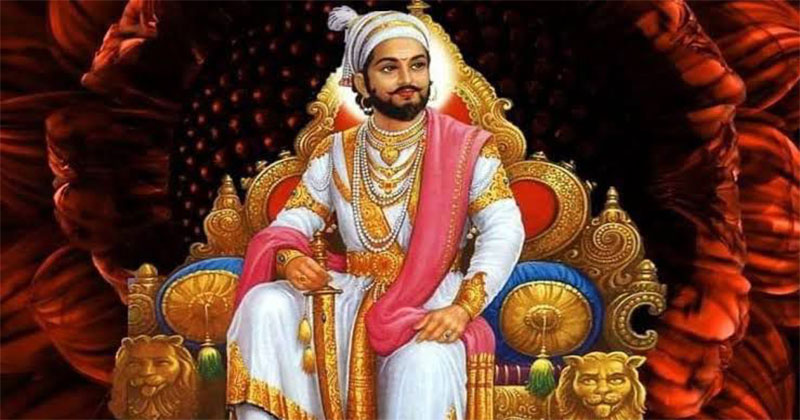
Chhatrapati Shivaji Maharaj is often celebrated for founding the Swarajya, a kingdom built on principles of justice, equality, and respect for all religions. Though deeply religious himself, Shivaji’s faith never translated into hatred or discrimination against other faiths. He was a king whose rational, pragmatic, and inclusive approach to religion distinguished him from many rulers of his time.
Shivaji’s Religious Tolerance
-
Shivaji awarded large gifts to temples and also respected Muslim institutions.
-
According to Khafi Khan’s Muntakhab-ul-Lubab, Shivaji strictly forbade his soldiers from harming mosques or women. If the Quran was found during conquests, it was honorably returned to Muslim leaders.
-
His chief justice, Raghunath Pandit Rao, recorded in a 1669 letter: “Shrimant Maharaj has ordained that everybody is free to follow his religion and nobody is allowed to disturb it.”
This ideology of coexistence came at a time when Aurangzeb was enforcing the jizya tax on non-Muslims, shutting down temples, and promoting an intolerant regime.
Shivaji’s Spiritual Philosophy
Shivaji’s beliefs transcended narrow sectarianism. He once compared human diversity to different hues used by the Divine Painter, emphasizing that all paths lead to God.
“To show bigotry for any man’s own creed and practices is equivalent to altering the words of the Holy Book.”
His version of Hinduism was neither oppressive nor dogmatic — it promoted freedom of conscience and respect for other beliefs.
A Ruler’s Responsibility
Shivaji’s criticism of Aurangzeb as a ruler was sharp and insightful:
“Your peasants are downtrodden; the yield of every village has declined… The yield of a thousand villages cannot meet the demands of your government.”
He called out economic mismanagement, oppression of peasants, and religious authoritarianism. This positioned him as a visionary monarch who stood for people’s welfare.
Legacy in the Freedom Movement
-
The escape from Agra where Shivaji defied Mughal captivity became a symbol of national resistance.
-
Leaders like Bipin Chandra Pal, Bal Gangadhar Tilak, and Ambedkar invoked Shivaji’s name to mobilize political consciousness.
-
Plays like Shivaji Kanda Hindu Rajyam and Bharati’s poem 190-line eulogy honored his spirit.
Even Mahatma Phule, in his work Chhatrapati Shivaji Raje Bhosale Yancha Powada, lauded Shivaji for resisting the oppression of Brahminical orthodoxy and Islamic dominance alike.
Conclusion
Chhatrapati Shivaji’s Swarajya was not just a territorial rule — it was an ideological revolution. He exemplified secular leadership, strategic brilliance, and compassionate governance. In today’s polarized world, Shivaji stands tall as a historical figure who showed how to wield power with wisdom, humility, and justice.
5 Q&A on Chhatrapati Shivaji’s Inclusive Rule
Q1. Was Shivaji anti-Muslim or sectarian?
No. He respected all religions. He returned copies of the Quran with honor, forbade destruction of mosques, and ensured Muslim women and children were unharmed.
Q2. How did Shivaji’s rule differ from Aurangzeb’s?
While Aurangzeb enforced religious orthodoxy and jizya tax on Hindus, Shivaji promoted freedom of worship, abolished sectarian discrimination, and criticized economic oppression.
Q3. What was Shivaji’s view on God and religion?
He believed all religions were valid paths to God, comparing them to different strokes by the same Divine Painter.
Q4. How has Shivaji inspired India’s freedom movement?
Leaders like Tilak, Phule, Ambedkar, and Subramania Bharati used Shivaji’s example to resist colonialism and inspire the people to fight injustice.
Q5. Why is Shivaji’s Swarajya still relevant today?
Because it shows how leadership rooted in justice, inclusiveness, and pragmatism can foster unity and resilience — values deeply needed in modern democratic governance.
