
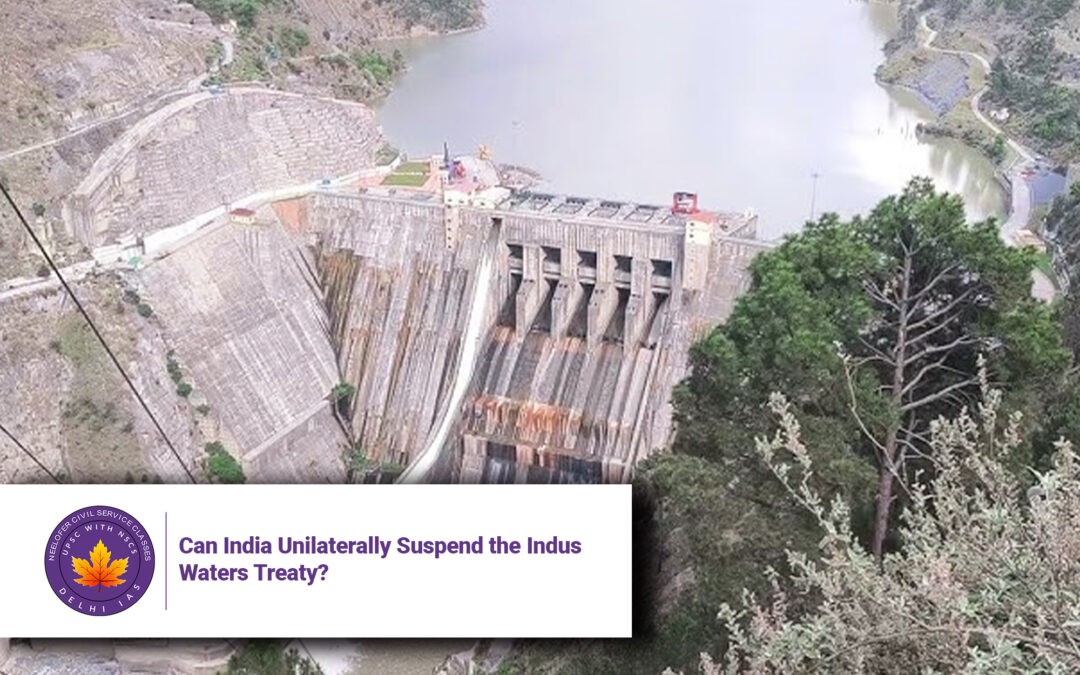
Can India Unilaterally Suspend the Indus Waters Treaty?
Why in News?
Following the Pulwama terror attack in 2019, India sent a notice to Pakistan regarding the possible suspension of the Indus Waters Treaty (IWT), reviving debates around whether a treaty like the IWT can be unilaterally revoked or suspended under international law. 
Introduction
Signed in 1960, the Indus Waters Treaty (IWT) is one of the most enduring water-sharing agreements between India and Pakistan. Brokered by the World Bank, it allocates control of the six rivers of the Indus Basin: India gets unrestricted use of the three eastern rivers (Ravi, Beas, Sutlej), while Pakistan controls the three western rivers (Indus, Jhelum, Chenab). Despite wars and conflicts, the treaty has remained intact. However, escalating tensions, especially after terror attacks, have raised questions over whether India can suspend or terminate the treaty unilaterally.
Key Issues and Background
1. India’s Position and the Pulwama Trigger
-
After the Pulwama terror attack (Feb 2019), India sent a letter to Pakistan on January 25, 2023, indicating its intention to modify the treaty, citing Pakistan’s refusal to engage on dispute resolution.
-
India had held the IWT in abeyance with “immediate effect.”
2. Treaty Provisions and International Law
-
Article XII of the IWT allows modification or termination only by mutual agreement between both countries.
-
The treaty does not permit unilateral suspension.
3. What Does International Law Say?
-
The Vienna Convention on the Law of Treaties (VCLT), 1969 governs such agreements.
-
Although the VCLT doesn’t use the word “suspension,” it allows countries to suspend or terminate a treaty if there is a “fundamental change in circumstances.”
-
However, India and Pakistan are not parties to the VCLT, though its principles are considered customary international law (and thus still relevant).
4. High Threshold for Treaty Suspension
-
International legal experts like Dr. Prabhash Ranjan suggest India likely used the term “suspension” deliberately instead of “termination” to stay within legal boundaries.
-
Historical rulings, like the Fisheries Jurisdiction case and the Gabcíkovo-Nagymaros Project dispute, indicate that such changes must be serious, unforeseeable, and deeply impactful (e.g., environmental disasters, war) to qualify for suspension.
5. Risks of Unilateral Action
-
Any unilateral move risks damaging India’s international credibility and could provoke retaliation or legal disputes.
-
Disruption of water flow could also impact Pakistan’s agriculture and water security, intensifying political and humanitarian tensions in the region.
The Core of the Concern
While India has strong political and strategic reasons for reviewing the treaty, international law does not support unilateral suspension. Such a move could undermine India’s global image as a law-abiding state and escalate regional tensions.
Key Observations
-
The IWT remains a cornerstone of India-Pakistan relations.
-
India’s reference to “suspension” may be more symbolic and diplomatic than legal.
-
A mutual agreement is still required to lawfully terminate or alter the treaty.
Conclusion
India’s discontent with the functioning of the Indus Waters Treaty is rooted in national security and fairness concerns. However, international legal frameworks restrict India from suspending or terminating the treaty unilaterally. Instead, diplomatic negotiation, modernization of clauses, or third-party mediation may offer a more sustainable path forward.
5 Questions and Answers
Q1. What is the Indus Waters Treaty, and when was it signed?
Answer: The Indus Waters Treaty (IWT) was signed in 1960 between India and Pakistan. It gives India control over the eastern rivers (Ravi, Beas, Sutlej) and Pakistan over the western rivers (Indus, Jhelum, Chenab).
Q2. Can India unilaterally suspend the IWT under its terms?
Answer: No, Article XII of the treaty clearly states that it can only be modified or terminated through mutual agreement between India and Pakistan.
Q3. What does the Vienna Convention on the Law of Treaties say about suspension?
Answer: The Vienna Convention permits suspension of a treaty in case of a “fundamental change in circumstances,” but this requires a high legal threshold and applies only if the states are parties to it. India and Pakistan are not, but the principle is considered customary law.
Q4. Why did India indicate suspension of the IWT in 2023?
Answer: India sent a notice to Pakistan citing non-cooperation in resolving disputes and delays in treaty mechanisms following increased tensions after the Pulwama terror attack.
Q5. What are the risks if India unilaterally suspends the treaty?
Answer: Such a move could damage India’s international reputation, trigger legal challenges, worsen bilateral relations, and disrupt water supply in Pakistan, causing humanitarian issues.

