
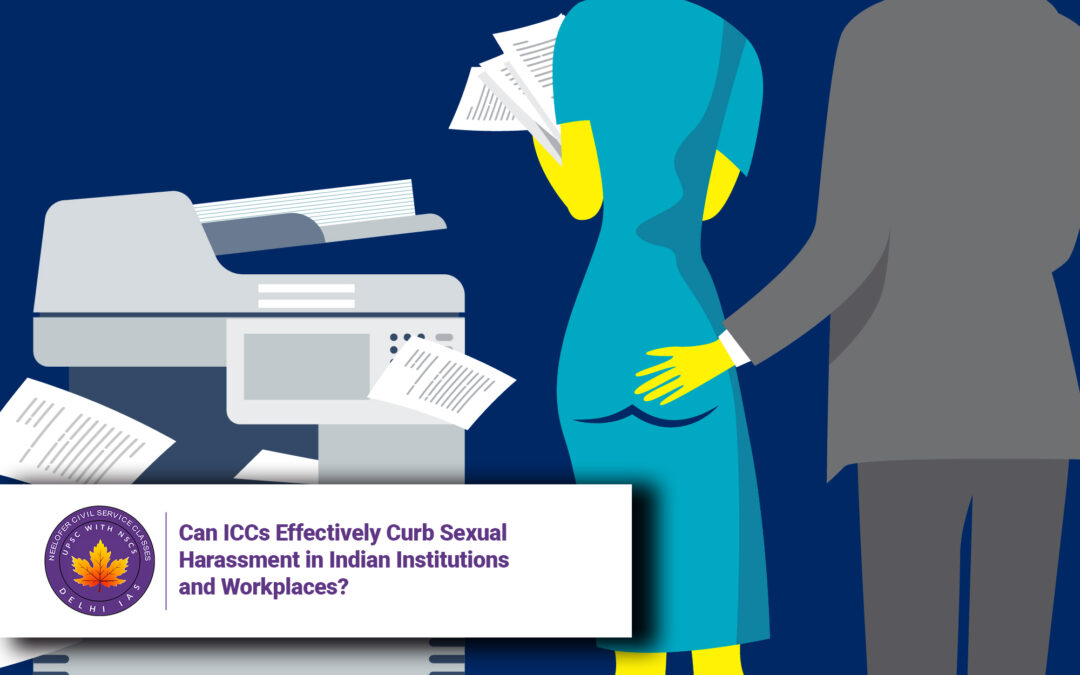
Can ICCs Effectively Curb Sexual Harassment in Indian Institutions and Workplaces?
Why in News
A tragic incident involving a young student’s self-immolation in Balasore, Odisha, has brought national attention to the Internal Complaints Committee (ICC) mechanism. The student had accused her head of department of sexual harassment, but the ICC reportedly failed to validate her complaint. This case has raised urgent concerns about the effectiveness, training, and impartiality of ICCs, particularly within academic institutions.
Introduction
Sexual harassment continues to plague workplaces and educational institutions in India. To combat this, the Indian legal system mandates the establishment of Internal Complaints Committees (ICCs) under the POSH Act (Prevention of Sexual Harassment at Workplace Act, 2013). These committees are designed to create a safer environment by investigating complaints and taking timely action.
However, this recent case in Odisha exposes how ICCs may not always function effectively due to bias, lack of training, or improper implementation, leaving survivors without justice.
Key Issues and Background
How Did the Law Behind ICCs Begin?
The concept of ICCs originated from the 1997 Vishaka Guidelines, issued by the Supreme Court in response to the gang rape of Bhanwari Devi, a social worker in Rajasthan who tried to stop a child marriage. The court directed employers to set up internal committees to deal with sexual harassment complaints, headed by women and including at least 50% women members.
The Vishaka Guidelines remained advisory until the Nirbhaya case (2012) shook the nation. This led to the POSH Act in 2013, which made these guidelines legally binding and expanded their scope significantly.
What Does the POSH Act Require?
-
Mandatory ICCs in all workplaces with 10 or more employees
-
ICCs to be headed by a senior woman employee
-
Inclusion of members from NGOs or experts in women’s rights
-
Equal gender representation, with at least half being women
-
Provision for Local Committees in unorganised sectors
Powers and Functions of an ICC
An ICC has the powers of a civil court under the Code of Civil Procedure, and must:
-
Complete its inquiry within 90 days
-
Recommend action if the complaint is proven
-
Maintain strict confidentiality about the identities and details involved
-
Help the victim file a criminal complaint, if desired
Complaints must be submitted within three months of the incident. Women can approach either the ICC or a district-level Local Committee depending on the type of workplace.
Specific Impacts or Effects
What Are ICCs Supposed to Ensure?
-
Quick resolution of sexual harassment complaints
-
A neutral and supportive environment for women victims
-
Structural accountability in public and private institutions
-
Confidential handling of sensitive cases
-
Reducing workplace power dynamics that often discourage reporting
In theory, these committees should act as the first line of defense for women facing harassment. However, several real-world cases—including the recent Odisha incident—highlight the gap between law and implementation.
Challenges and the Way Forward
Implementation Gap
Even after a decade of the POSH Act:
-
ICCs are not set up in many institutions
-
Where they exist, members are often poorly trained
-
Committees may be biased in favor of powerful accused individuals
-
Victims continue to face intimidation, delays, and inaction
In December 2024, the Supreme Court criticized the “sorry state of affairs” in enforcing the POSH Act. It called for:
-
Immediate government compliance
-
A nationwide audit of ICC implementation in public and private sectors
-
Improved training and awareness among committee members
Lack of Awareness
Many employees and students are unaware of their rights under the POSH Act, or the procedures for filing complaints. This results in underreporting and mistrust in the system.
Conclusion
While the POSH Act and ICC framework were born out of a strong legal and social necessity, the ground realities reveal deep flaws in execution. The ICC system needs urgent strengthening—through better training, strict oversight, and public awareness—to truly serve the cause of justice.
The Odisha tragedy is not just an isolated failure of one committee—it is a wake-up call. ICCs must not exist on paper alone. They must function effectively, independently, and with empathy to uphold the very purpose for which they were created: to make workplaces and institutions safe for all women.
5 Questions and Answers
1. What is the purpose of ICCs in India?
ICCs are mandated under the POSH Act to investigate and resolve complaints of sexual harassment in workplaces and educational institutions.
2. When were ICCs first introduced?
They were first introduced in 1997 under the Vishaka Guidelines and became legally binding with the POSH Act in 2013.
3. Who can file a complaint with the ICC?
Any aggrieved woman can file a written complaint within three months of the incident to the ICC or district Local Committee.
4. What powers does an ICC have?
An ICC has powers similar to a civil court, can complete inquiries within 90 days, and can recommend disciplinary action if the complaint is proven.
5. What has the Supreme Court said about ICCs recently?
In December 2024, the Supreme Court expressed concern over poor implementation and serious lapses in the functioning of ICCs, urging immediate action by authorities.

