
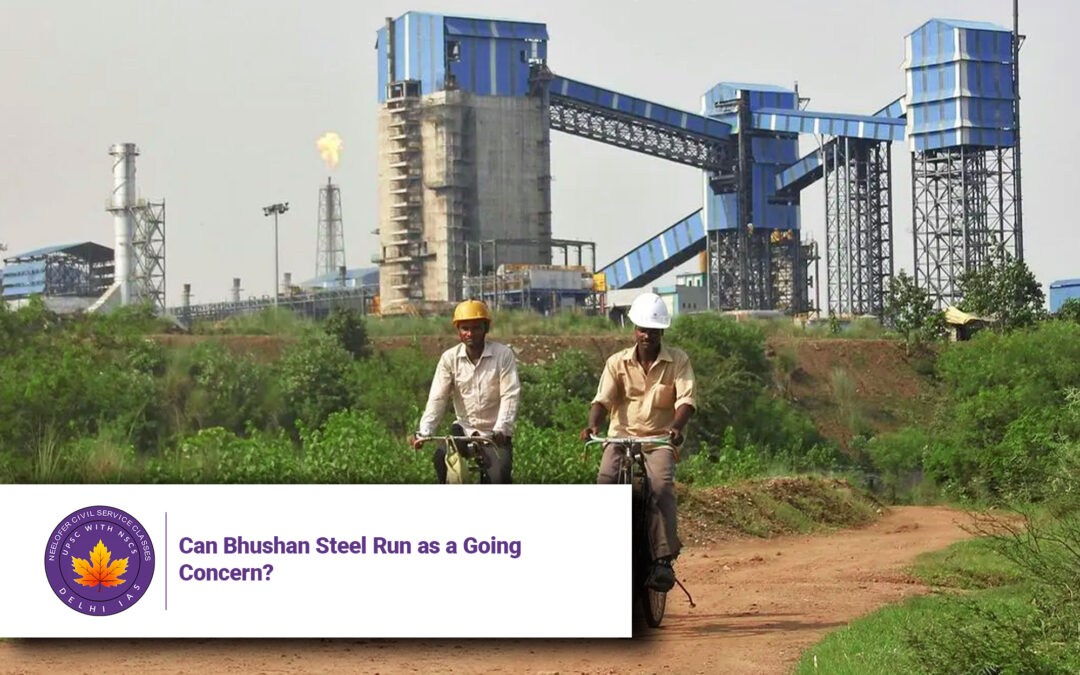
Can Bhushan Steel Run as a Going Concern?
Why in News?
A recent order by the Supreme Court in the Bhushan Power and Steel Ltd. (BPSL) case has reignited the debate around the possibility of companies undergoing insolvency proceedings continuing to operate as going concerns—even during liquidation. The ruling reverses earlier decisions and opens a window to explore a lesser-used exit route under the Insolvency and Bankruptcy Code (IBC). 
Introduction
The Supreme Court’s decision has brought fresh focus on the potential for distressed companies to be liquidated while still functioning as going concerns. This decision has serious implications for the conduct of stakeholders and adds another layer of complexity to India’s evolving insolvency regime. The case of Bhushan Steel is now at the center of discussions about balancing liquidation, revival, asset value protection, and investor confidence.
Key Issues and Background
1. The Players in the IBC Framework
-
The IBC involves four key stakeholders: the Adjudicating Authority, Resolution Professional (RP), Committee of Creditors (CoC), and Information Utility.
-
The current ruling impacts the roles of these stakeholders, particularly their approach to liquidation under Section 33 of the IBC.
2. Supreme Court’s Reversal
-
The Supreme Court reversed the National Company Law Tribunal (NCLT) order that had pushed BPSL into liquidation despite its revival prospects.
-
With this reversal, BPSL’s liquidation can be explored under the “going concern” clause—a significant departure from traditional shut-down liquidation.
3. Exit Option in Focus
-
IBC allows liquidation as a going concern, but this has faced resistance.
-
The Insolvency Law Committee has backed this method, stressing it can help protect value and jobs, and better secure creditor interests.
4. Corporate Debtor as a Going Concern
-
The IBBI (Insolvency and Bankruptcy Board of India) has issued guidelines emphasizing that even during liquidation, assets and operations should be preserved and sold as functional units.
-
The Supreme Court’s move revalidates this logic, opening the door for continued operations while resolving debt.
Specific Impacts or Effects
-
This decision may improve recoveries during liquidation as operational continuity preserves asset value.
-
Helps protect jobs and contracts, avoiding fire-sale of assets.
-
Investors and lenders may gain confidence in IBC as a value-maximizing, not asset-stripping, mechanism.
-
Could create legal precedents for other insolvency cases stuck in long litigation.
Challenges and the Way Forward
Challenges
-
Resistance from creditors or RPs reluctant to support ongoing operations during liquidation.
-
Lack of detailed frameworks or clarity for implementing going-concern liquidation.
-
Uncertainty over how to evaluate such companies—should recent investments be included?
Steps Forward
-
IBBI and NCLT must standardize criteria for approving going-concern liquidation.
-
Stakeholder committees (like CoC) need to be more proactive and transparent in evaluating going-concern potential.
-
Government should encourage investment during insolvency with safe harbor policies.
Conclusion
The Supreme Court’s verdict in the Bhushan Steel case could shape the future of India’s insolvency regime. It shows that liquidation doesn’t always have to mean closure. With better valuation strategies, legal clarity, and stakeholder alignment, companies in distress can still run and preserve their economic value—even while going through liquidation.
5 Questions and Answers
Q1: What is the Supreme Court’s recent decision in the Bhushan Steel case?
A: The Supreme Court reversed an earlier NCLT decision and allowed Bhushan Steel to be liquidated as a going concern, enabling it to continue operating during liquidation.
Q2: What does liquidation as a going concern mean under IBC?
A: It means the company is not shut down during liquidation. Its assets, operations, and contracts are preserved and possibly sold as a functioning business.
Q3: Why is this ruling significant?
A: It helps protect asset value, jobs, and economic continuity, and provides an alternative to fire-sale liquidations that often result in major value losses.
Q4: What challenges exist in implementing this exit option?
A: Resistance from stakeholders, lack of frameworks, and complications in valuation and investor interest are key obstacles.
Q5: What is the way forward according to insolvency experts?
A: Standardizing procedures, boosting creditor confidence, and improving coordination among CoC, RP, and IBBI can make going-concern liquidation a practical and value-saving exit route.

