
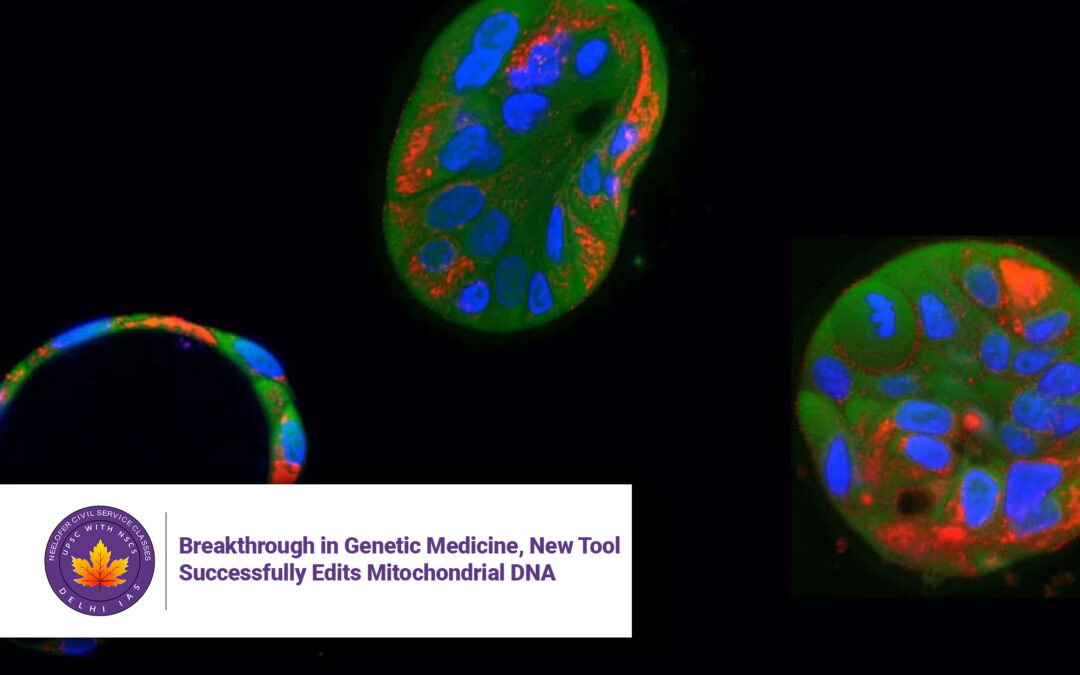
Breakthrough in Genetic Medicine, New Tool Successfully Edits Mitochondrial DNA
Why in News?
Dutch scientists have developed and successfully tested a new genetic tool capable of rewriting single letters in mitochondrial DNA—a major breakthrough in gene therapy. This innovation marks a significant milestone, as CRISPR-based tools have not been able to target mitochondrial DNA until now. 
Introduction
The mitochondrial genome plays a crucial role in energy production in human cells. Errors or mutations in this DNA can lead to serious genetic diseases. Unlike nuclear DNA, mitochondrial DNA has long been considered inaccessible to traditional gene editing technologies such as CRISPR. However, a team of Dutch researchers has now introduced a base-editor that precisely targets and edits single-letter mutations in mitochondrial DNA.
Key Features and Achievements
-
Base Editing Precision:
The new tool was used to fix a harmful mutation in the skin cells of a patient. It successfully corrected the faulty genetic code at a single-base level, an unprecedented achievement in mitochondrial research. -
Therapeutic Impact:
Post-editing, the cells showed an 80% correction rate, significantly restoring normal mitochondrial membrane potential. This means improved energy output—an indicator of better cell health. -
Delivery Innovation:
The base editors were delivered via mRNA wrapped in lipid nanoparticles, a method similar to mRNA vaccines. This enhanced both the precision and effectiveness of the therapy, while reducing unintended (off-target) mutations. -
Overcoming a Genetic Barrier:
CRISPR has revolutionized gene editing, but it cannot access mitochondrial DNA due to its unique structure and localization. This new tool opens up therapeutic possibilities for treating mitochondrial diseases, which currently lack effective treatments.
Conclusion
This new base-editing tool signals a transformative advancement in molecular medicine. By enabling precise, safe, and effective editing of mitochondrial DNA, it may pave the way for future therapies for currently untreatable mitochondrial disorders. It also showcases the growing synergy between gene therapy and innovative delivery mechanisms such as lipid nanoparticles.
5 Q&A Based on the Article
Q1. What is the key breakthrough reported by Dutch scientists?
A1. They have developed a base-editor capable of rewriting single letters in mitochondrial DNA, a region previously inaccessible to CRISPR-based tools.
Q2. What was the result of using this tool in skin cells?
A2. About 80% of the edited cells showed restored mitochondrial membrane potential, indicating healthier energy output.
Q3. Why is mitochondrial DNA difficult to edit using traditional methods?
A3. Mitochondrial DNA has a unique structure and localization that prevents CRISPR-based tools from accessing or editing it.
Q4. How was the base editor delivered into cells?
A4. It was delivered as mRNA wrapped in lipid nanoparticles, improving delivery efficiency and reducing off-target effects.
Q5. What is the significance of this development for medical science?
A5. It offers hope for treating mitochondrial diseases, improves gene-editing precision, and broadens the scope of genetic therapies.

