
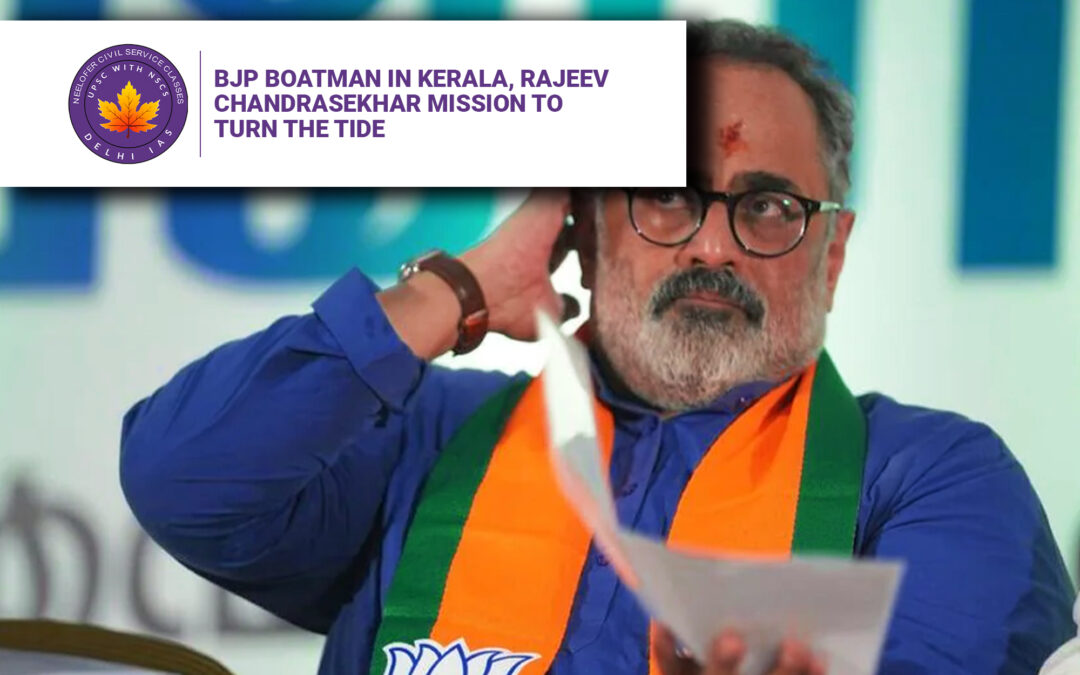
BJP Boatman in Kerala, Rajeev Chandrasekhar Mission to Turn the Tide
Why in News?
Rajeev Chandrasekhar’s appointment as the head of the BJP’s Kerala unit marks a strategic move by the party, as it attempts to expand its influence in a state where it has historically struggled to gain ground. His background, credentials, and calculated low-threat image in Kerala make this a noteworthy development in Indian politics.
Introduction
In a state known for its fiery political traditions and charismatic orators, Rajeev Chandrasekhar’s soft-spoken style and outsider status might seem unusual. But that’s exactly why he has been chosen to lead the Bharatiya Janata Party (BJP) in Kerala. He is seen as a man who won’t ruffle feathers—at least not initially—and can work within Kerala’s deeply factional political structure to help the BJP gain a toehold. )
Key Journey and Career Highlights
1. Military Roots and Technical Expertise
A self-described fauji brat, Chandrasekhar was born in Ahmedabad and raised across various military stations in India. His father, Air Commodore M.K. Chandrasekhar, was a distinguished officer in the Indian Air Force (IAF), which deeply influenced Rajeev’s respect for defence forces and national service.
He went on to study electrical engineering at Manipal Institute of Technology and later pursued a postgraduate degree in the U.S. His academic excellence and technical prowess led him to become one of three engineers involved in designing the Intel 486 processor.
2. Corporate Forays and Entrepreneurial Spirit
Chandrasekhar’s early career involved helping build India’s telecom landscape. He led BPL Mobile, one of the largest telecom companies at the time, before selling it in 2005 when it was valued at $1.1 billion. He then launched Jupiter Capital, an investment firm that funded businesses like Asianet News.
3. Entry into Politics and Policy Leadership
He joined the Rajya Sabha in 2006 as an independent and became a BJP member in 2018. Since then, he has played a key role in important policy initiatives, including the Digital Personal Data Protection Act, 2023. He also served as Minister of State in the Union Cabinet with portfolios of Skill Development and Electronics.
Challenges and the Way Forward
Despite BJP’s steady rise in national politics, Kerala remains an elusive terrain. In the 2024 Lok Sabha polls, BJP secured 19.21% of votes—an improvement, but still far from winning seats. Chandrasekhar’s role will be to unify the party, overcome Kerala’s deeply entrenched political identities, and lead BJP into the 2026 Assembly elections with renewed energy.
His experience managing tough corporate boardrooms and complex portfolios may prove crucial as BJP attempts to turn votes into seats.
Conclusion
Rajeev Chandrasekhar’s appointment reflects BJP’s broader strategy—bringing in technocratic, non-threatening faces with proven managerial skillsets to build the party in states where traditional models have failed. As Kerala heads towards its Assembly elections in 2026, all eyes will be on Chandrasekhar to see whether he can truly be the boatman who helps BJP cross the turbulent political waters of the state.
Q&A Section
Q1. Why did BJP choose Rajeev Chandrasekhar to lead the Kerala unit?
Because he is seen as a calm, capable leader who can operate without provoking hostility, while strategically building the party’s base in a difficult state like Kerala.
Q2. What is Rajeev Chandrasekhar’s professional background?
He is an electrical engineer, a former Intel engineer, and a telecom entrepreneur. He founded Jupiter Capital and was also instrumental in building BPL Mobile.
Q3. What roles has he played in Indian politics so far?
He served as a Rajya Sabha member, contributed to the Data Protection Act, 2023, and was part of the Union Cabinet handling electronics and skill development.
Q4. What is the biggest challenge BJP faces in Kerala?
Despite increasing its vote share, BJP has not yet been able to convert that into legislative seats, due to entrenched regional and ideological loyalties.
Q5. How might his corporate background help in politics?
His experience in navigating corporate challenges may help him deal with Kerala’s political factions, bring discipline to the party, and implement modern campaign strategies.

