
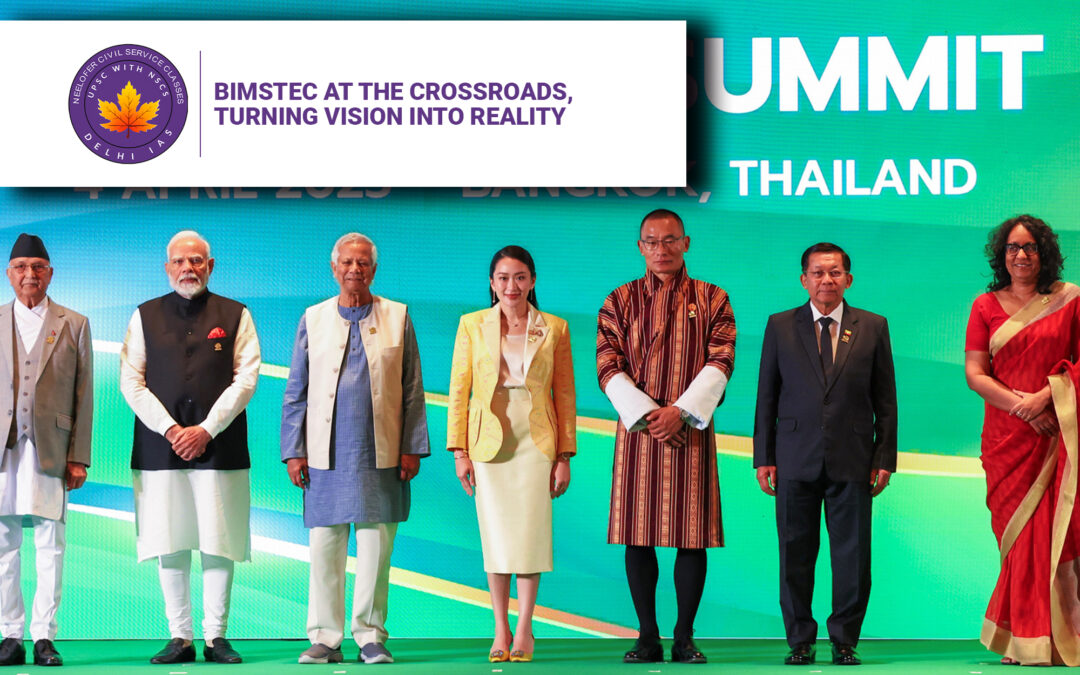
BIMSTEC at the Crossroads, Turning Vision into Reality
Why in News?
The 6th summit of BIMSTEC (Bay of Bengal Initiative for Multi-Sectoral Technical and Economic Cooperation) was held in Bangkok on April 4, 2025. While it showcased a clear vision for the future, the summit revealed gaps between intention and implementation, urging for action at the highest political level. 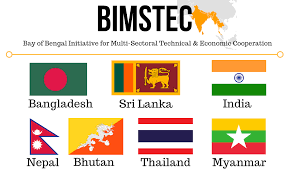
Introduction
Established in 1997, BIMSTEC comprises seven member nations—five from South Asia (India, Bangladesh, Nepal, Bhutan, Sri Lanka) and two from Southeast Asia (Thailand, Myanmar). Despite being a promising platform that bridges South and Southeast Asia, the grouping has long struggled with delivering tangible outcomes.
This year’s summit, hosted by Thailand, was marked by ceremonial diplomacy, yet it also highlighted the persistent gap between vision and action. While past summits often lacked continuity, the Bangkok summit brought renewed commitment and strategic planning through its adoption of ‘Vision 2030’.
Key Outcomes of the Bangkok Summit
The highlight of the summit was the adoption of the Vision 2030 document, subtitled:
“A Prosperous, Resilient, and Open BIMSTEC by 2030 for Our People and Future Generations.”
This vision rests on three major pillars:
-
Prosperity: Targeting regional growth, trade, investment, supply chains, and poverty reduction.
-
Resilience: Strengthening response mechanisms for disasters, health emergencies, and climate change.
-
Openness: Promoting inclusive collaboration in tourism, culture, education, and connectivity.
The summit also:
-
Welcomed the report of the Eminent Persons Group on institutional reform.
-
Reviewed the BIMSTEC Master Plan for Transport Connectivity.
-
Signed the BIMSTEC Maritime Transport Cooperation Agreement.
-
Discussed promotion of Buddhist tourism circuits and eco-tourism.
-
Called for health cooperation and a potential health ministers’ forum.
-
Endorsed cooperation with the Indian Ocean Rim Association (IORA).
However, notable gaps persisted—especially the lack of progress in the Free Trade Agreement (FTA), which has remained pending for over two decades.
Challenges
-
Implementation gap: While documents and declarations are created, translating them into action remains slow.
-
Dependence on political will: National priorities often override regional ones.
-
Security and trust deficits: Bilateral tensions, especially involving Myanmar and Bangladesh, can derail collective agendas.
-
Weak institutional follow-up: Absence of strong monitoring mechanisms impedes continuity between summits.
India’s Role and the Way Forward
India’s strong commitment, as seen in PM Narendra Modi’s 21-point action plan, positions it as a potential driver of change. The roadmap aligns well with India’s foreign policy goals of regional connectivity and strategic autonomy.
Bangladesh’s upcoming chairmanship (2026) is expected to be crucial. The transition of leadership among BIMSTEC nations, if well-prepared, can enhance momentum.
For BIMSTEC to succeed, domestic implementation of its decisions must be taken seriously by all member governments. The need of the hour is institutional memory, clear performance metrics, and regular high-level oversight.
Conclusion
BIMSTEC stands at a critical juncture. With a defined vision and strategic frameworks in place, its future depends on real-time actions, not ceremonial gestures. Political commitment, diplomatic consistency, and bureaucratic diligence will determine whether BIMSTEC becomes a model for regional cooperation—or remains another underachieving regional group.
5 Q&A on BIMSTEC
Q1. What is BIMSTEC and which countries are part of it?
BIMSTEC is a regional organization comprising seven countries: India, Bangladesh, Sri Lanka, Nepal, Bhutan, Myanmar, and Thailand. It aims to foster cooperation across the Bay of Bengal region.
Q2. What was the major highlight of the 2025 BIMSTEC summit?
The summit in Bangkok adopted the ‘Vision 2030’ document outlining goals for prosperity, resilience, and openness by 2030.
Q3. What are the key challenges facing BIMSTEC?
Key challenges include a lack of implementation, political divergence, weak institutional mechanisms, and unresolved bilateral tensions.
Q4. What progress has been made on the BIMSTEC Free Trade Agreement (FTA)?
Very little. Despite discussions for over two decades, the FTA has not been finalized, reflecting the slow pace of consensus-building.
Q5. How can BIMSTEC improve its effectiveness?
By ensuring stronger political will, monitoring progress through institutional mechanisms, reducing bilateral frictions, and focusing on projects with measurable impact.
