
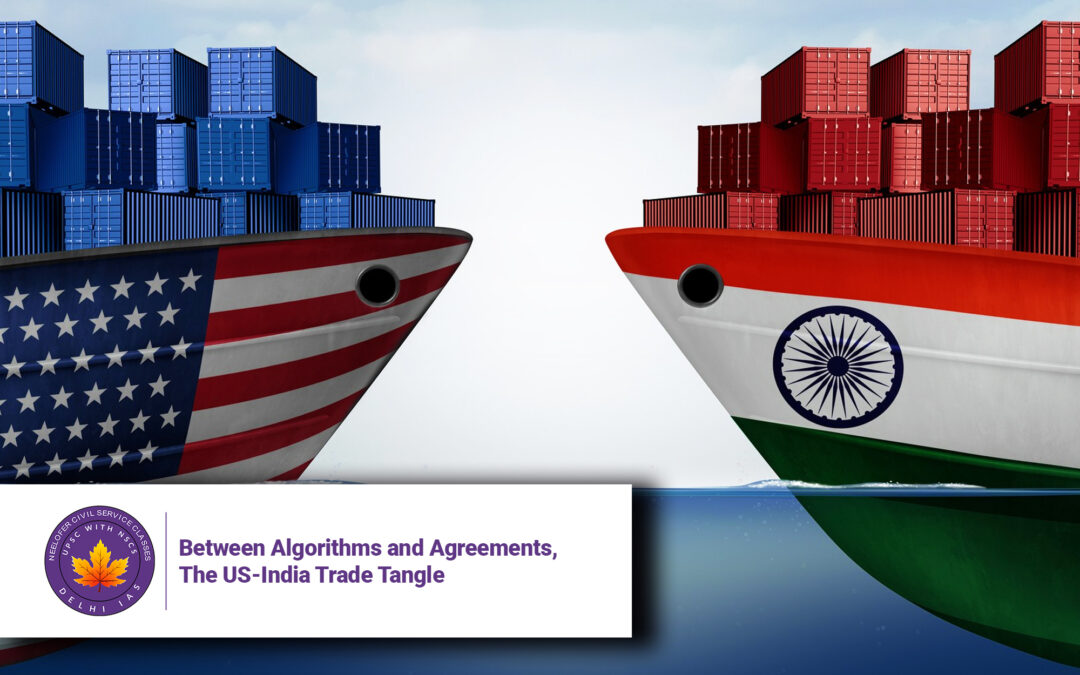
Between Algorithms and Agreements, The US-India Trade Tangle
Why in News?
Despite a growing convergence in geopolitical goals and strategic interests, the much-anticipated US-India trade deal remains elusive. Recent policy exchanges, digital sovereignty concerns, and the clash of institutional styles have pushed both democracies into a trade impasse that reflects deeper questions of sovereignty, trust, and economic identity. 
Introduction
When great powers shake hands, history listens. But sometimes, the handshake stalls—caught between algorithmic policy rules and hard-nosed diplomacy. The current US-India trade gridlock, intensified under the Trade Policy Forum (TPF) 2.0, symbolizes not just a negotiation failure but a philosophical divergence. India’s cautious, consensus-driven model stands in stark contrast to America’s lobby-fueled urgency, revealing a tale of two democracies divided by expectations.
Diverging Tempos, Divergent Tongues
India’s trade concessions, including duty cuts on whisky and EV components, procedural reforms on digital trade, and structural alignment efforts, signaled readiness for mutual accommodation. However, the US response was marked by retaliatory tariffs—especially on Indian steel and aluminum—and a reinstated emphasis on quantifiable gains.
India’s approach, grounded in transparency and public trust, values phased liberalisation and sectoral calibrations. Whether it’s farm produce, pharma, or digital policy, New Delhi seeks to future-proof its markets, preferring slow-burning alignment over pressure-cooked deals.
In contrast, Washington treats trade as a vehicle of industrial ascendancy, expecting quick wins through legal precision, directness, and clearly defined economic deliverables.
The Misalignment of Perceptions
The US often misreads India’s deliberate pace as defensive posturing. American negotiators push for clarity on digital trade, cross-border data access, and tax rules, perceiving delay as avoidance. Yet India asserts its digital rules are under active legislative review—still in flux and not ripe for commitment.
Meanwhile, India views the US insistence on tariff averages (13% Indian vs 3% American) and zero-duty EV access as overlooking domestic vulnerabilities, especially in agriculture and MSMEs.
India’s trade outlook is shaped by socio-political cohesion, parliamentary processes, and a wider lens of economic self-reliance. Washington, however, leans on a transactional mindset: cut tariffs, fix data rules, deliver outcomes.
The Architecture of Stalemate
At the heart of this deadlock is not mere disagreement but institutional incongruity. India’s policymaking is layered, consensus-based, and heavily influenced by public interest scrutiny. The US model—centralised, fast-tracked, and lobbying-intensive—clashes with this rhythm.
Even as India made goodwill moves like revoking retaliatory tariffs and showing flexibility on WTO positions, the US hardened its stance on data, EVs, and e-commerce. Joint statements read positively, but undercurrents of mistrust remain.
Conclusion: A Tangle of Expectations
This is not merely a trade dispute—it’s a civilizational contrast in how nations negotiate value. One side seeks algorithmic certainty, the other values gradual harmony. As digital frontiers expand and AI reshapes economies, this deadlock underscores a broader question: Can two democracies with shared visions but dissimilar styles ever forge a truly balanced economic accord?
The answer may lie not in the next tariff table, but in reimagining diplomacy that respects divergence while seeking convergence.
Q&A Section
1. Q: What triggered the recent US-India trade deadlock despite strong geopolitical ties?
A: Clashing negotiation styles, with India favoring gradual, consensus-based policymaking, and the US demanding rapid, legally quantifiable trade outcomes.
2. Q: What were India’s trade concessions under TPF 2.0?
A: Reductions in tariffs on whisky and EV components, alignment with US digital trade norms, and procedural reforms to support smoother trade.
3. Q: How has India justified delays in digital trade commitments?
A: By asserting that its digital rules are still under legislative process and not finalized for international agreement.
4. Q: What sectors does India want to protect in trade talks?
A: Agriculture, pharmaceuticals, and MSMEs, which are seen as vulnerable to rapid trade liberalisation.
5. Q: What is suggested as a possible way forward in resolving the deadlock?
A: Strengthening joint platforms like the US-India CEO Forum, harmonising trade priorities, and building a shared understanding of each country’s institutional and cultural frameworks.
