
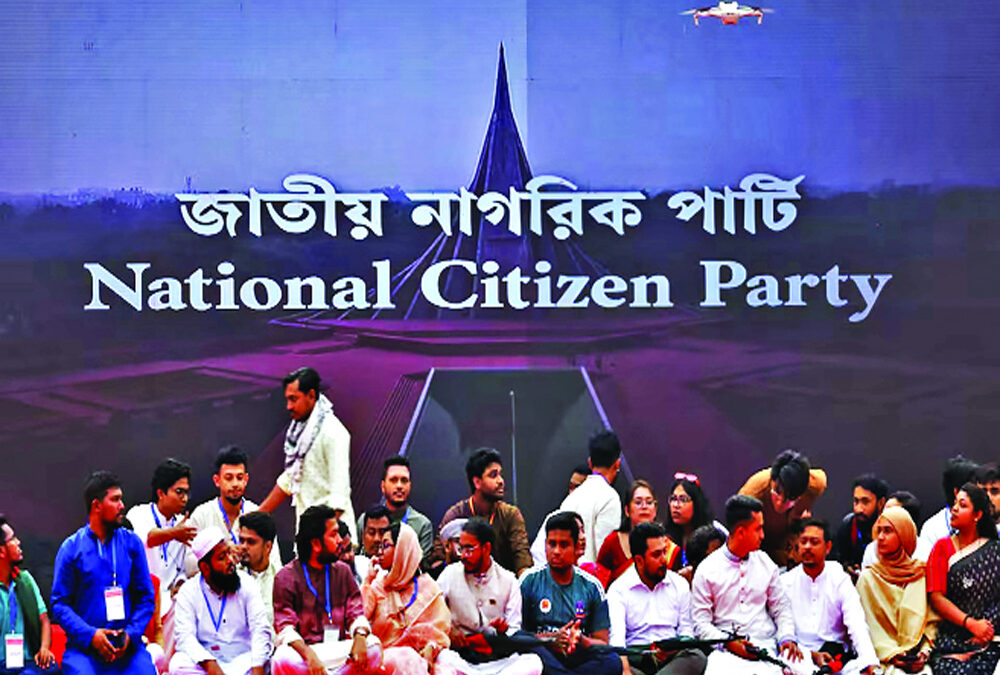
Bangladesh National Citizen Party (NCP): A New Dawn or Fleeting Revolution?
Why in News?
On February 28, 2025, Bangladesh witnessed the birth of the National Citizens Party (NCP), or Jatiya Nagorik Party (NJP) in Bengali. Emerging from the embers of the Anti-Discrimination Students Movement (ADSM)—the very force that toppled former Prime Minister Sheikh Hasina on August 5, 2024—the NCP represents both hope and uncertainty for Bangladesh’s political future. 
Introduction
The political landscape of Bangladesh has dramatically shifted since the ouster of Sheikh Hasina. From the widespread protests to the formation of an interim government, the emergence of the NCP symbolizes a potentially transformative moment. However, the movement’s long-term prospects remain uncertain, as ideological conflicts and factionalism threaten to undermine its unity.
Key Features
Birth of the National Citizens Party (NCP)
- Formed on February 28, 2025, in Bangladesh.
- A political offspring of the Anti-Discrimination Students Movement (ADSM), which spearheaded Sheikh Hasina’s removal.
- Key leaders include Mahfuz Alam, a prominent ADSM activist, and Nahid Islam, former ADSM member and now NCP convenor.
Role of the Anti-Discrimination Students Movement (ADSM)
- Led mass protests starting January 2023, culminating in the toppling of Sheikh Hasina in August 2024.
- Played a key role in mobilizing students, teachers, and other civil society groups.
- Members formed the core leadership of the NCP.
Political Developments
- 17-member interim government chaired by Nobel Laureate Muhammad Yunus established after Hasina’s departure.
- ADSM activists initially involved in interim governance.
- Nahid Islam resigned as adviser to focus on NCP formation.
Party Ideology and Structure
- The NCP claims to represent a movement toward an inclusive, just Bangladesh free from authoritarian control.
- However, factionalism and ideological divides persist, with some members linked to hardline Islamist groups like the Shibir and Jamaat-e-Islami.
- Political rivalries and suspicion among former allies continue to simmer under the surface.
Emerging Challenges
- Differences between senior ADSM leaders and grassroots members over strategy.
- Concerns about whether NCP can maintain the revolutionary momentum or fall into familiar patterns of political power struggles.
- Critics warn that the NCP’s call for a new constitution and structural reforms may be unrealistic amid political instability.
Specific Impacts or Effects
Hope for Political Renewal
- The NCP offers an alternative to the Awami League and BNP, both blamed for decades of corruption and repression.
- Promises of democratic reform and justice have garnered significant public interest.
Risk of Factionalism and Extremism
- Inclusion of groups with radical Islamist ties raises concerns about the party’s ideological coherence.
- Factional power struggles could derail reformist ambitions.
Electoral Prospects
- The NCP may contest elections as early as Fall 2025.
- Success depends on public trust, the interim government’s performance, and the NCP’s ability to stay united.
Challenges and the Way Forward
Challenges
- Factional Divisions
- Deep ideological rifts between progressive and fundamentalist factions threaten stability.
- Public Skepticism
- Cynicism about political parties after years of authoritarian rule and broken promises.
- Governance and Justice
- Ensuring the interim government delivers justice fairly and transparently.
- Extremist Influence
- Avoiding domination by extremist elements within the coalition.
Steps Forward
- Maintaining Unity
- Leadership must bridge ideological divides to maintain party cohesion.
- Transparent Governance
- Interim government and NCP must demonstrate commitment to justice and rule of law.
- Clear Vision for Reform
- Develop a practical, inclusive agenda focusing on constitutional reforms and national reconciliation.
- Engaging the Public
- Build trust through grassroots mobilization and transparent communication.
Conclusion
The formation of the National Citizens Party represents a critical juncture for Bangladesh. While it carries the promise of renewal and justice, the path ahead is fraught with challenges. Whether it emerges as a genuine force for change or succumbs to political infighting remains to be seen. As Bangladesh stands at the crossroads, the decisions made today will shape its democratic future.
Questions and Answers
1. When was the National Citizens Party (NCP) formed?
On February 28, 2025.
2. What movement led to the formation of the NCP?
The Anti-Discrimination Students Movement (ADSM).
3. Who led the ADSM protests against Sheikh Hasina’s government?
Student leaders like Mahfuz Alam and Nahid Islam.
4. What happened to Sheikh Hasina?
She was ousted on August 5, 2024, and resigned as prime minister.
5. Who is heading Bangladesh’s interim government?
Nobel Laureate Muhammad Yunus.
6. What are the key challenges faced by the NCP?
Factionalism, ideological differences, and extremist influences.
7. Which extremist groups are allegedly linked to some NCP members?
Shibir and Jamaat-e-Islami.
8. What does the NCP promise to deliver?
Structural reforms, a new constitution, and justice for past crimes.
9. When are elections expected to be held?
As early as Fall 2025.
10. Why is the NCP’s future uncertain?
Due to internal divisions, ideological conflicts, and public skepticism about its ability to deliver change.

