
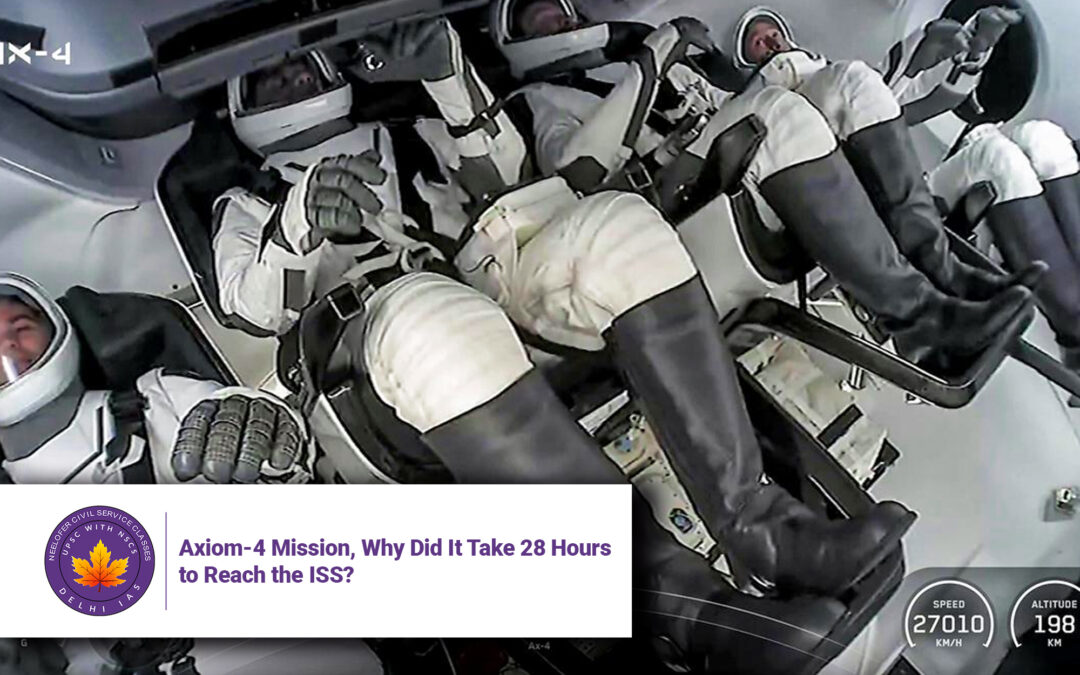
Axiom-4 Mission, Why Did It Take 28 Hours to Reach the ISS?
Why in News?
The Axiom-4 mission, launched on June 25, successfully carried four astronauts—including India’s Group Captain Shubhanshu Shukla—to the International Space Station (ISS) aboard SpaceX’s Crew Dragon capsule. However, unlike a direct flight, the journey took 28 hours due to the complex orbital mechanics involved in docking with the ISS. 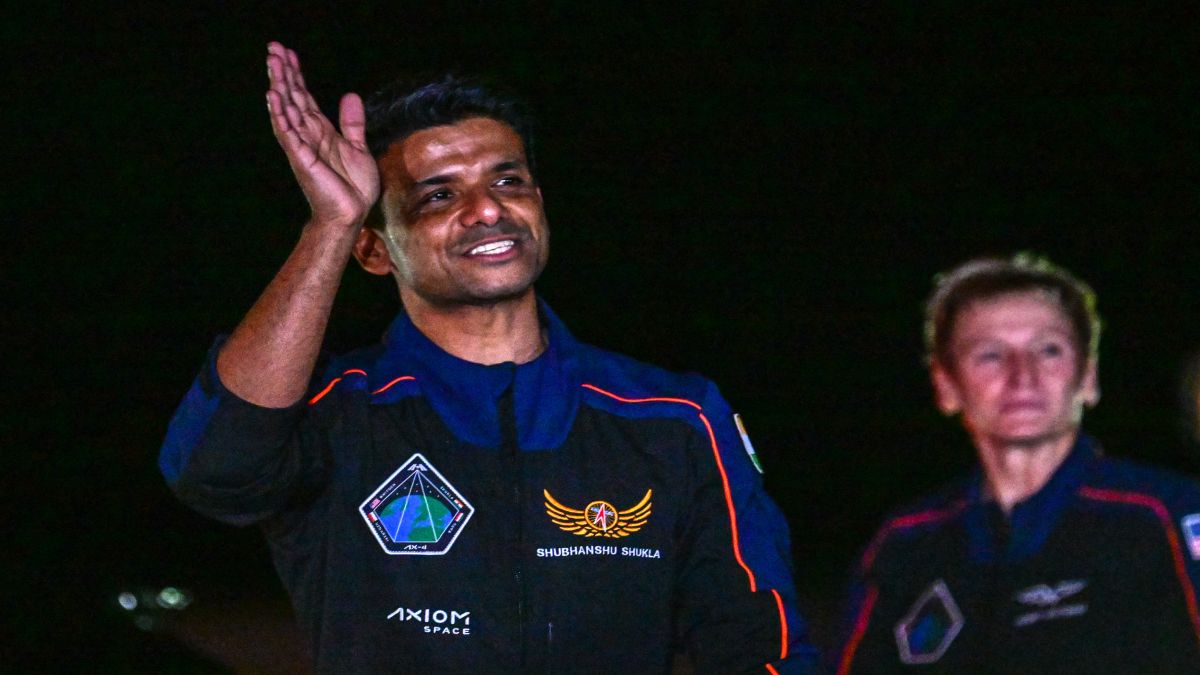)
Introduction
Space travel isn’t as simple as flying straight up to a destination. The Axiom-4 mission highlights the intricate orbital maneuvers required to safely reach the ISS, which orbits Earth at 400 km altitude. The 28-hour journey was a carefully calculated process involving phasing burns, orbital adjustments, and precise timing—not just raw speed.
Key Details of the Mission
1. Why SpaceX’s Dragon Capsule?
-
Proven Reliability: SpaceX’s Crew Dragon has a strong track record in crewed missions.
-
Reusability: The Falcon 9 rocket and Dragon capsule are partially reusable, reducing costs.
-
NASA Partnership: Axiom Space, a private space company, collaborates with NASA for ISS missions, and SpaceX is NASA’s preferred crew transporter.
2. Why Did It Take 28 Hours Instead of a Direct Flight?
-
Orbital Mechanics Rule: The ISS moves at 27,600 km/h, completing an orbit every 92 minutes.
-
Parking Orbit First: The Falcon 9 placed Dragon in a lower elliptical orbit (~200 km) at 27,000 km/h.
-
Phasing Burns: Dragon performed small thruster burns to gradually raise its orbit and synchronize with the ISS.
-
Slow Catch-Up: Since Dragon was in a faster but lower orbit, it took multiple orbits to match the ISS’s position—like merging onto a highway at the right exit.
3. Safety & Precision Over Speed
-
No Shortcuts: A direct ascent would require impossible fuel reserves and pose collision risks.
-
NASA’s Strict Protocols: Docking must be flawless, requiring multiple system checks before final approach.
Key Takeaways
✔ Orbital Mechanics Dictate Timing – Spacecraft must match speed and position, not just altitude.
✔ Phasing Burns Are Crucial – Small thruster adjustments ensure a safe, gradual approach.
✔ SpaceX’s Dragon is NASA’s Go-To – Reusable and reliable for crewed missions.
✔ India’s Representation – Gp. Capt. Shukla’s inclusion marks India’s growing role in space exploration.
Challenges & Future of Space Travel
-
Faster Docking? Russia’s Soyuz sometimes docks in 3-6 hours, but NASA prefers more cautious approaches.
-
Private Spaceflight Growth – Axiom Space plans commercial ISS modules, paving the way for more missions.
-
Next-Gen Spacecraft – SpaceX’s Starship may reduce transit times for future Moon/Mars missions.
Conclusion
The Axiom-4 mission’s 28-hour journey underscores the precision of orbital science—proving that space travel is more about smart maneuvering than sheer speed. With private players like Axiom and SpaceX, the future of human spaceflight looks more dynamic than ever.
Q&A Section
Q1. Why didn’t Dragon fly straight to the ISS?
A: Orbital mechanics require matching speed and position, not just altitude. A direct ascent would need excessive fuel and risk collisions.
Q2. How does SpaceX’s Dragon compare to Russia’s Soyuz?
A: Soyuz sometimes docks in 3-6 hours, but NASA prefers Dragon’s safer, step-by-step approach.
Q3. Will future missions be faster?
A: Yes—SpaceX’s Starship could shorten Moon/Mars trips, but ISS docking will still need careful phasing.
Q4. What’s next for Axiom Space?
A: Building commercial ISS modules and eventually a private space station.

