
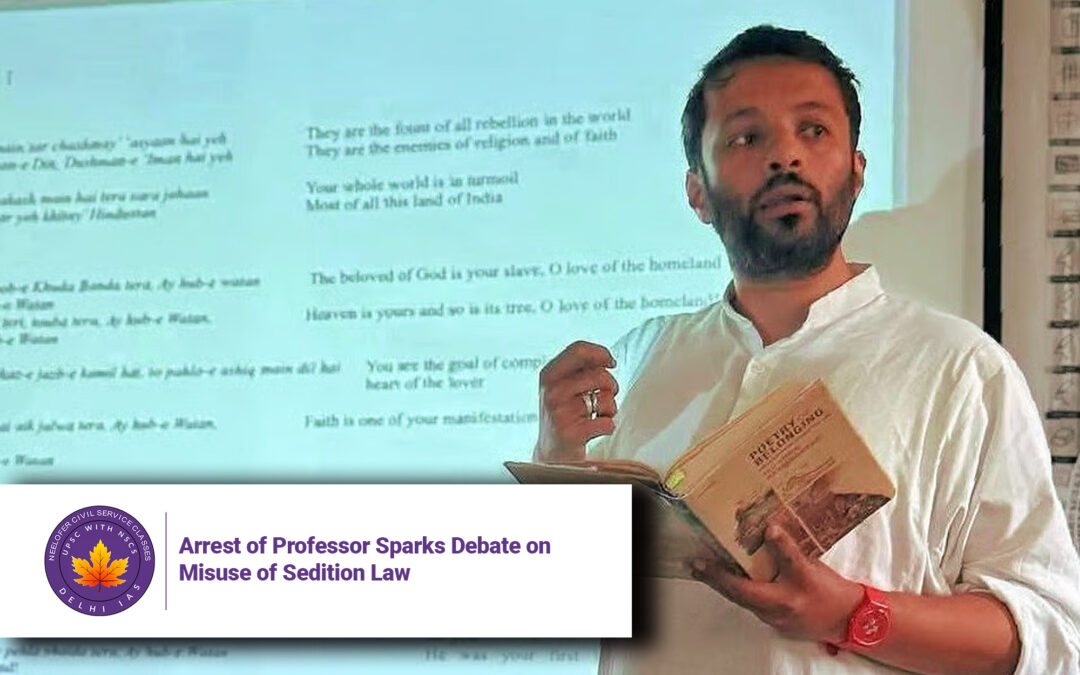
Arrest of Professor Sparks Debate on Misuse of Sedition Law
Why in News?
A professor of political science at Ashoka University, Alok Kumar Maunmuaid, was arrested by the Haryana Police over social media posts linked to Operation Sindoori, raising national concern over the misuse of sedition laws and the shrinking space for dissent in India. 
Introduction
The arrest of a university professor for expressing views on social media has once again ignited debate over the misapplication of sedition and anti-terror laws. The case brings into focus the erosion of academic freedom, the targeting of dissent, and growing intolerance for criticism of the state.
Details of the Incident
-
FIRs were registered against Professor Maunmuaid in Sonipat, Haryana, due to his posts about India’s Operation Sindoori.
-
His first post critiqued Pakistan’s military, suggesting it hides behind non-state actors while promoting terror in India.
-
The second post called the public’s reaction to war a “blind bloodlust”, questioning the jingoism and selective memory regarding India’s historical actions.
-
His posts were neither abusive nor violent but reflective and analytical in nature.
Despite this, the Haryana police acted on a complaint filed by the BJP’s IT cell head, who claimed the posts were anti-national and malicious.
Key Issues and Background
-
The professor was accused of undermining India’s sovereignty, though his posts merely discussed the realpolitik and consequences of war.
-
Sedition laws, often used to suppress criticism, were invoked.
-
Haryana State Women Commission Chairperson Renu Bhatia added political weight by condemning the posts.
-
Critics argue this is a symptom of shrinking tolerance in academia and public discourse.
The Core of the Concern
This is not an isolated event. In recent years, laws meant to protect national security have been increasingly used against students, journalists, activists, and now, educators. The case raises urgent concerns regarding:
-
Academic freedom
-
Freedom of speech
-
Misuse of Section 124A (sedition)
Judicial Stand
In its 2021 judgment, the Supreme Court of India warned against using sedition charges casually. The Court emphasized the need for evidence of incitement to violence, not mere criticism or disagreement.
Conclusion
The arrest of Professor Maunmuaid must serve as a wake-up call. In a democracy, intellectual freedom and critical discourse are essential. When educators are jailed for expressing thought-provoking views, it reflects poorly on democratic values. The need of the hour is to protect dissent, reform outdated laws, and uphold constitutional rights.
5 Questions and Answers
Q1: Who was arrested and why?
A: Professor Alok Kumar Maunmuaid of Ashoka University was arrested by the Haryana Police for his social media posts commenting on India’s Operation Sindoori.
Q2: What were the posts about?
A: One post discussed Pakistan’s use of non-state actors in war, and the other criticized the public’s blind call for war, encouraging critical thinking.
Q3: Who filed the complaint against the professor?
A: The complaint was reportedly filed by a BJP IT cell official, claiming that the professor’s posts were anti-national and malicious.
Q4: What laws were invoked in the FIR?
A: Charges related to sedition and spreading misinformation were included in the FIR.
Q5: What did the Supreme Court say about such arrests?
A: The Supreme Court has emphasized that sedition laws should only apply in cases of incitement to violence, not against peaceful dissent or criticism.

