
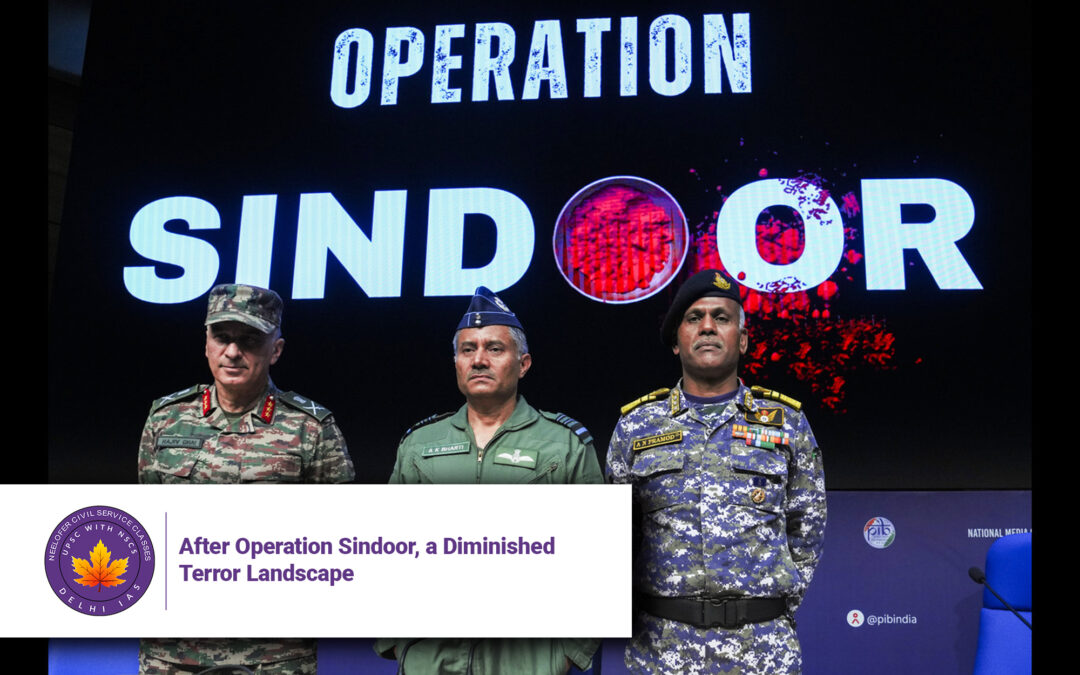
After Operation Sindoor, a Diminished Terror Landscape
Why in News?
India recently launched Operation Sindoor, a significant counter-terror operation targeting terror infrastructure in Pakistan-occupied Kashmir (PoK). The operation reflects a firm shift in India’s counter-terror strategy, moving from restraint to proactive military action. 
Introduction
Operation Sindoor marks a crucial turning point in India’s fight against cross-border terrorism. Triggered by recent attacks on Indian soldiers and civilians, the operation aimed to eliminate leadership and camps of terror outfits like Jaish-e-Mohammed (JeM) and Lashkar-e-Taiba (LeT). The action comes at a time when the global counter-terror narrative, especially led by the United States, is also shifting toward direct, deterrent-based strategies.
Key Issues
-
What is Operation Sindoor?
Operation Sindoor began on May 7, 2024, as a military response to attacks orchestrated from Pakistani soil. It involved targeted strikes on terror camps and leaders in PoK. This marks one of India’s largest counter-terror responses since the Balakot airstrikes in 2019. -
What triggered the operation?
The immediate provocation was a deadly terrorist attack in Reasi, Jammu and Kashmir, killing Indian soldiers and civilians. India attributed the attack to Pakistan-based proxies, including newer front groups operating under traditional terror organizations. -
Strategic shift in India’s counter-terror doctrine
Operation Sindoor demonstrates a decisive departure from past reactive approaches. Building upon precedents like the 2016 surgical strikes and the 2019 Balakot airstrike, India now employs a policy of pre-emptive and punitive action to deter future attacks. -
International response and context
The operation comes amid rising global consensus on holding state sponsors of terrorism accountable. The United States’ broader policy against terrorism has indirectly supported India’s hardline stance. At the same time, Pakistan has faced growing isolation over its failure to act against internationally designated terrorists on its soil. -
Pakistan’s response and the risks of escalation
So far, Pakistan has denied involvement and attempted to downplay the strikes. However, India has signaled that any future provocation will be met with even stronger responses. The risk of escalation remains but is being managed through calculated military and diplomatic planning.
Challenges and the Way Forward
-
While the operational success is clear, India faces the challenge of dismantling local terror networks that continue to function within Kashmir.
-
The ideological roots of terrorism need to be addressed through de-radicalization efforts and community-level interventions.
-
India must continue building international pressure on countries that provide safe havens for terrorists.
-
Stronger coordination between military, intelligence, and diplomatic institutions is essential to maintain the gains achieved through such operations.
Conclusion
Operation Sindoor marks a new chapter in India’s counter-terror policy. The message is clear: India will act decisively and independently against terrorism emanating from across the border. While terror threats have not vanished, their landscape has been significantly diminished. Sustaining this momentum will require vigilance, preparedness, and a clear national security vision.
Five Questions and Answers
Q1. What is Operation Sindoor?
A: Operation Sindoor is an Indian military operation launched in May 2024 targeting terrorist camps and leadership in Pakistan-occupied Kashmir, specifically linked to JeM and LeT.
Q2. What triggered Operation Sindoor?
A: A terrorist attack in Reasi, Jammu and Kashmir, which killed Indian soldiers and civilians, served as the immediate trigger for the operation.
Q3. How does Operation Sindoor differ from earlier strikes like Balakot?
A: Unlike earlier one-time retaliatory actions, Operation Sindoor signals a sustained and proactive approach against cross-border terrorism.
Q4. What has been the international response?
A: The operation aligns with the global post-9/11 narrative on terrorism. Countries like the United States indirectly support such counter-terror initiatives.
Q5. What challenges remain for India?
A: Major challenges include eliminating local terror modules, countering radical ideology, and maintaining diplomatic momentum against states that shelter terrorists.

