
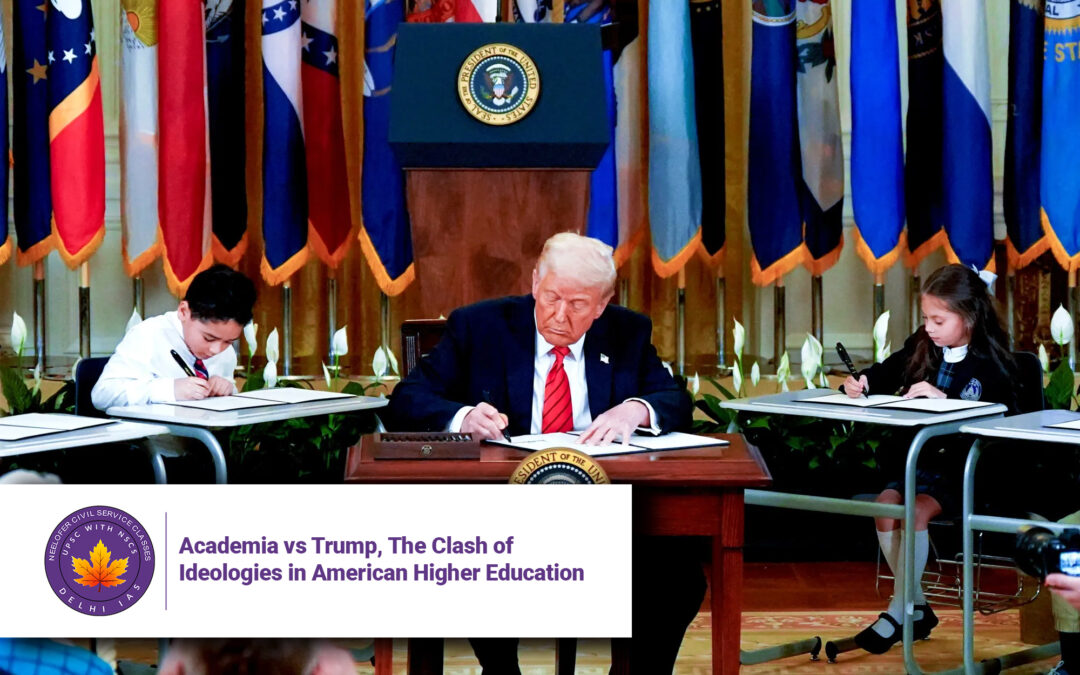
Academia vs Trump, The Clash of Ideologies in American Higher Education
Why in News?
The U.S. administration under Donald Trump is intensifying efforts to reshape the ideological foundation of American universities by leveraging financial grants and funding mechanisms, igniting a deep ideological battle between conservative politics and liberal academic traditions. 
Introduction
Tensions between U.S. universities and the Trump administration have escalated over ideological grounds. The administration is accused of attempting to realign university values by controlling public funding, with accusations of bias against liberal ideologies, diversity, and inclusion programs. This reflects a broader culture war over freedom of thought and academic independence.
Key Issues and Background
1. Trump’s Offensive Against Academia
-
Trump labeled American universities as “Marxist maniac” breeding grounds and accused them of liberal indoctrination.
-
Efforts have been made to cut federal funding, enforce ideological compliance, and challenge liberal academic narratives.
2. Allegations of Liberal Dominance
-
A Harvard University survey (2024) revealed that over 80% of faculty identify as “liberal” or “very liberal”.
-
Conservative students and groups argue they face discrimination and ideological exclusion on campuses.
3. Weaponization of Grants
-
Trump’s administration is linking research and education grants to ideological alignment.
-
With $60 billion public research funding at stake, universities face mounting pressure to conform to federal expectations.
The Core of the Concern
1. Polarization of Knowledge Spaces
-
Universities are being accused of promoting progressive values like diversity, equity, inclusion (DEI), and LGBTQ+ rights.
-
Conservatives argue these initiatives are being used to silence alternative viewpoints and create ideological echo chambers.
2. Historical Parallels and Chilling Effects
-
Analysts compare this situation to past eras such as:
-
McCarthyism (1950s): where hundreds of professors were investigated or fired for alleged communist links.
-
Post-9/11 Patriot Act: which expanded surveillance on academics critical of U.S. foreign policies.
-
Key Observations
1. Financial Dependency and Academic Freedom
-
Universities like Harvard may survive without federal funding, but smaller institutions risk collapse.
-
The recent $500 million funding cut to Columbia University exemplifies the growing financial-ideological conflict.
2. The Broader Cultural Battle
-
There is a trend of right-wing attempts to control or reshape intellectual culture by influencing university curriculum and faculty composition.
-
Conservative groups are pushing for self-conformity, warning students and institutions to avoid “liberal bias.”
Conclusion
The conflict between academia and the Trump administration represents a deep ideological struggle over the soul of American education. With upcoming elections, the outcome could redefine the relationship between the state and universities. The fight over academic freedom, political influence, and the definition of “truth” is far from over.
Q&A Section
Q1. What triggered the conflict between Trump and U.S. universities?
Ans: The Trump administration accused universities of liberal indoctrination and began cutting federal funding to push them towards conservative alignment.
Q2. How did universities respond to these moves?
Ans: While some elite institutions like Harvard resisted due to independent resources, many others struggled with sudden financial cuts, raising concerns over autonomy.
Q3. What are the ideological issues at the center of this conflict?
Ans: The debate centers around diversity, equity, LGBTQ+ inclusion, liberal academic dominance, and the suppression of conservative viewpoints.
Q4. How does this situation compare with U.S. history?
Ans: The situation is reminiscent of McCarthyism in the 1950s and the Patriot Act era, where academic freedom was curtailed in the name of national security and ideology.
Q5. What could be the long-term impact of this ideological conflict?
Ans: It could lead to a shift in how federal funds are allocated, increased polarization in education, and a possible rise in private philanthropy if public funding is politically weaponized.
