
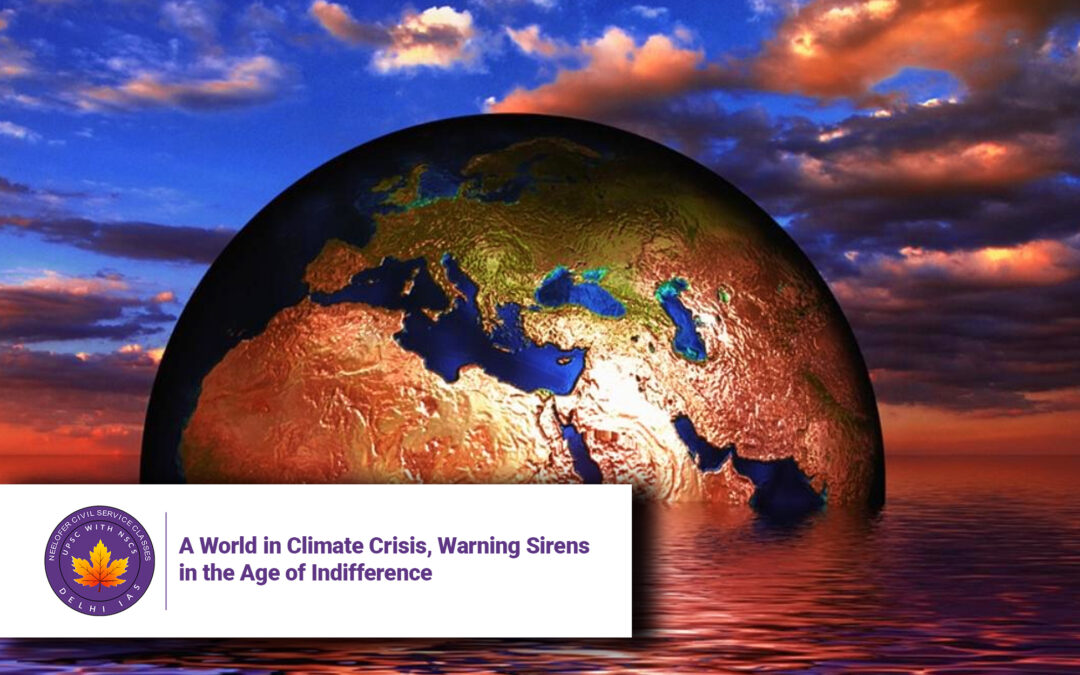
A World in Climate Crisis, Warning Sirens in the Age of Indifference
By BK Singh
Former Principal Chief Conservator of Forests, Karnataka Forest Department
Introduction: The Climate Alarm Grows Louder
On July 4, 2024, central Texas was hit by catastrophic flooding—the deadliest in a century—killing 88 people and leaving dozens unaccounted for. In just 45 minutes, the Guadalupe River rose nearly eight meters, following intense rainfall that delivered a month’s worth of water in mere hours. This catastrophic flood was part of a broader and increasingly undeniable pattern of climate-fueled disasters happening across the world. 
Meanwhile, in India, the northern states of Himachal Pradesh and Uttarakhand faced a series of cloudbursts, flash floods, and landslides, which claimed nearly a hundred lives in a week. In Odisha, workers died in a manganese mine in Keonjhar district, buried alive during landslides exacerbated by heavy rains.
From Europe’s searing heatwaves to India’s deadly monsoons, climate extremes are not isolated natural events—they are systemic consequences of a warming planet.
The Bigger Picture: A Planet in Crisis
The disasters in Texas and India highlight a terrifying truth: climate change is no longer a future concern—it is here, it is now, and it is deadly. Countries around the globe are witnessing simultaneous and intensifying climate catastrophes. In southern Europe, nations like Spain, Portugal, and France are dealing with record-breaking heatwaves, forcing vulnerable populations indoors, suspending municipal services, and straining public infrastructure.
Climate change is not just melting glaciers or drying rivers. It’s affecting real people, especially the poor and marginalized, who are least equipped to adapt. Heatwaves, flash floods, and erratic weather patterns are now routine headlines. Yet, in many parts of the world, including India, business continues as usual.
India’s Forest Rights and Environmental Violations
Ironically, even as natural disasters devastate Indian states, the government continues to undermine its own ecological safeguards. In Telangana, the Forum for Good Governance, Hyderabad and retired Indian Forest Service (IFS) officials have raised alarms over the massive clearance of forest lands under the Forest Rights Act (FRA) just ahead of the 2023 Assembly elections.
The Ministry of Tribal Affairs (MoTA) revealed that over 1.15 lakh hectares (equivalent to 2.84 lakh acres) of forest land were cleared for claims made under the FRA between 2018 and 2023. Alarmingly, this included areas not notified as forest land, raising red flags about fraudulent claims, political misuse, and hasty approvals.
Manipulated Claims and Political Exploitation
Evidence suggests that forest land claims were manipulated and approved in bulk, without proper verification. In 2018, Telangana alone registered a shocking 3.7 lakh acres under FRA, despite significant objections from District Level Committees (DLCs) and forest officers.
Satellite imagery, the gold standard for modern land verification, was deliberately ignored in favor of village elders’ oral evidence, a move that raises serious questions. Despite Supreme Court orders emphasizing conservation and procedural transparency, illegal encroachments continue under the guise of tribal rights and political appeasement.
Case Study: Kancha Gachibowli Tree Felling Scandal
A particularly egregious example of state-sponsored environmental damage occurred in Kancha Gachibowli, a 400-acre forested zone near Hyderabad Central University. The Telangana Government began tree cutting in April 2023 to clear land for real estate development, ignoring protests from students and activists.
The Supreme Court had to intervene to stop the destruction, calling out the state’s attempt to bypass the Tree Act, which protects tree cover and ecological balance. Over 1500 trees had already been felled when only 1399 were legally cleared, exposing the fraudulent misclassification of tree categories to expedite the project.
This case is a textbook example of how climate denialism at the state level undermines national and international climate commitments.
Government’s Double Standards on Environment
Telangana’s Chief Minister, speaking on February 12, 2023, boasted about the distribution of 1.5 lakh acres of forest land, yet 75,000 acres of that were earmarked for non-tribal landowners and political influencers, not genuine forest dwellers. Despite numerous warnings, forest officers were overridden, and claims were processed under questionable criteria.
The government’s intention to offset this environmental degradation with “compensatory afforestation” rings hollow. Replanting trees is not an effective replacement for old-growth forests that have developed over centuries, supporting rich biodiversity and complex ecosystems.
India’s Record of Forest Dilution and Greenwashing
Recent years have seen a dramatic shift in India’s forest policy direction—from conservation to commercialization. Key examples include:
-
Large-scale afforestation statistics being used to greenwash tree loss due to infrastructure.
-
Expansion of mining projects in forest zones without proper environmental impact assessments (EIAs).
-
Displacement of indigenous communities in favor of industrial and commercial interests.
While India is a signatory to the Paris Climate Agreement, its on-ground actions reflect a contradictory approach. India’s national tree cover is under serious threat, even as it continues to pledge climate action on global platforms.
Conclusion: A Climate Crisis We Can No Longer Ignore
As deadly floods submerge parts of Texas and India mourns lives lost in landslides and flash floods, the world is at a critical juncture. The interconnectedness of climate disasters is a warning we can no longer ignore.
Policymakers must treat these events as climate emergencies, not isolated natural mishaps. From urban planning to forest governance, from energy use to disaster preparedness, every sector must undergo green reform.
Governments must stop using forests as a political commodity. Protecting our natural heritage is not optional, but a survival imperative in the age of climate crisis.
Q&A Section
Q1: What triggered the recent flooding in Texas and how severe was it?
A: The flooding in central Texas on July 4, 2024, was triggered by intense rainfall delivering a month’s worth of water in less than an hour. The Guadalupe River rose eight meters in 45 minutes, leading to 88 deaths and massive infrastructure damage. It is considered the deadliest flood in over a century.
Q2: What are the main causes of recent climate disasters in India?
A: Cloudbursts, flash floods, and landslides driven by erratic monsoon patterns and warming atmospheric conditions have caused tragedies in Himachal Pradesh, Uttarakhand, Odisha, and Maharashtra. These are worsened by poor urban planning, deforestation, and lack of disaster preparedness.
Q3: How is the Forest Rights Act (FRA) being misused in India?
A: The Forest Rights Act is being manipulated to distribute forest land illegally. In Telangana, for example, claims over 3.7 lakh acres were approved, many without proper verification. These actions often serve political interests rather than genuine tribal rights.
Q4: What is the Kancha Gachibowli case and why is it significant?
A: The Kancha Gachibowli case involved the illegal felling of over 1500 trees in a forested area near Hyderabad Central University, to clear land for real estate development. The Supreme Court had to intervene after the Telangana government ignored conservation laws and public protests.
Q5: What steps must be taken to address the climate crisis effectively?
A: Solutions must include:
-
Enforcing strict environmental regulations.
-
Preserving existing forest cover, not just planting new trees.
-
Stopping political misuse of forest land.
-
Promoting climate-resilient infrastructure.
-
Ensuring inclusive governance that respects tribal and local community rights.

