
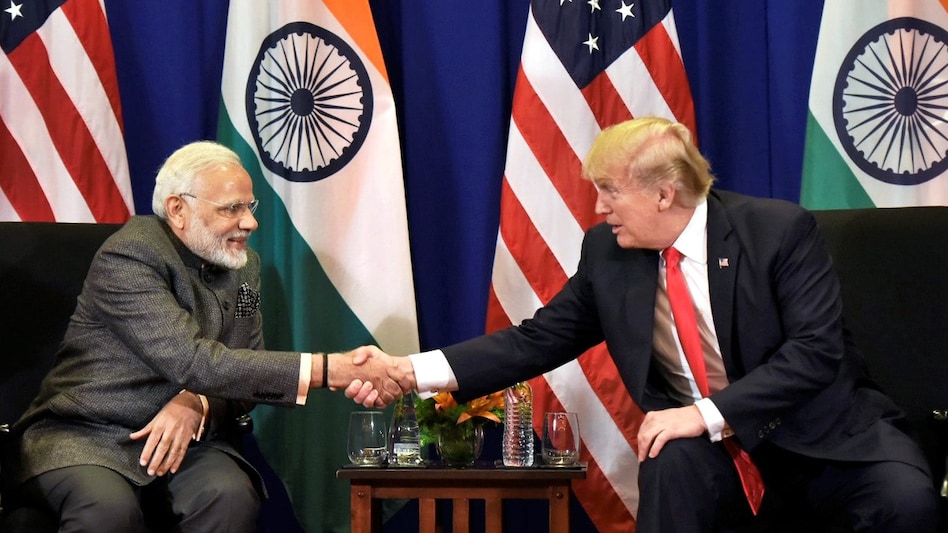
A Trade Deal Between India and the US: A Strong Possibility
Why in News?
The evolving strategic partnership between India and the United States has opened new avenues for economic cooperation. As both nations seek to counter China’s influence in the Asia-Pacific region, a potential India-US trade deal appears increasingly likely, laying the groundwork for deeper bilateral ties.
Introduction
India and the United States are redefining their partnership, shaped by geopolitical compulsions and mutual economic interests. While former US President Donald Trump pursued closer ties with leaders like Xi Jinping, Vladimir Putin, and Kim Jong Un, his administration recognized the importance of India in countering China’s growing power. This has made India a crucial ally for the United States in Asia-Pacific affairs.
Key Features
US Demands and India’s Position
US Commerce Secretary Howard Lutnick emphasized the need for India to open its agricultural sector, arguing that this should not be excluded from trade negotiations. Lutnick advocates a comprehensive trade pact over product-specific agreements, believing harmonized tariff policies would benefit both countries.
India’s Commerce Minister Piyush Goyal recently concluded productive discussions in Washington with US officials, including Trade Representative Jamieson Greer and Secretary Lutnick. These talks mark progress towards a bilateral trade deal. During Prime Minister Narendra Modi’s visit to the US, both nations pledged to double bilateral trade to $500 billion by 2030, aiming to finalize the first phase of the trade deal by 2025.
The Indian Diaspora’s Growing Influence
The Indian diaspora in the US has emerged as a vital economic and political force. Indian Americans are one of the most prosperous and educated communities in the US, significantly influencing bilateral relations.
A substantial portion of the Indian diaspora supported Trump in the elections, factoring into the political landscape. As of 2021, Indian Americans’ average household income exceeded that of other ethnic groups. Between 1995 and 2005, Indian immigrants founded more technology and engineering companies than those from China, Taiwan, and Japan combined.
The Indian-American population rose from 2.3 million in 2005 to around 4.4 million, making them the second-largest immigrant group. Their increasing economic clout has strengthened India-US ties, particularly in trade and technology dialogue.
Specific Impacts or Effects
Indo-Pacific Security Dynamics
In the Indo-Pacific, the US relies on allies such as Japan, South Korea, and Australia to counterbalance China. Trump’s support for security alliances like AUKUS and Quad is expected to enhance collaboration with India and other regional powers. However, if the US withdraws from its commitments, China could exploit the vacuum through its Belt and Road Initiative (BRI), offering economic and military incentives across Asia, Africa, and Latin America.
Trump’s Alignment with Russia
Trump’s foreign policy leaned toward isolationism and unconventional alliances. His overtures to Russia, including efforts to sideline NATO and reduce support for Ukraine, strained transatlantic relations. While Europe may increase defense spending, the absence of robust American support could weaken NATO’s deterrent capabilities. Trump’s realignment with Moscow may reshape global alliances, indirectly benefiting China and altering the strategic equation for India.
Challenges and the Way Forward
Challenges
- US insistence on India opening its agricultural sector.
- Managing diplomatic complexities arising from shifting US-Russia-China relations.
- Maintaining India’s strategic autonomy amidst global realignments.
Steps Forward
- India must balance its geopolitical interests, ensuring trade agreements serve its national priorities.
- Expanding ties with the US while safeguarding relationships with Russia and China.
- Strengthening regional partnerships and participating in multilateral forums like Quad and AUKUS.
Conclusion
A trade deal between India and the United States appears increasingly viable, driven by economic and strategic interests. While Trump’s policies posed unique challenges, the US remains a key partner for India in balancing global power shifts. India’s ability to navigate these complex dynamics will determine its future geopolitical and economic standing. With focused efforts, India can leverage its partnerships to secure favorable trade terms while preserving its strategic autonomy.
Questions and Answers
1. Why is the India-US trade deal significant?
It strengthens economic ties and counters China’s growing influence in the Asia-Pacific region.
2. What are the US demands in the trade deal negotiations?
Opening India’s agricultural market and aligning tariff policies with the US.
3. Who are key US officials involved in trade talks?
US Commerce Secretary Howard Lutnick and Trade Representative Jamieson Greer.
4. What trade target has India and the US set?
Doubling bilateral trade to $500 billion by 2030.
5. How does the Indian diaspora influence US-India relations?
Their economic and political clout shapes trade and foreign policy decisions.
6. How does Indo-Pacific security impact the trade deal?
US alliances and strategies in the region influence trade dynamics with India.
7. What role does China play in these negotiations?
China’s assertiveness drives India and the US closer in trade and security cooperation.
8. How does Trump’s Russia policy affect India?
It alters global alliances, creating opportunities and risks for India.
9. What is India’s challenge in this evolving scenario?
Maintaining strategic autonomy while leveraging relationships with the US, Russia, and China.
10. What is the future outlook for India-US trade relations?
Promising, with negotiations advancing and mutual interests aligned for a long-term partnership.

