
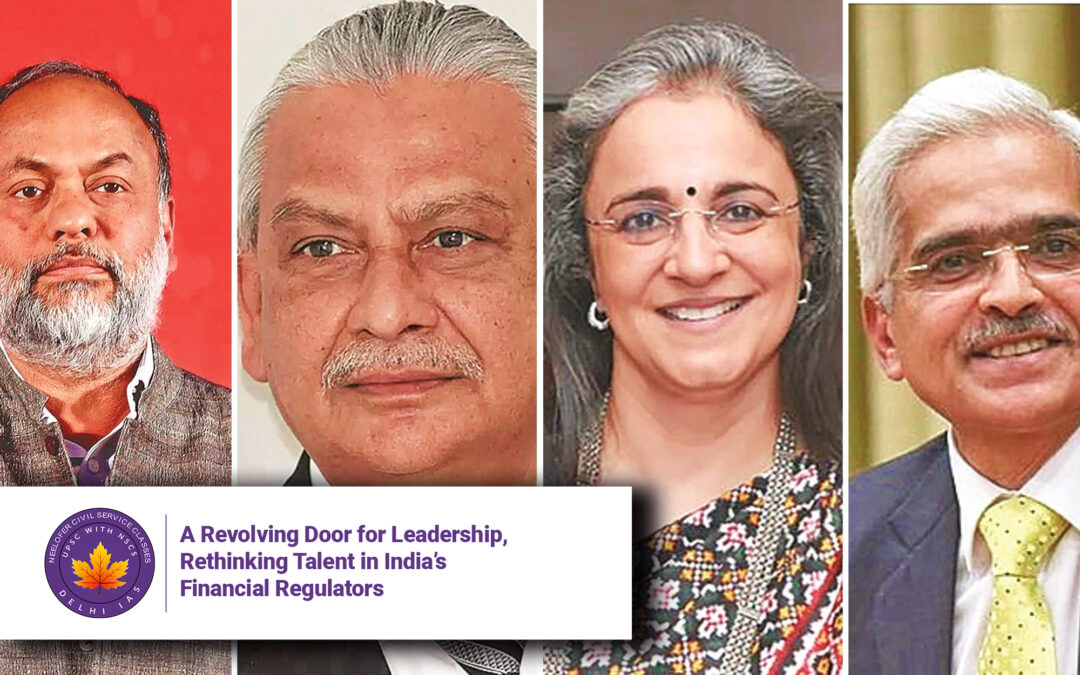
A Revolving Door for Leadership, Rethinking Talent in India’s Financial Regulators
Why in News?
The recent debate over leadership appointments in India’s financial regulatory institutions—the Reserve Bank of India (RBI), the Securities and Exchange Board of India (SEBI), and the Insurance Regulatory and Development Authority of India (IRDAI)—has once again highlighted the pressing question of diversity in leadership talent. Historically, the top leadership positions in these bodies have been dominated by officers from the Indian Administrative Service (IAS). While these officials bring vast knowledge of governance and bureaucracy, questions are being raised about whether this system excludes other highly qualified professionals from academia, industry, and research who could enrich regulatory leadership.
Introduction
Financial regulators hold the crucial responsibility of ensuring the stability, transparency, and fairness of India’s financial ecosystem. They supervise banks, securities markets, and the insurance sector, directly affecting millions of citizens and businesses. As India’s economy becomes more complex and globally interconnected, the skill set required for leadership in these regulators has also evolved.
Traditionally, India has relied heavily on IAS officers to head these regulatory agencies. The logic behind this choice has been that civil servants possess strong administrative capabilities, familiarity with government processes, and the ability to coordinate with political structures. However, critics argue that this tradition has become an institutional weakness, leading to a narrow leadership pipeline that excludes specialists from academia, law, industry, and finance.
The call for reform is not about rejecting the role of civil servants but about broadening the talent pool and creating a more inclusive model of leadership that can meet the challenges of modern finance.
Historical Context: IAS Dominance in Financial Regulation
A look at the history of leadership in financial regulators shows a recurring pattern. Almost all the chairpersons of RBI, SEBI, and IRDAI have been drawn from the IAS. Eminent names such as C. Rangarajan, Bimal Jalan, Y.V. Reddy, and D. Subbarao all hailed from civil services backgrounds. Similarly, SEBI has been headed by civil servants like G.V. Ramakrishna, C.B. Bhave, and U.K. Sinha.
This pattern reveals an institutional bias towards administrative officers, sidelining equally capable professionals from other fields. The reasoning often presented is that civil servants bring continuity, broad exposure to policymaking, and deep knowledge of bureaucratic functioning. But this approach overlooks the equally critical need for domain expertise, particularly in finance, law, risk management, and technology—areas central to modern regulation.
Key Issues and Institutional Concerns
1. Over-Reliance on Civil Services
The consistent preference for IAS officers is not due to a lack of qualified candidates from other sectors. Instead, it stems from a systemic design that makes it difficult for non-IAS professionals to break into top leadership positions. This creates an impression that regulation is solely an administrative task rather than a multidisciplinary challenge.
2. Exclusion of Specialists
Modern financial systems require knowledge of complex financial instruments, risk management, technological innovation, and global financial trends. Specialists from academia, law, and industry often possess these skills in abundance. By excluding them, India’s regulators risk falling behind in innovation and effective oversight.
3. Institutional Weaknesses
The reliance on IAS officers has created a cycle in which the system is unable to develop processes that allow non-bureaucrats to thrive. Institutions depend heavily on unwritten conventions, insider knowledge, and government procedures that are unfamiliar to outsiders. This discourages professionals from other fields from even aspiring to such roles.
4. Lack of Transparent Processes
Many regulatory appointments are made without transparent and competitive procedures. Unlike judicial appointments or academic leadership selections, which often involve clear criteria and search committees, regulator leadership remains influenced by tradition and closed-door decisions.
5. Global Comparisons
Globally, financial regulators are often led by experts from diverse backgrounds. For instance, in the United States and Europe, regulators include economists, lawyers, financial market experts, and researchers alongside administrators. This diversity strengthens their ability to respond to crises, regulate complex instruments, and engage with global institutions. India’s insular approach stands out as outdated in this context.
Challenges in Reforming the System
-
Resistance to Change: Bureaucratic systems are naturally resistant to reform. Any move to dilute IAS dominance is perceived as a threat to established power structures.
-
Political Considerations: Leadership appointments in regulatory institutions are deeply political. Governments often prefer civil servants because of their loyalty, accountability, and experience in working with political masters.
-
Institutional Readiness: Even if non-IAS professionals are appointed, institutions themselves may not be designed to support their functioning. Without structural reforms, outsiders could struggle to succeed.
-
Need for a Balanced Model: Critics warn that moving entirely away from IAS officers could also be problematic. Civil servants bring valuable experience in governance and public accountability, which specialists may lack. The real challenge is finding a balanced, hybrid model.
The Way Forward: Building a Multi-Faceted Leadership Model
-
Diversified Appointments
A new model must encourage the inclusion of professionals from finance, law, academia, and industry into leadership positions. These experts should not just be token appointments but empowered to lead, innovate, and implement. -
Transparent and Competitive Selection
Appointments should be made through transparent, competitive processes with search committees that evaluate candidates from multiple backgrounds. This will ensure meritocracy and discourage favoritism. -
Institutional Support for Non-IAS Leaders
Regulators must evolve systems and processes that enable professionals unfamiliar with government machinery to succeed. Clear guidelines, codified rules, and structured orientation programs can help bridge this gap. -
Learning from the FSLRC
The Financial Sector Legislative Reforms Commission (FSLRC), chaired by Justice B.N. Srikrishna, had earlier recommended a shift towards rule-based, formalised governance in regulators. Its proposals for transparent processes, accountability mechanisms, and multi-stakeholder leadership remain highly relevant today. -
Balanced Leadership Mix
The solution is not to eliminate IAS officers but to create mixed leadership teams where administrators, economists, researchers, and industry experts work together. This collective expertise would bring both governance skills and domain knowledge to regulation.
Conclusion
India’s financial sector is at a critical juncture. With rapid digitisation, globalisation, and the emergence of complex financial instruments, the old model of regulation based primarily on bureaucratic leadership is no longer sufficient. While civil servants have served the nation with distinction, the future demands a broader, more inclusive model of leadership.
By opening the doors of regulatory institutions to experts from diverse fields, India can build resilient, innovative, and forward-looking regulators capable of safeguarding the financial system. The challenge lies not in replacing one group with another but in creating structures where multiple streams of expertise converge to serve the public interest.
Q&A Section
Q1. Why is there criticism of IAS dominance in financial regulatory leadership?
A1. The criticism arises because IAS officers, though skilled in governance, often lack deep domain expertise in finance, law, or technology. This narrows the leadership talent pool and sidelines professionals from other fields who could enhance regulation.
Q2. What risks does the current system pose for India’s financial sector?
A2. Over-reliance on civil servants risks regulatory stagnation, weaker responses to financial innovations, and poor adaptation to global financial changes. It may also undermine public trust if leadership is seen as opaque and insular.
Q3. How do other countries appoint regulatory leaders?
A3. In the US and Europe, leadership in financial regulators is drawn from diverse pools, including economists, lawyers, market experts, and academics. This diversity ensures stronger decision-making and resilience in times of crisis.
Q4. What reforms have been suggested to improve the system?
A4. Suggested reforms include transparent and competitive selection processes, inclusion of professionals from varied sectors, institutional reforms to support outsiders, and adopting the rule-based frameworks proposed by the FSLRC.
Q5. What is the ideal way forward for India’s financial regulators?
A5. The ideal path is to create a balanced leadership model that combines the governance expertise of civil servants with the domain knowledge of industry, academia, and research professionals. This hybrid approach would provide both accountability and innovation.

