
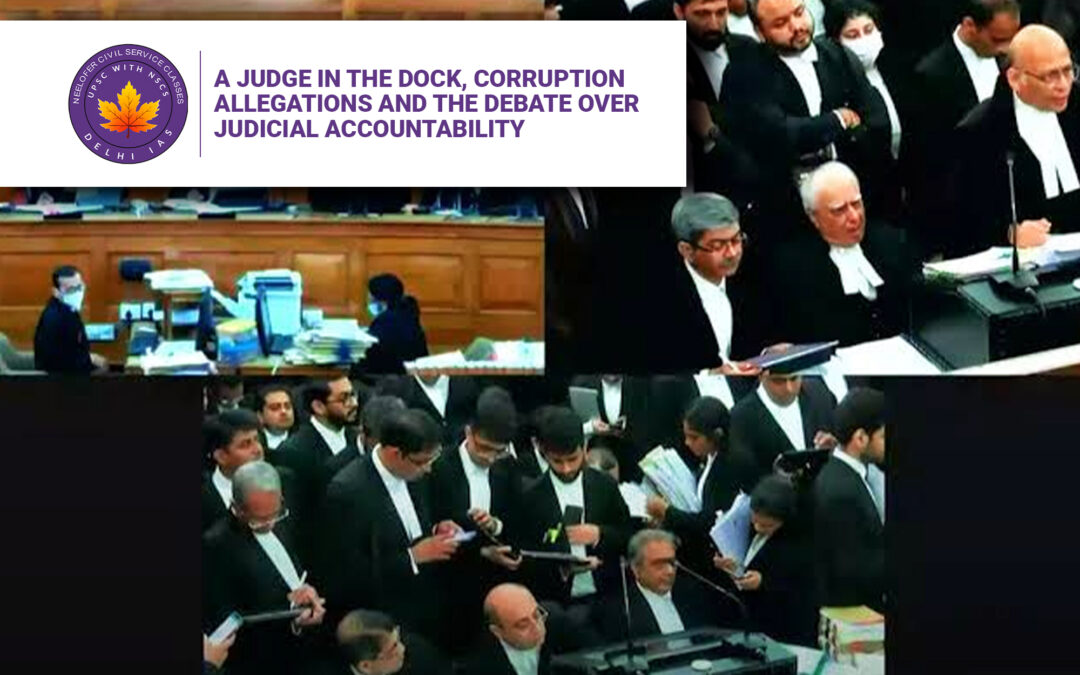
A Judge in the Dock, Corruption Allegations and the Debate Over Judicial Accountability
Why in News?
A three-member bench of the Supreme Court of India has initiated an in-house inquiry into corruption allegations against Justice Yashwant Varma, following the discovery of cash in official premises. The issue has reignited discussions on judicial accountability, the independence of the judiciary, and the limits of executive intervention.
Introduction
Allegations of corruption against members of the judiciary strike at the very heart of judicial credibility and constitutional democracy. While the inquiry into Justice Varma may be welcomed as a step toward transparency, it also opens complex questions on the balance of powers between the executive, judiciary, and collegium system.
Key Issues and Developments
-
The Allegations and In-House Probe
-
Justice Yashwant Varma is accused of corruption, with the alleged discovery of cash in chambers sparking public attention.
-
The Supreme Court Collegium and Chief Justice of India D.Y. Chandrachud have released a detailed note about the inquiry, marking a rare public disclosure.
-
Justices Sheel Nagu (Punjab & Haryana HC), S.S. Sandhawalia (Himachal Pradesh HC), and Anu Sivaraman (Karnataka HC) are conducting the investigation.
-
-
Reactions from Judiciary and Government
-
Vice President Jagdeep Dhankhar and Rajya Sabha Chairman hailed the decision to make the inquiry public.
-
Dhankhar termed it a move in the “right direction,” with implications for judicial transparency and public trust.
-
-
Concerns over Judicial Independence
-
Legal experts and commentators warn that publicizing allegations before proof risks creating a “conspiracy narrative” or presumption of guilt, undermining the judiciary’s credibility.
-
The judiciary, being adversarial, operates under the presumption of innocence, which must be preserved.
-
-
Constitutional Debate: Collegium vs. NJAC
-
The article revisits the struck-down NJAC (National Judicial Appointments Commission).
-
Critics of the Collegium system argue that it lacks transparency and accountability, while others warn against giving executive control over judicial appointments.
-
The 2003 decision in Harish Uppal emphasized that Bar Councils can call strikes and boycott judges, pointing to broader tensions between the judiciary and the legal community.
-
-
Public Perception and Judicial Reform
-
The current issue reflects a public crisis of confidence in judicial integrity.
-
Judicial independence must be protected without becoming a shield for non-transparency or lack of accountability.
-
5 Key Takeaways
-
The Supreme Court is publicly addressing a corruption allegation against a sitting judge—an uncommon but significant act.
-
The move may promote transparency but must avoid prejudicing fair trial and natural justice.
-
The Collegium system continues to face challenges and calls for reform due to its opaque procedures.
-
The struck-down NJAC still remains a point of debate in ensuring both judicial independence and accountability.
-
The broader legal community is divided—some demand stronger scrutiny, others warn against executive overreach.
Challenges and the Way Forward
-
Due Process Protection: Allegations must be handled without presumption of guilt, safeguarding the judge’s rights.
-
Transparency vs. Confidentiality: While public disclosure builds trust, it must be balanced with procedural fairness.
-
Institutional Reform: Collegium reforms or a revised NJAC-type system may need to be explored afresh.
-
Bar Council’s Role: The Bar must push for integrity without turning into a pressure group that undermines institutions.
-
Media and Political Sensitivity: Public discourse must avoid sensationalism that could compromise the judiciary’s sanctity.
Conclusion
The inquiry into Justice Varma has brought the judiciary under the scanner in an unprecedented way. While this is a moment of reckoning for judicial integrity, it also emphasizes the delicate balance between openness and independence. India’s democratic health depends not just on the efficiency of its courts, but also on the trust they inspire. As the system evolves, it must embrace both accountability and constitutional prudence.
Q&A Section
Q1. Who is Justice Yashwant Varma and why is he in the news?
Justice Varma is a sitting judge accused of corruption. An in-house inquiry has been initiated by the Supreme Court after cash was allegedly found in his official premises.
Q2. What is the role of the Supreme Court Collegium in this case?
The Collegium, led by the Chief Justice of India, took the unusual step of publicizing the inquiry, which is typically handled discreetly.
Q3. What are the concerns raised about judicial independence?
There are fears that premature disclosure may undermine the presumption of innocence and create a media trial, affecting judicial integrity.
Q4. What was the NJAC and why is it relevant now?
The NJAC aimed to make judicial appointments more transparent but was struck down for violating judicial independence. Its revival or reform remains a contentious topic.
Q5. What does this incident suggest about India’s judiciary?
It signals a growing need for judicial reform, emphasizing accountability, transparency, and institutional trust without compromising independence.

