
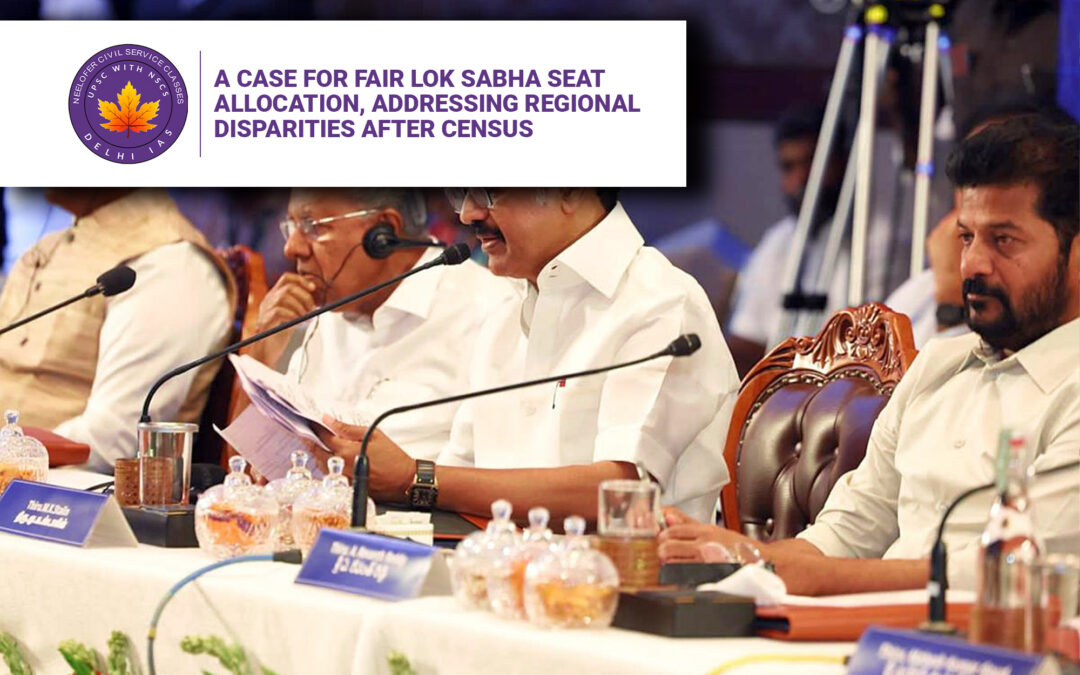
A Case for Fair Lok Sabha Seat Allocation, Addressing Regional Disparities After Census
Why in News?
The upcoming readjustment of Lok Sabha seats based on the new Census has sparked a national debate, especially among southern States like Tamil Nadu and Kerala. Leaders are raising serious concerns about the possible political marginalisation of States that have successfully controlled population growth. The debate revolves around whether seat allocation should solely reflect population increase or account for States’ policy successes in population control.

Introduction
Delimitation refers to redrawing the boundaries of electoral constituencies, usually conducted by the Delimitation Commission after every Census. With the last seat allocation based on the 1971 Census, massive demographic changes over five decades have created stark population disparities across States, raising concerns over the equity and fairness of future parliamentary representation.
Key Issues and Background
1. What is Delimitation?
-
It is the rearrangement or redrawing of constituencies based on updated population data from the Census.
-
The Delimitation Commission is activated only after a Census, under Article 82 of the Constitution.
-
The total number of Lok Sabha seats is fixed at 543, based on the 1971 population of 54.8 crore.
2. The Population Shift Since 1971
-
India’s population rose to around 141 crore in 2023.
-
Northern States like Uttar Pradesh, Bihar, and Madhya Pradesh saw significant growth.
-
UP’s population grew from 8.38 crore (1971) to 24.1 crore.
-
-
Southern States, especially Tamil Nadu and Kerala, managed to control population growth.
-
Kerala’s population grew from 2.13 crore (1971) to 3.76 crore, one of the lowest rates in India.
-
3. Political Implications
-
If Lok Sabha seats are increased solely based on population:
-
UP could gain 23 seats (from 80 to 103).
-
Tamil Nadu may gain only one seat.
-
Kerala may not gain any, or even lose representation.
-
The Core of the Concern
1. Penalising Progressive States
-
Southern States are being “punished” for successfully implementing population control.
-
States with high fertility and poor family planning, mainly in the north, may get more seats and hence more parliamentary power.
2. Union of States and Constitutional Principles
-
Article 1 of the Constitution calls India a Union of States, implying that unity and equity should guide any seat readjustment.
-
Using population as the only yardstick ignores efforts of States that promoted education, health, and women’s empowerment to control population.
Key Observations
-
Tamil Nadu Chief Minister M.K. Stalin has articulated strong opposition, arguing for a rational formula.
-
The central argument is: States that registered the lowest population increase should become the template for seat allocation.
-
Article 81 and 82 allow for flexibility and equity-based formulas.
Conclusion
The proposed readjustment of seats post-Census is not just a technical exercise but a deeply political and ethical challenge. It must balance population growth with good governance outcomes. A fair, transparent, and equity-oriented formula must be adopted to ensure that States that managed demographic control are not sidelined in the national political framework.
Q&A Section
Q1. What is the purpose of delimitation?
Delimitation is the act of redrawing Lok Sabha constituency boundaries to reflect population changes after a Census.
Q2. Why is there a concern about the upcoming delimitation exercise?
Because States like UP may gain more seats due to higher population growth, while States like Kerala and Tamil Nadu may lose out, despite better population control.
Q3. What is the population of India as per the 1971 and 2023 Census estimates?
In 1971: 54.8 crore; in 2023: around 141 crore.
Q4. What does Article 1 of the Constitution emphasize in this context?
That India is a Union of States, and any rearrangement of representation must be based on equity, not just numbers.
Q5. What is the proposed fair solution by southern leaders?
Use the State with the lowest population growth (like Kerala) as the template for seat allocation, ensuring a balanced and just representation.
