
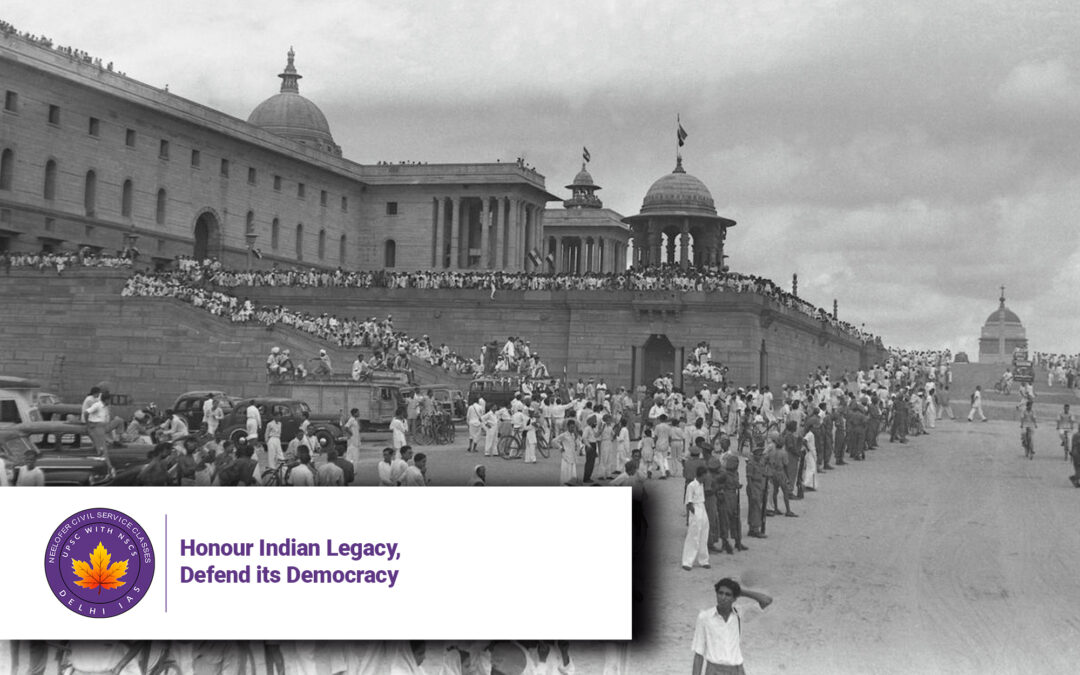
Honour Indian Legacy, Defend its Democracy
Why in News
On the occasion of India’s 79th Independence Day, Pinarayi Vijayan, the Chief Minister of Kerala, published a thought-provoking article reflecting on the nation’s democratic journey. His piece emphasized the importance of safeguarding India’s constitutional values, strengthening federalism, resisting manipulative forms of nationalism, and defending democracy from regressive and authoritarian tendencies. Given the current socio-political context, his views underline crucial issues related to governance, freedom, and the role of institutions in a modern republic.
Introduction
Independence Day in India is not only a celebration of freedom from colonial rule but also an annual reminder of the long journey undertaken to build a democratic, secular, and inclusive republic. August 15 holds immense historical significance, symbolizing the collective sacrifices of millions who envisioned a nation based on equality, justice, and fraternity.
However, as Chief Minister Vijayan pointed out, the meaning of independence extends far beyond political sovereignty; it demands continuous protection of constitutional values and people’s rights. His analysis focused on:
-
The manipulation of nationalism.
-
The concentration of wealth and policymaking in the hands of a few.
-
The misuse of federal institutions against State governments.
-
The need for strong federalism, cooperative governance, and safeguarding of democratic practices.
Thus, the debate on Independence Day 2025 has moved beyond symbolic celebrations toward serious introspection on India’s democracy and its resilience.
Key Issues and Background
1. Essence of Nationalism and its Manipulations
The foundation of India’s freedom struggle was rooted in inclusive nationalism, which sought to empower the masses, guarantee equality, and fight for a prosperous future. However, Vijayan argues that today’s nationalism is increasingly manipulated by forces that equate patriotism with majoritarian identity politics.
-
Dissent is often branded as “anti-national,” which shrinks democratic space.
-
Minorities face targeted hostility, exclusion, and violence.
-
Divisive politics deepen polarization and weaken the unity envisioned by the nationalist movement.
This shift from inclusive nationalism to a narrow, exclusionary narrative undermines the constitutional spirit of equality and fraternity.
2. Concentration of Wealth and Inequality
Economic justice was one of the promises of independence, yet the reality remains different.
-
Studies reveal that a small section of society has accumulated disproportionate wealth.
-
Farmers, workers, and the poor struggle with unemployment, rising prices, malnutrition, and inadequate state support.
-
As Mahatma Gandhi called farmers the “soul of the nation,” their neglect symbolizes a deviation from the nationalist dream.
A development model favoring a few corporate elites has widened inequality, leaving millions marginalized.
3. Constitutional Framework and Federalism
The Indian Constitution envisions a strong federal structure where powers are shared between the Union and the States. However, Vijayan highlights growing centralization:
-
State legislatures, elected by the people, often face restrictions.
-
Governors, instead of being neutral constitutional heads, are increasingly accused of interfering in day-to-day administration, stalling Bills, and weakening State governments.
-
Central investigative agencies like the CBI, ED, and Income Tax Department are alleged to be used selectively against opposition parties.
This undermines the principle of cooperative federalism and weakens democratic accountability.
4. Manipulation of Governor’s Powers
The Governor’s office, meant to be a constitutional authority, has become controversial in many States:
-
Governors are accused of delaying or blocking Bills passed by elected assemblies.
-
In Kerala, universities have suffered due to repeated interventions in appointments and administration.
-
Across States, such actions have paralyzed academic institutions, slowed governance, and created uncertainty.
This trend has made the role of Governors a flashpoint in Centre-State relations, raising concerns about misuse of constitutional provisions.
Specific Impacts or Effects
-
Democratic Backsliding
-
Branding dissent as anti-national discourages citizens from questioning authority.
-
Suppression of protests and curtailment of free speech erodes democratic values.
-
-
Rise of Authoritarianism
-
Centralization of power and weakening of State autonomy foster a governance model less accountable to local needs.
-
-
Economic Inequality
-
Wealth concentration among elites and neglect of rural poor deepen economic divides, undermining social harmony.
-
-
Institutional Paralysis
-
Universities, legislatures, and policy-making bodies suffer delays, reducing efficiency and credibility.
-
-
Erosion of Federal Spirit
-
The Union’s overreach into State matters weakens the constitutional balance of power and disrupts cooperative governance.
-
Challenges and the Way Forward
-
Restoring Inclusive Nationalism
-
Revive the spirit of the freedom struggle by promoting unity, fraternity, and equal citizenship for all communities.
-
-
Strengthening Federalism
-
Ensure Governors act as neutral heads, not political agents.
-
Strengthen institutional mechanisms to protect States’ autonomy.
-
-
Addressing Inequality
-
Prioritize welfare of farmers, workers, and marginalized groups.
-
Adopt equitable economic policies that distribute resources fairly.
-
-
Safeguarding Democracy
-
Encourage free expression, dissent, and public debate.
-
Prevent misuse of investigative agencies for political purposes.
-
-
Institutional Reforms
-
Streamline Centre-State relations.
-
Protect educational and policy-making bodies from undue interference.
-
Conclusion
Independence is not merely about celebrating the past but about continuously defending and nurturing the ideals of democracy, secularism, and social justice. As Pinarayi Vijayan emphasizes, India’s survival as a vibrant constitutional republic depends on strengthening federalism, ensuring equality, and resisting authoritarian manipulation.
The struggle for freedom was never just about expelling colonial rulers but about guaranteeing that every citizen lives with dignity, justice, and liberty. Today, the challenge lies in ensuring that governance remains people-centric, inclusive, and democratic.
India’s true independence will be safeguarded only when democracy thrives, diversity is respected, and constitutional principles remain supreme. The nation must, therefore, guard against regressive forces and honor the legacy of its founding vision.
5 Questions & Answers
Q1. What was the central theme of Pinarayi Vijayan’s Independence Day article?
A1. The article highlighted the need to protect India’s democratic values, resist manipulative nationalism, strengthen federalism, and ensure that constitutional principles guide governance.
Q2. How does Vijayan describe the misuse of nationalism in India?
A2. He criticizes the branding of dissenters as “anti-national,” the creation of majoritarian identity politics, and the exclusion of minorities, which undermine India’s inclusive nationalist legacy.
Q3. Why is the role of Governors controversial in many States?
A3. Governors are accused of overstepping their constitutional role by delaying or blocking State legislation, interfering in administration, and undermining State autonomy, thereby weakening cooperative federalism.
Q4. What challenges to democracy does the article highlight?
A4. Key challenges include economic inequality, centralization of power, misuse of agencies, suppression of dissent, and institutional paralysis in education and governance.
Q5. What is the suggested way forward for India’s democracy?
A5. Strengthening inclusive nationalism, ensuring true federalism, reducing inequality, protecting democratic freedoms, and implementing institutional reforms are essential to safeguard India’s constitutional republic.

