
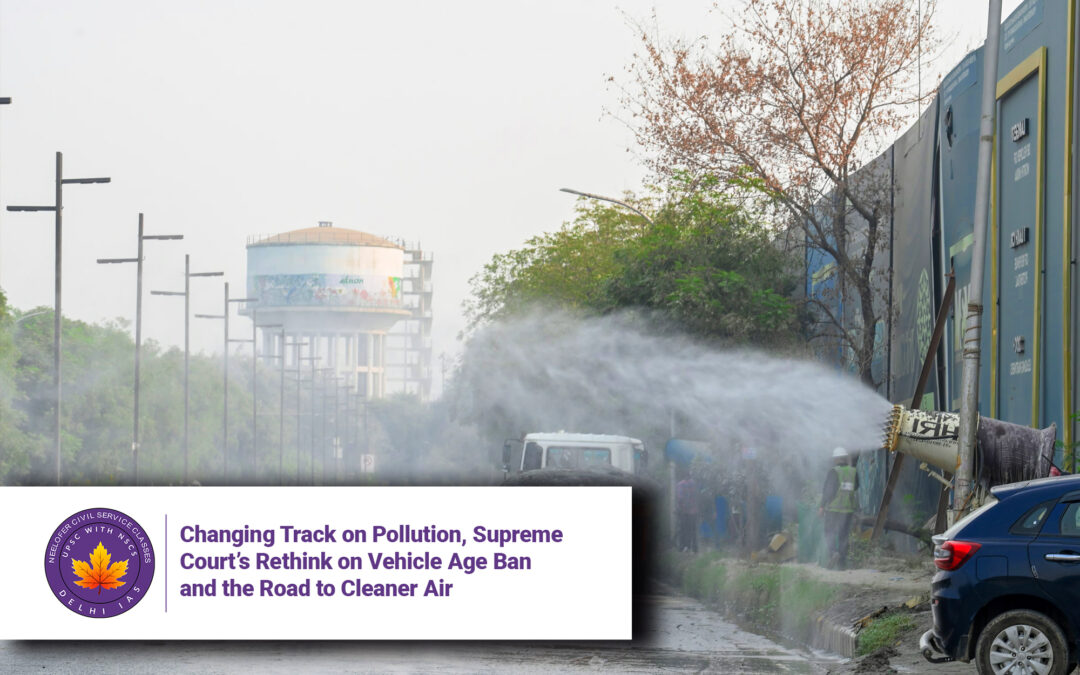
Changing Track on Pollution, Supreme Court’s Rethink on Vehicle Age Ban and the Road to Cleaner Air
Introduction
Air pollution remains one of India’s most persistent and complex public health challenges. Nowhere is this crisis more visible than in Delhi, which regularly ranks among the most polluted cities in the world. Over the years, governments and courts have tried multiple interventions to curb pollution, often through bans and regulatory orders. One such measure was the prohibition of “old” vehicles — diesel vehicles over 10 years old and petrol vehicles over 15 years old — in the National Capital Region (NCR), based on the assumption that older vehicles pollute more.
On Tuesday, in a significant policy turn, the Supreme Court of India decided to halt coercive action against owners of such so-called “end-of-life vehicles” (ELVs) and agreed to revisit its own 2018 order, which upheld the National Green Tribunal’s (NGT) 2014 directive imposing the age-based ban. This marks not just a procedural pause, but a deeper acknowledgment that age-based bans may lack scientific rigour and could unfairly burden certain sections of society.
The court’s willingness to reconsider its earlier stance could signal the beginning of a more evidence-based and comprehensive approach to pollution control — one that targets actual high emitters rather than using age as a proxy for emissions.
Background of the Vehicle Age Ban
The origins of this policy lie in the NGT’s 2014 directive, which banned:
-
Diesel vehicles over 10 years old
-
Petrol vehicles over 15 years old
The ban applied specifically to the National Capital Region — an area notorious for winter smog and dangerously high PM2.5 levels. The NGT’s reasoning was straightforward: older vehicles are presumed to emit more pollutants because of outdated technology and wear-and-tear.
In 2018, the Supreme Court endorsed this view, lending judicial weight to the ban. Since then, Delhi’s traffic enforcement agencies have acted against thousands of vehicles deemed unfit based on age, including impounding and scrapping.
However, this “age equals pollution” approach has faced criticism from environmental scientists, transport experts, and vehicle owners alike. They argue that the rule, while easy to implement, is not always fair, nor is it the most effective way to cut emissions.
Supreme Court’s New Stand
In its latest decision, the Supreme Court has:
-
Paused coercive action against ELV owners.
-
Agreed to re-examine the 2018 ruling upholding the NGT’s order.
-
Opened the door to a shift from age-based bans to emission-based standards.
The court’s new openness allows for a more nuanced discussion: Should a vehicle’s roadworthiness be determined by its age, or by its actual emissions performance?
The Case Against Age-Based Bans
1. Lack of Scientific Evidence
There is no conclusive data proving that all diesel vehicles over 10 years old or petrol vehicles over 15 years old are uniformly more polluting than newer models. A well-maintained older vehicle with low mileage can have emissions comparable to, or even better than, a poorly maintained newer vehicle.
2. Misplaced Enforcement Priority
While the ban targets private motorists, it leaves untouched several other major sources of Delhi’s pollution, such as:
-
Industrial emissions
-
Construction dust
-
Biomass burning
-
Open waste burning
Focusing heavily on ELVs while ignoring these bigger contributors risks creating an illusion of action without delivering significant air quality improvements.
3. Disproportionate Social Impact
Lower- and middle-income vehicle owners bear the brunt of the ban. For many, replacing a vehicle is financially burdensome, especially if the existing one is still functional and compliant with Pollution Under Control (PUC) norms.
4. Environmental Costs of Scrapping
Scrapping older vehicles and manufacturing new ones consumes vast amounts of energy and raw materials, producing additional emissions. This can undermine the environmental benefits of simply replacing old vehicles.
5. Blunt, One-Size-Fits-All Approach
The current rule makes no distinction between:
-
A vintage petrol car driven occasionally.
-
A high-usage diesel SUV driven daily in congested traffic.
This uniform treatment is easy to enforce but scientifically questionable.
Why Emissions-Based Standards Make More Sense
Shifting the focus from a vehicle’s “birthday” to its actual emission performance is both logical and fair. Emissions-based fitness tests can:
-
Identify and target high emitters regardless of age.
-
Incentivize better maintenance among vehicle owners.
-
Encourage retrofitting of older vehicles with cleaner technology.
-
Ensure resources are spent on the biggest polluters, not just the oldest.
Such a system would require real-world emissions monitoring — a technology and policy investment that India has so far under-utilized.
The Broader Pollution Context in Delhi
While vehicular emissions are a significant source of Delhi’s air pollution, they are part of a multi-source problem. According to various studies, the contributors to NCR’s air pollution include:
-
Vehicular emissions: 20–30% during peak smog periods.
-
Industrial activities: Significant, particularly from nearby states.
-
Construction dust: A year-round contributor to PM10 levels.
-
Agricultural residue burning: Seasonal spikes in winter months.
-
Domestic fuel use: Especially in low-income settlements.
This diversity of sources means piecemeal measures—such as banning certain categories of vehicles—are insufficient.
A Comprehensive, Sector-Wide Strategy
If the goal is truly cleaner air, the approach must be integrated and multi-sectoral. The editorial’s suggestions, aligned with expert opinion, include:
-
Real-World Emissions Monitoring
-
Deploy portable emission measurement systems (PEMS) to check actual on-road pollution levels.
-
Make PUC norms stricter and enforce them consistently.
-
-
Expansion of Clean Public Transport
-
Increase the fleet of electric and CNG buses.
-
Improve last-mile connectivity to reduce dependency on private vehicles.
-
-
Mandatory Retrofitting of High Emitters
-
Introduce retrofit kits for older commercial vehicles.
-
Offer subsidies or low-interest loans for retrofitting.
-
-
Investing in Walkable and Cyclable Infrastructure
-
Build safe pedestrian pathways and cycle tracks to encourage non-motorized transport.
-
Integrate such infrastructure into urban planning.
-
-
Addressing Non-Vehicular Pollution Sources
-
Strict dust control norms at construction sites.
-
Incentives for cleaner industrial production.
-
Alternatives to crop residue burning.
-
The Role of the State
The editorial underlines that the State’s role is not just to ban but to create proactive, consistent, science-based systems. This means:
-
Framing rational policies grounded in data.
-
Avoiding symbolic measures that are easy to announce but hard to justify.
-
Balancing environmental goals with economic and social considerations.
The Supreme Court’s latest move provides an opportunity to design a new legal and policy framework—one that:
-
Targets polluting vehicles, not all old vehicles.
-
Aligns with India’s broader climate commitments.
-
Integrates urban mobility planning with air quality goals.
Global Comparisons
Other countries have addressed vehicular emissions with more targeted measures:
-
European Union: Stringent Euro emission norms, low-emission zones based on performance, not age.
-
Japan: Regular, strict vehicle inspections focusing on safety and emissions.
-
California, USA: Smog checks and mandatory repairs for high emitters.
India can adapt lessons from these models while considering its own socio-economic realities.
Potential Challenges Ahead
-
Implementation Capacity: Real-world emissions testing requires infrastructure, trained personnel, and funding.
-
Corruption and Evasion Risks: PUC enforcement in India has faced issues with fake certificates.
-
Public Acceptance: New systems must be accompanied by awareness campaigns.
-
Industry Pushback: Vehicle manufacturers may resist retrofitting mandates.
Conclusion
The Supreme Court’s decision to pause and reconsider the blanket age-based ban is not a rollback of environmental concern—it’s a chance to make policy more intelligent, equitable, and effective. For too long, pollution control in Delhi has relied on quick fixes and headline-grabbing bans. The future lies in data-driven, technology-backed, and socially balanced strategies.
If the government and judiciary can use this moment to establish a rational, evidence-based framework focusing on actual polluters rather than arbitrary categories, Delhi could make real progress towards cleaner air. This will require political will, public cooperation, and administrative competence—but the alternative is continuing the cycle of ineffective measures and worsening public health outcomes.
5 Exam-Oriented Q&A
Q1. What was the National Green Tribunal’s 2014 directive regarding old vehicles?
A: It banned diesel vehicles over 10 years old and petrol vehicles over 15 years old from operating in the NCR, based on the assumption that older vehicles pollute more.
Q2. Why has the Supreme Court decided to revisit its 2018 order on ELVs?
A: The court acknowledged that the age-based ban might lack scientific rigour and that emissions, not age, should determine a vehicle’s roadworthiness.
Q3. List three criticisms of the age-based vehicle ban.
A:
-
No conclusive evidence that all older vehicles pollute more.
-
Disproportionate financial burden on lower- and middle-income citizens.
-
Ignores other major pollution sources while focusing on private motorists.
Q4. Suggest three measures for a comprehensive anti-pollution strategy.
A:
-
Real-world emissions monitoring.
-
Expansion of clean public transport.
-
Investment in walkable and cyclable infrastructure.
Q5. How do other countries regulate vehicle pollution without blanket age bans?
A: They use performance-based measures like strict emission norms, regular inspection regimes, and low-emission zones (e.g., EU, Japan, California).

