
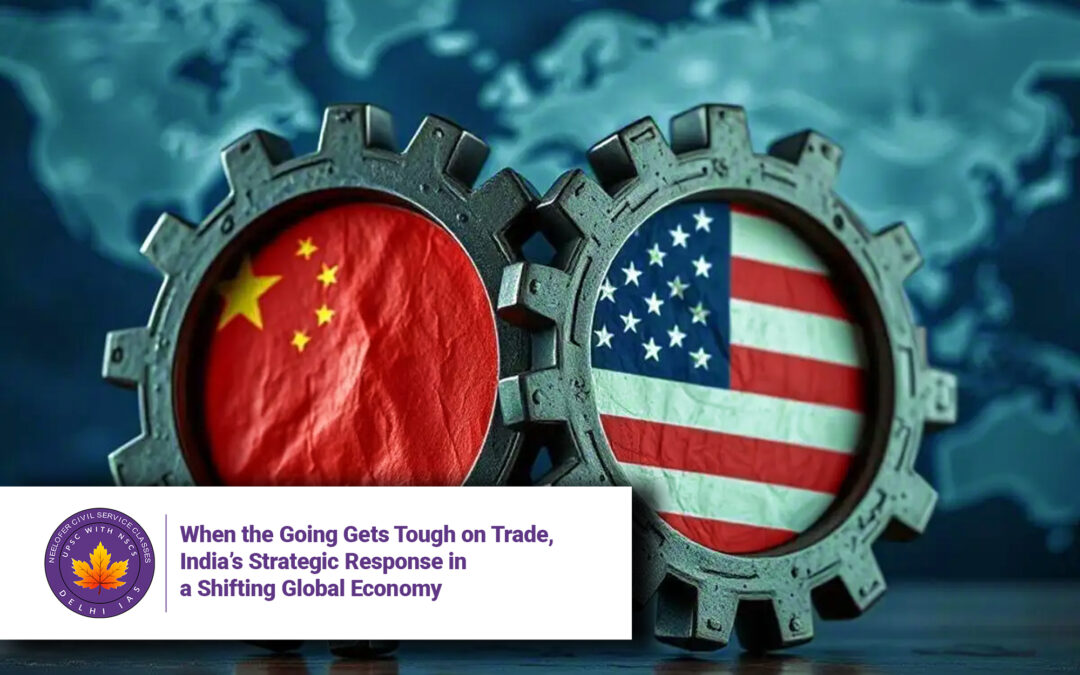
When the Going Gets Tough on Trade, India’s Strategic Response in a Shifting Global Economy
Introduction
Global trade has always been subject to the push and pull of economic power, political rivalry, and shifting alliances. In recent years, the rules of the game have become more unpredictable, as countries increasingly use trade policy as an extension of their foreign policy. The United States, under successive administrations, has employed tariffs and sanctions not only as economic measures but also as tools for strategic pressure.
India, a rapidly growing economy with ambitions to be a leading voice in global affairs, has found itself navigating a complex trade environment shaped by geopolitical tensions, supply chain disruptions, and shifting market access rules. The recent imposition of an additional 25% US import tariff on India — announced via executive order on August 6, 2025 — is the latest episode in a long-running series of trade skirmishes.
Accused of fuelling Russia’s war machine through energy imports, India has rejected the allegations and instead responded with a carefully calibrated strategy. This response is neither confrontational nor submissive — it blends economic resilience with diplomatic caution.
I. Background to the US Tariff Escalation
The newly announced 25% tariff adds to an already existing 25% “reciprocal tariff” that India faced on certain exports to the US. The roots of the trade tension go back to earlier disputes over most-favoured-nation (MFN) tariffs, where the US maintained high import duties on certain Indian goods. These duties, combined with anti-dumping measures and regulatory barriers, made Indian exports less competitive in the American market.
From the US perspective, India’s increasing energy trade with Russia violates the spirit of Western sanctions imposed after the Ukraine conflict. The White House’s argument is that revenues from India’s oil purchases indirectly finance Moscow’s military operations. India counters this by pointing to its energy security needs and non-aligned strategic posture, which allow it to trade with multiple partners to safeguard its own interests.
II. India’s Oil Trade with Russia: The Energy Security Rationale
The numbers reveal why energy imports are such a sensitive issue:
-
India buys 88% of its crude oil from overseas.
-
Imports from Russia have surged to 1.76 million barrels per day, accounting for 36% of India’s overall crude imports in 2024–25, compared to less than 0.1 million barrels per day in 2020–21.
-
This represents an 18-fold increase over the past four years.
Two private-sector giants, Nayara Energy and Reliance Industries, have been central to these imports, signing major supply contracts with Russian oil producer Rosneft.
This surge was partly driven by discounted Russian oil, made available after Western sanctions redirected Moscow’s supply chains. For India, buying cheaper oil is an inflation-control measure — it helps keep fuel prices stable, reduces input costs for industries, and supports overall economic stability.
III. Economic Performance Amid Global Headwinds
Ironically, these US sanctions arrive at a time when India’s economy is showing robust performance:
-
GDP growth averaged 6.5% between 2022–25, more than twice the US growth rate.
-
The Purchasing Managers’ Index (PMI) for manufacturing was 59.1 in July 2025, well above the 50-point expansion threshold. By comparison, the US PMI was 49.8 and China’s was 49.5, both indicating contraction.
-
India’s foreign exchange reserves stood at $698 billion, showcasing strong macroeconomic fundamentals.
The World Bank has praised India for its poverty alleviation efforts, which have lifted over 171 million people out of extreme poverty between 2011 and 2023. This reduced the percentage of Indians in extreme poverty from 16.2% to 2.3%.
IV. Historical Lessons: India’s Record in Navigating Crises
India has faced external economic pressures before — and emerged stronger. During the 2008–09 global financial crisis, when the US economy contracted, India still managed 6.7% GDP growth, though slower than the 9.8% seen in 2007–08. The same resilience was evident during the COVID-19 pandemic recovery, when India quickly ramped up manufacturing and digital trade systems.
The government often invokes the maxim:
When the going gets tough, the tough get going.
This belief underpins India’s current approach — using challenges as opportunities to restructure trade relations, diversify markets, and invest in domestic capacity.
V. India’s Trade Strategy: Calibrated, Not Confrontational
The Indian government’s reaction to US tariff measures has been notably restrained. Instead of retaliating with steep counter-tariffs or lodging an immediate WTO dispute, India is:
-
Continuing trade negotiations with multiple partners.
-
Expanding free trade agreements (FTAs) with countries like the UK, the EU, and Australia.
-
Enhancing non-economic cooperation in areas like security, immigration policy, and anti-smuggling operations.
Multilateral Engagement
India maintains active trade relations across geopolitical divides. It works with:
-
Western economies (EU, US, UK) for technology and capital investment.
-
Russia for energy supplies.
-
Southeast Asia and Africa for market expansion and resource security.
This “multi-vector” policy reflects India’s recognition that the global trade environment is no longer dominated by a single power bloc.
VI. Trade with the UK: A Case Study in Complementarity
India’s recent signing of an enhanced trade deal with the UK demonstrates its ability to balance market access with sensitivity to domestic industries. The agreement:
-
Reduces tariffs in selected sectors.
-
Increases opportunities for Indian professionals in the UK.
-
Strengthens collaboration in research, education, and technology.
The UK deal showcases how India tailors its trade policy — it’s not purely about volume; it’s about aligning with partners that respect mutual sensitivities.
VII. US Trade Policy: The Bigger Picture
The US’s use of tariffs under both Donald Trump and his successors has been described as “consistently inconsistent.” Since Trump’s election in 2016, US trade policy has:
-
Imposed tariffs as leverage in unrelated negotiations.
-
Targeted countries across the spectrum — from allies like Canada to rivals like China and Russia.
-
Justified tariffs with both economic and non-economic arguments, including security and human rights concerns.
While such tactics have unsettled global trade partners, they have also opened opportunities for nations like India to present themselves as reliable and predictable trading partners.
VIII. India’s Strategic Advantage: Stability and Predictability
India’s cautious stance has several benefits:
-
Avoiding Escalation – By not rushing into retaliatory measures, India keeps diplomatic channels open.
-
Economic Signalling – Demonstrates confidence in domestic growth and resilience.
-
Investor Confidence – Foreign investors value stable trade environments, and India’s steady hand could attract long-term capital.
However, this restraint is not without risks. A prolonged tariff regime could erode India’s competitive edge in the US market, especially for sectors like textiles, machinery, and agricultural products.
IX. Balancing Short-Term Costs with Long-Term Gains
In the short term, Indian exporters may face reduced market access in the US. This will require:
-
Market Diversification – Targeting the EU, ASEAN, Africa, and Latin America.
-
Domestic Value Addition – Moving up the value chain to make exports less price-sensitive.
-
Innovation in Trade Logistics – Reducing supply chain costs to offset tariff disadvantages.
In the long run, if India can sustain growth, deepen FTAs, and maintain diversified energy sources, it will emerge from this period with greater strategic autonomy.
X. Conclusion: Navigating the Storm
The imposition of new US tariffs is a significant challenge, but it is not an existential threat to India’s economy. By combining pragmatic diplomacy with economic resilience, India is demonstrating that it can protect its national interests without being drawn into zero-sum confrontations.
The coming years will test whether this strategy can hold — especially if geopolitical tensions intensify. But if history is any guide, India’s ability to adapt, negotiate, and diversify will remain its greatest strength.
5 Exam-Oriented Q&A
Q1. What percentage of India’s crude oil imports came from Russia in 2024–25?
A: 36%, equivalent to 1.76 million barrels per day.
Q2. How much has India reduced its extreme poverty rate between 2011 and 2023?
A: From 16.2% to 2.3%, lifting over 171 million people out of extreme poverty.
Q3. What was India’s Purchasing Managers’ Index (PMI) reading for July 2025, and why is it significant?
A: 59.1 — it indicates robust manufacturing growth, in contrast to contraction in the US and China.
Q4. Which two Indian companies have major crude oil supply contracts with Russia’s Rosneft?
A: Nayara Energy and Reliance Energy.
Q5. What key approach defines India’s trade strategy in the face of US tariffs?
A: A calibrated, non-confrontational, multi-vector trade policy that diversifies markets while keeping diplomatic channels open.

