
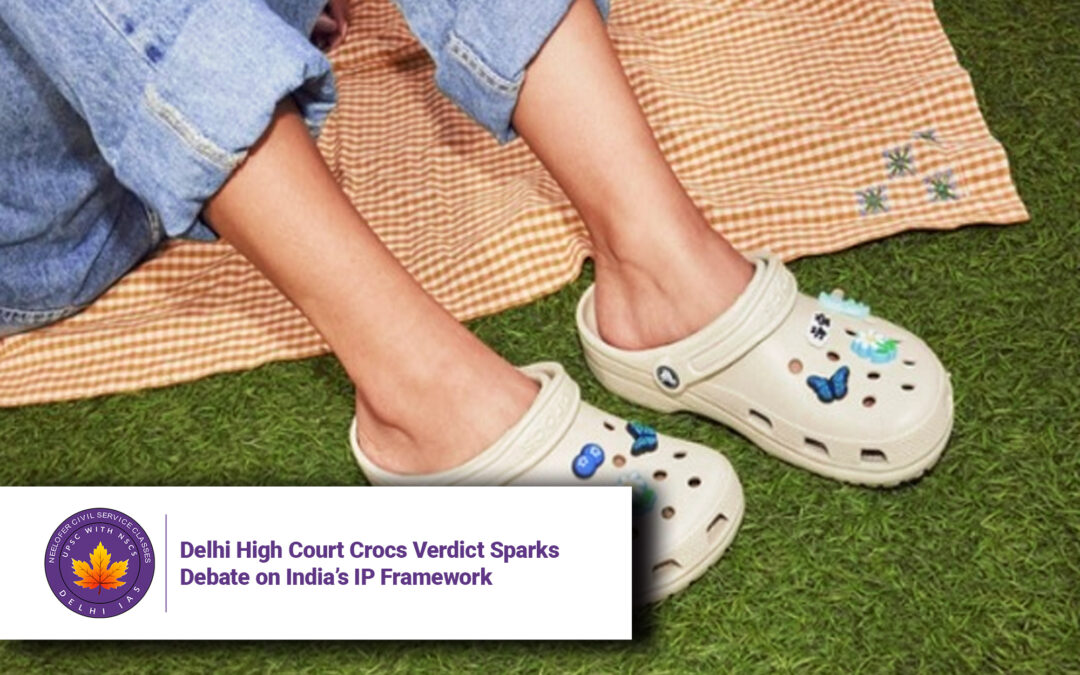
Delhi High Court Crocs Verdict Sparks Debate on India’s IP Framework
The Delhi High Court’s recent decision in M/S Crocs Inc. USA v. M/S Bata India Ltd. & Ors. (RFA (OS) (Comm) 22/2019 and connected matters), delivered on 1 July 2025, has reignited debate over the nuanced relationship between India’s Designs Act, 2000 and the Trade Marks Act, 1999. The judgment not only impacts how design registrations interact with trademark rights but also raises important concerns about India’s intellectual property (IP) regime’s alignment with global standards.
Legal experts argue that the Court’s approach, which refused to allow Crocs to protect its registered design through passing off once its design term had expired, could weaken brand protection and open the door to greater imitation in the market.
I. The Legal Context: Designs vs. Trade Marks
1. Understanding the Designs Act, 2000
Under Section 2(d) of the Designs Act, “design” refers to features of shape, configuration, pattern, ornament, or composition of lines or colors applied to an article by any industrial process. Importantly, the definition explicitly excludes trademarks.
Section 19(1)(b) of the Act provides that a design registration can be cancelled if it does not qualify as a design or if it has been previously registered in India.
2. Understanding the Trade Marks Act, 1999
The Trade Marks Act defines “trademark” as any mark capable of being represented graphically and distinguishing the goods or services of one person from those of others. It explicitly includes shapes of goods, provided they are distinctive and not functional in nature.
This overlap — where a product’s shape might be both a design and a trademark — creates the legal tension at the heart of the Crocs case.
II. The Dispute: Crocs v. Bata and Others
Crocs Inc. had registered the distinctive clogs design under the Designs Act. After the design’s statutory protection period ended, Crocs attempted to rely on the law of passing off to stop others from selling similar footwear. Passing off protects goodwill and reputation associated with a product from misrepresentation by others.
The Delhi High Court, however, rejected this attempt. Relying heavily on its interpretation of Section 2(d) and previous case law such as Carlsberg Breweries v. Som Distilleries (2019), the Court concluded that:
-
Once a registered design expires, the shape cannot be protected as a trademark if it overlaps with features that were protected under the Designs Act.
-
The statutory exclusion under Section 2(d) means that granting trademark protection to such shapes post-design expiry would undermine the limited-term monopoly intended by the Designs Act.
III. Court’s Reasoning and Key References
1. Reliance on Carlsberg Case
In Carlsberg, the Court held that using a registered design as a trademark could lead to cancellation of the design registration. The Delhi HC in Crocs adopted a similar logic: permitting trademark rights after design expiry would effectively grant perpetual protection, contrary to legislative intent.
2. Interpretation of “Passing Off”
The Court distinguished between using design elements as trademarks and using them purely as part of the product’s appearance. It held that while passing off protects misrepresentation, it cannot be applied to extend expired design rights into indefinite monopolies.
3. International Precedents
The Court’s approach diverges from global trends:
-
In the EU, the Procter & Gamble v. OHIM case allowed certain shapes to be protected as trademarks after design expiry, provided they met distinctiveness criteria.
-
UK law (e.g., Coca-Cola bottle precedent) has recognized shape marks post-design expiry where the shape had acquired secondary meaning.
By not considering these precedents in depth, critics argue, the Delhi HC risks making India less attractive for design-led industries.
IV. Criticism of the Judgment
Legal scholars have pointed out several perceived shortcomings in the judgment:
-
Conflation of Design and Trademark Doctrines
By preventing a design from being protected as a trademark post-expiry, the Court arguably misinterprets the scope of each IP right. Trademarks protect source identification and goodwill, while designs protect appearance for a limited period. -
Ignoring Market Realities
Many designs, especially in the fashion and footwear industries, become closely associated with a brand over time. Consumers may see the Crocs clog shape and instantly think of the Crocs brand, even without logos. -
Over-Reliance on Statutory Exclusions
The rigid interpretation of Section 2(d) could discourage companies from registering designs in India, fearing that they would lose the chance to later claim trademark protection for shapes that have acquired distinctiveness. -
Potential Misalignment with Global IP Standards
Countries like the US, UK, and EU allow overlapping protection under certain conditions, which incentivizes innovation and brand building. India’s more restrictive stance may undermine competitiveness.
V. Why Some Support the Judgment
Not all experts disagree with the Court:
-
Avoiding Perpetual Monopolies: Supporters argue that allowing shape trademarks after design expiry undermines the purpose of having a limited monopoly for designs.
-
Consumer Choice and Competition: Restricting such protection can encourage competition and prevent monopolization of common product shapes.
-
Legislative Clarity Needed: The Court’s decision may push lawmakers to clarify the relationship between the two Acts, avoiding inconsistent rulings.
VI. Implications for Businesses
The judgment has immediate and long-term effects:
-
Short-term: Brands with iconic product shapes (footwear, bottles, electronics) may face increased imitation once design protection expires.
-
Long-term: Companies may shift strategies — relying more on trademarks and trade dress from the outset instead of design registrations.
Foreign companies might reassess their IP strategies in India, especially in industries where product shape is a key branding element.
VII. Recommendations for Reform
Experts suggest:
-
Legislative Amendment: Clarify in law that shapes can be trademarks post-design expiry if they meet distinctiveness criteria.
-
Judicial Sensitization: Courts should adopt a more nuanced understanding of overlapping IP rights.
-
Public Awareness: Educate businesses on structuring IP portfolios to maximize protection.
VIII. Conclusion: A Call for Balance
The Crocs verdict represents a strict, statutory reading of the Designs Act that prioritizes competition over extended monopoly rights. While this aligns with the spirit of limiting design protection, it may come at the cost of undermining brand value and consumer association built over years.
India now faces a choice:
-
Maintain a rigid separation of design and trademark rights, favoring competition but potentially discouraging investment.
-
Or align with international norms, allowing overlap in cases where a shape has acquired distinctiveness, protecting both innovation and market identity.
Without legislative and judicial clarity, the uncertainty will persist, affecting both domestic and foreign businesses operating in India’s design-driven sectors.
5 Key Q&A for Understanding
Q1. What was the central issue in the Crocs case before the Delhi High Court?
The key question was whether Crocs could use the law of passing off to protect its footwear shape as a trademark after its registered design under the Designs Act had expired.
Q2. What does Section 2(d) of the Designs Act state?
It defines “design” and explicitly excludes trademarks, meaning that a registered design’s features cannot simultaneously be protected as a trademark during its design registration.
Q3. How does the judgment differ from international practice?
While many jurisdictions allow shapes to be registered as trademarks post-design expiry if they have acquired distinctiveness, the Delhi HC refused this overlap, interpreting statutory exclusions strictly.
Q4. What are the main criticisms of the judgment?
Critics argue the Court conflated design and trademark doctrines, ignored market realities, over-relied on statutory exclusions, and diverged from global IP standards.
Q5. Why do some experts support the judgment?
Supporters believe it prevents perpetual monopolies, promotes competition, and encourages legislative clarity on the overlap between design and trademark rights.

