
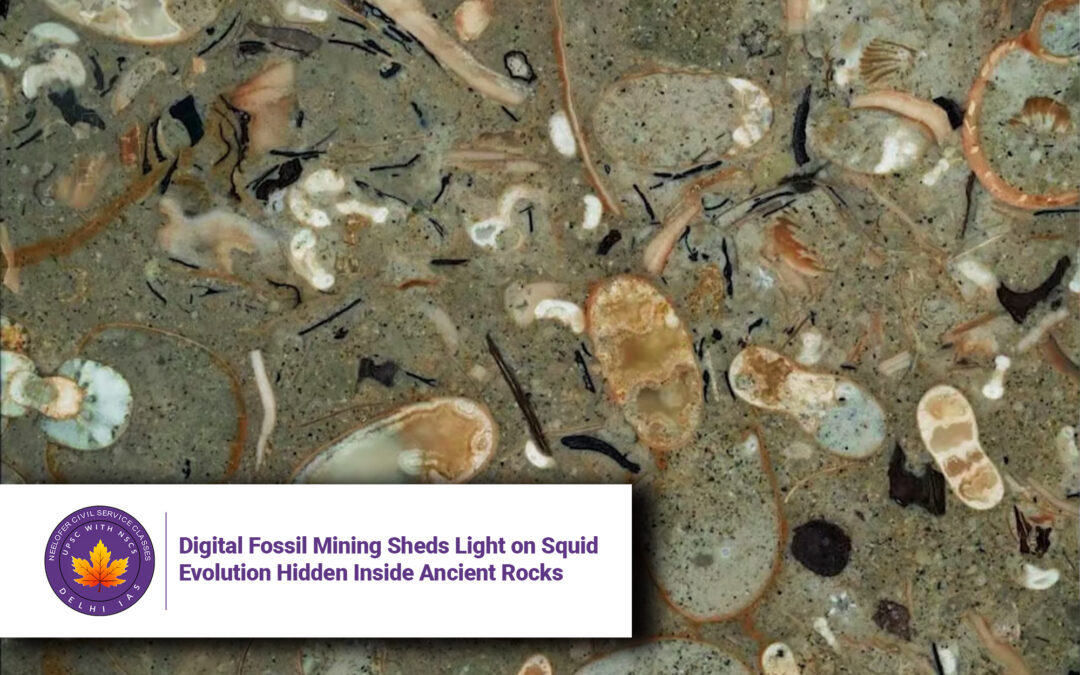
Digital Fossil Mining Sheds Light on Squid Evolution Hidden Inside Ancient Rocks
Why in News?
A groundbreaking study by Japanese scientists has revolutionized the understanding of squid evolution using a new technique called digital fossil-mining. This innovation has allowed researchers to extract well-preserved fossils of squids hidden inside ancient rocks, offering significant insights into the origins and diversification of these highly intelligent marine animals.
Introduction
Squids, known for their intelligence and agility, have long puzzled evolutionary biologists due to the absence of well-preserved fossils. Their soft bodies do not fossilize easily, leaving gaps in their evolutionary record. However, the digital fossil-mining technique has changed the game by enabling scientists to visualize squid fossils embedded in hard carbonate rock formations without damaging them.
Key Findings of the Study
-
Innovative Technology
Researchers developed a machine that gently grinds rock while photographing each layer. These images are compiled into a 3D model that reveals hidden fossils, including hard chitin-based squid beaks. -
Discovery of 40 Squid Species
The technique helped identify fossils of at least 40 squid species across 23 genera—far exceeding the previously known single fossil beak. -
Squid Evolution Traced to 100 Million Years Ago
The team traced squid fossils to about 100 million years ago, which is roughly 30 million years earlier than previously believed. -
Modern Squid Groups Identified
Fossils showed two modern squid groups: deep-sea squids (Oegopsida) and coastal squids (Myopsida), suggesting they evolved early and diversified rapidly. -
Ecological Impact of Squids
By the Late Cretaceous, squids had become more abundant than ammonites and belemnites, showing their dominance in marine ecosystems even before the mass extinction event 66 million years ago.
Conclusion
This study not only fills a major gap in marine evolutionary history but also establishes squids as one of the early pioneers of contemporary ocean life. Their advanced cognitive traits and diverse adaptations allowed them to thrive post-mass extinction, even replacing many other marine predators. Digital fossil-mining may now become a standard technique in paleontology, opening doors to hidden evolutionary secrets buried inside rocks.
5 Q&A Based on the Article
Q1. What is digital fossil-mining, and why is it significant?
A1. Digital fossil-mining is a technique that uses layered imaging to create 3D models of fossils hidden inside rocks, allowing scientists to extract delicate fossils without damaging them. It provides a non-destructive way to study previously inaccessible specimens.
Q2. What new discoveries did the technique reveal about squids?
A2. Researchers discovered fossil beaks from at least 40 squid species belonging to 23 genera—an extraordinary leap from the previously known single beak fossil.
Q3. How old are the newly discovered squid fossils?
A3. Some fossils date back to 100 million years ago, placing squid evolution 30 million years earlier than previously thought.
Q4. What does the study suggest about squid diversification?
A4. Squid families evolved rapidly after their appearance, and by the Late Cretaceous period, they had outnumbered ammonites and belemnites, showing their dominant role in marine ecosystems.
Q5. What future potential does this method offer?
A5. Digital fossil-mining can transform paleontology by revealing fossils hidden in rocks without destruction, helping decode the evolutionary history of many species beyond squids.

