
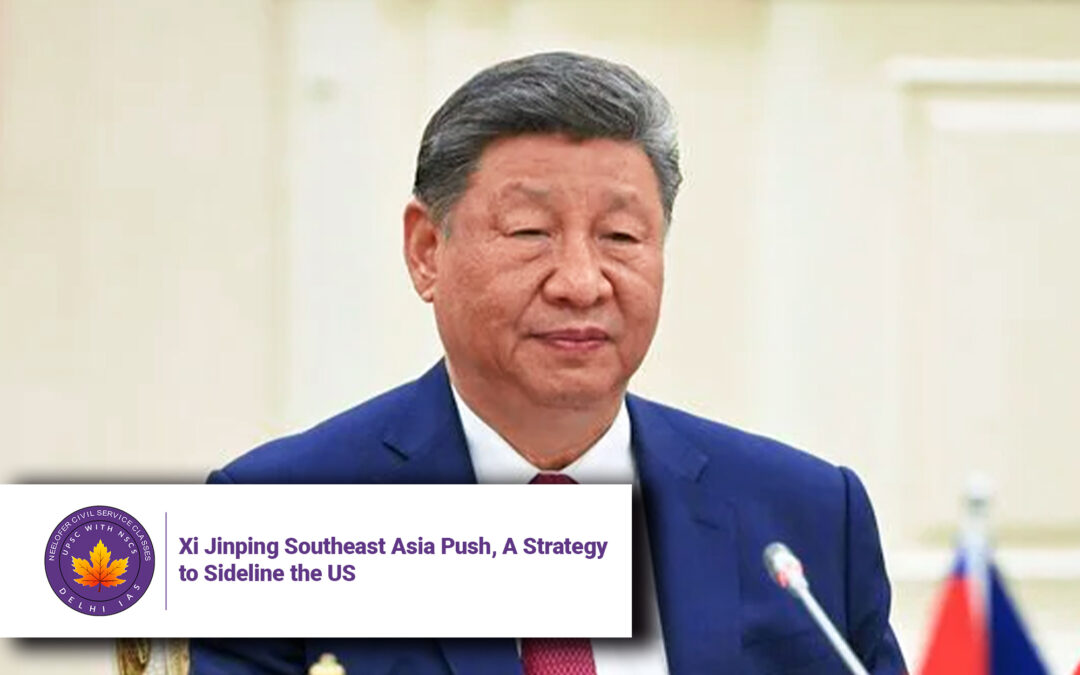
Xi Jinping Southeast Asia Push, A Strategy to Sideline the US
Why in News?
Chinese President Xi Jinping’s recent diplomatic charm offensive in Southeast Asia is being seen as more than just a move for trade and cooperation. Experts suggest it is a strategic effort to fill the power vacuum left by former US President Donald Trump, and to position China as the dominant force in the Indo-Pacific region. 
Introduction
While President Xi Jinping’s recent visits to Southeast Asia were publicly about strengthening trade and friendly cooperation, the deeper agenda appears to be strategic dominance in the region. Xi is working to replace US influence, which has weakened in the wake of Trump-era policies, with China’s economic leadership and diplomatic muscle.
Key Highlights from the Editorial
-
Filling the US Void
-
Trump’s lack of interest in Southeast Asia left a strategic vacuum.
-
Xi is capitalizing on this by projecting China as a reliable and cooperative regional leader.
-
-
Soft Power with Strategic Intent
-
Xi’s visit to China’s southern neighbour nations emphasized friendship and trade, but it also included tough behind-the-scenes negotiations.
-
The tone was diplomatic, but the motive was clear: undermine US credibility.
-
-
Economic Leverage and Trade Deals
-
China is already the largest trading partner of ASEAN nations.
-
China’s 2022 total trade with ASEAN was worth $764 billion.
-
It’s using debt-trap diplomacy and infrastructure deals to pull nations into its orbit.
-
-
Response from the Region
-
Southeast Asian nations welcome China’s money and investment but are cautious of Beijing’s influence.
-
They are also seeking to balance ties by strengthening links with India, Japan, and the EU.
-
-
US Must Re-engage
-
With Biden in office, the US is trying to rebuild relations.
-
Xi’s timing is clever—he’s pushing deeper ties before the US fully returns to the scene.
-
5 Key Takeaways
-
China is using diplomacy and trade to assert dominance in Southeast Asia.
-
The withdrawal of US leadership under Trump gave China an opening to act.
-
Xi’s approach mixes soft diplomacy with tough, strategic negotiations.
-
While Southeast Asia benefits economically, it remains wary of Chinese intentions.
-
The US and allies must act swiftly to re-establish influence and balance power in the Indo-Pacific.
Challenges and the Way Forward
-
Challenges:
-
Growing economic dependence on China.
-
Diplomatic pressures and reduced US presence.
-
Regional divisions in how to respond to China.
-
-
Way Forward:
-
The US and allies must present an alternative to China’s economic dominance.
-
Initiatives like the Indo-Pacific Economic Framework must be strengthened.
-
Southeast Asian nations need to adopt a multi-alignment policy to preserve autonomy.
-
Conclusion
Xi Jinping’s charm offensive is not just about warmth and trade. It is a calculated move to expand China’s influence and shrink America’s strategic footprint in Asia. The region is watching carefully — wanting growth, but also fearing over-dependence on Beijing. In this new geopolitical contest, economic power is the new weapon, and China is already ahead.
Q&A Section
1. What is Xi Jinping trying to achieve with his Southeast Asia visit?
He aims to fill the strategic and leadership vacuum left by the US and position China as the region’s dominant power.
2. How did the US lose influence in Southeast Asia?
During Donald Trump’s presidency, the US deprioritized Southeast Asia, weakening alliances and exiting trade pacts like the Trans-Pacific Partnership.
3. What tools is China using to expand influence?
China is using trade deals, infrastructure investments, debt diplomacy, and regional partnerships like the RCEP to expand its footprint.
4. How are Southeast Asian countries responding?
They are engaging with China economically but remain wary, and many are also looking to strengthen ties with the US, India, Japan, and the EU to balance power.
5. What should the US do to counter China’s strategy?
Re-engage more actively in the region, revive partnerships like the TPP, and offer viable economic alternatives that match China’s outreach.
