
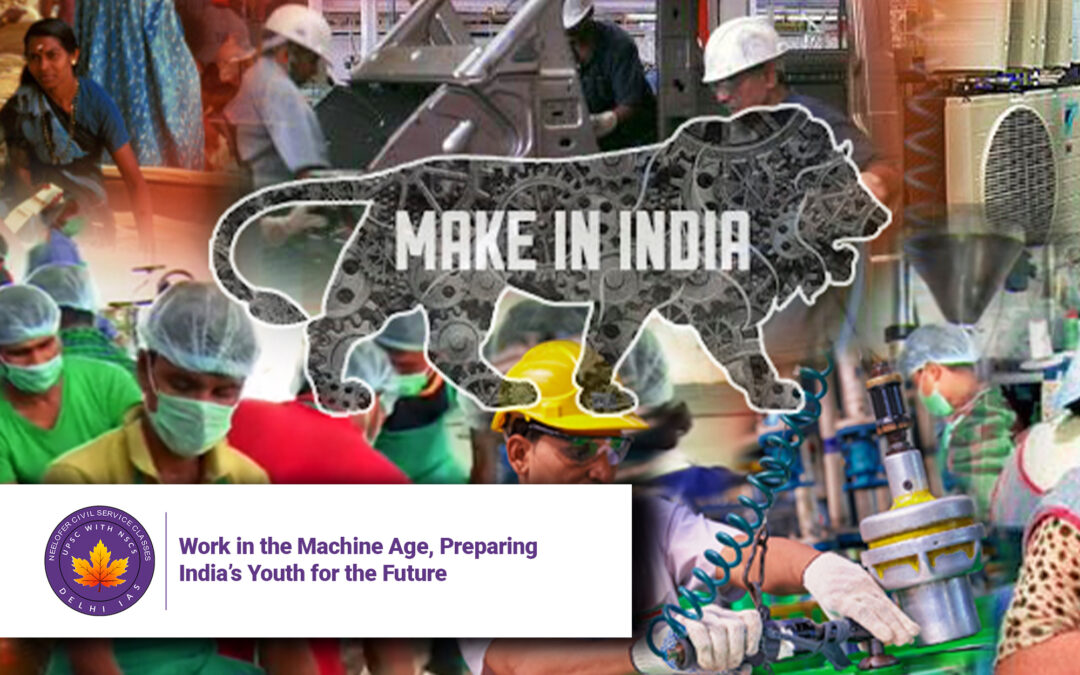
Work in the Machine Age, Preparing India’s Youth for the Future
Why in News?
With over 50% of young Indians unemployed despite having secondary or higher education, India is facing a multidimensional employment crisis. As AI, automation, and digital transformation reshape every sector, there is an urgent need to prepare India’s youth for jobs that do not yet exist. This calls for reimagining education with tech and data literacy at its core. 
Introduction
India must create 90 million new jobs by 2030 to meet the demand for a growing young workforce. However, many of these jobs will be in sectors that are yet to evolve. The visible unemployment crisis is worsened by a hidden crisis—a lack of readiness for the future of work in an age of machines, automation, and artificial intelligence.
Key Issues
-
The Invisible Crisis
-
Unemployment is not just about the lack of jobs but also the mismatch between education and employability.
-
Three in ten young Indians are disengaged from both work and learning.
-
-
Shift in the Nature of Work
-
As AI and automation take over traditional tasks, future jobs will demand adaptability, analytical thinking, creativity, and technology fluency.
-
Skills will matter more than degrees.
-
-
Education System Needs Overhaul
-
The current system still prioritizes outdated teaching methods.
-
There is a need for data literacy, digital fluency, and problem-solving skills embedded across subjects from arts to agriculture.
-
-
Role of Schools and Colleges
-
Schools must help students understand how digital systems function, how to analyze data, and how to make informed decisions in a tech-driven world.
-
Colleges must incorporate interdisciplinary curricula, promote real-world experiences, and focus on AI and data comprehension.
-
-
Learning from Global Models
-
Institutions like Northeastern University (US) are leading by offering flexible, credential-based learning that evolves with market demands.
-
India needs similar innovation in education, especially through micro-credentials, personalized learning, and experiential models.
-
5 Key Takeaways
-
India faces a deep employment crisis, especially among educated youth, due to poor alignment between education and evolving job markets.
-
The rise of automation and AI means jobs of the future will require data and tech literacy across all sectors.
-
Education must shift from theory-based learning to skill-based, adaptable, and real-world learning models.
-
Interdisciplinary education, especially blending humanities and tech, is key to future readiness.
-
India must embrace global education innovations, like micro-credentials and project-based learning, to upskill its youth.
Challenges and the Way Forward
Challenges:
-
Outdated curriculums focused on rote learning.
-
Lack of tech infrastructure and trained teachers in rural and urban areas.
-
Low awareness of data-driven decision-making and AI concepts among educators.
Way Forward:
-
Introduce AI and data literacy early in school education.
-
Reform higher education with interdisciplinary programs and flexible credentials.
-
Invest in teacher training for digital fluency.
-
Promote real-world projects, internships, and industry collaboration.
Conclusion
To shape a future-ready workforce, India must reimagine its education system—not just to help students find jobs, but to thrive in a world driven by machines and data. Schools and colleges must focus on cultivating curiosity, tech fluency, and human creativity—because in the machine age, these are the skills that will matter most.
Q&A Section
1. What is the biggest employment challenge India faces today?
India faces both visible and invisible unemployment—where many youth are unemployed despite education, due to lack of future-ready skills.
2. Why is technology and data literacy important for today’s students?
Because jobs in the future will rely heavily on AI, data analysis, digital systems, and decision-making based on technology.
3. How should schools and colleges change?
They should embed tech and data literacy, support interdisciplinary learning, and prepare students for jobs that don’t yet exist through adaptable and experiential education.
4. What is a good example of educational reform globally?
Northeastern University in the US offers a framework called Humanics, blending liberal arts, technology, and data with real-world application.
5. What are some ways India can prepare its youth for the future?
By revamping curricula, introducing AI and data learning early, supporting micro-credentials, and promoting hands-on learning across fields.
