
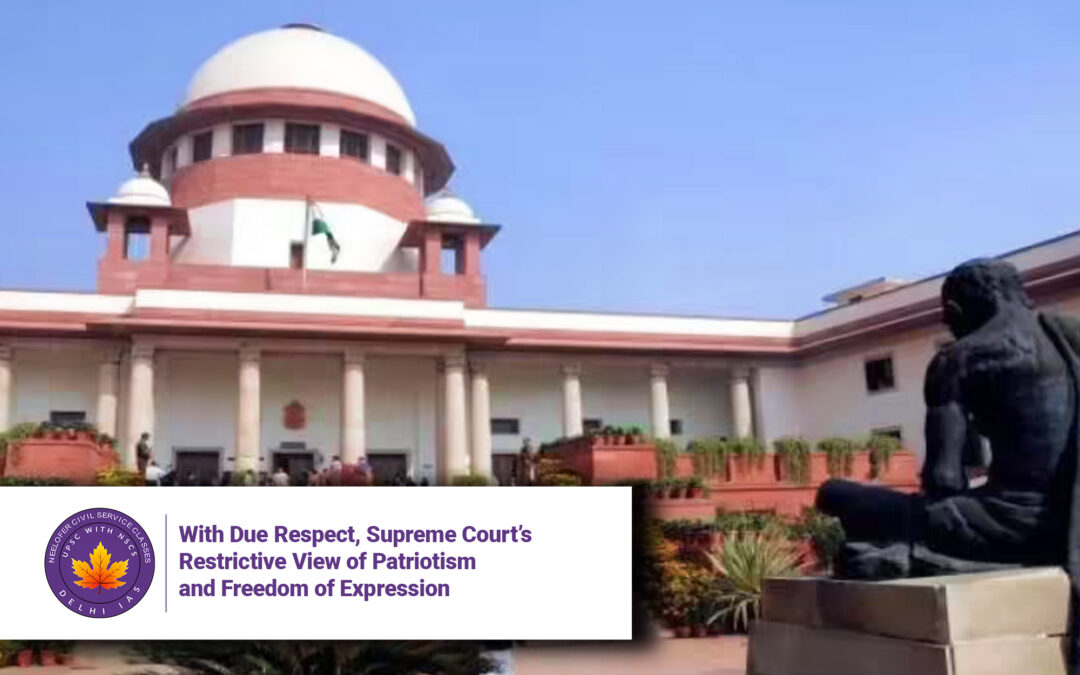
With Due Respect, Supreme Court’s Restrictive View of Patriotism and Freedom of Expression
Why in News?
The Supreme Court of India, while granting Congress leader Rahul Gandhi relief in a defamation case concerning his comments on the Galwan clash, made controversial observations regarding the definition of a “true Indian.” This followed shortly after the Bombay High Court denied the Communist Party of India (Marxist) and the Communist Party of India permission to protest in solidarity with Gaza, citing national interest concerns. These judicial observations have raised questions on freedom of speech, constitutional boundaries, and the judiciary’s approach to dissent and political expression.
Introduction
Democracy thrives on the strength of its institutions, especially when they act within their boundaries and uphold the Constitution in both letter and spirit. However, recent actions and statements by the Indian judiciary have triggered concerns about judicial overreach, the narrowing of acceptable dissent, and the shifting standards for what constitutes patriotism and national interest. At the heart of this debate is the role of the judiciary in defining “Indianness” and the implications this has for free speech and political plurality.
Key Issues
1. Supreme Court’s Comments on “True Indian”
While granting relief to Rahul Gandhi in a defamation case, the Supreme Court remarked:
“If you are a true Indian, you would not say all these things.”
This raises critical concerns:
-
What defines a “true Indian”?
-
Is patriotism to be judged by courts?
-
Should expressions of political criticism be weighed against one’s national allegiance?
The Court’s observations implicitly suggest a moral and ideological benchmark for patriotism. This becomes especially problematic in a pluralistic democracy where national identity is multifaceted and open to interpretation.
2. High Court’s Denial of Protest for Gaza Solidarity
Just days prior, the Bombay High Court refused permission to the CPI(M) and CPI to hold a protest at Azad Maidan in Mumbai, citing national interest. The protest was meant to express solidarity with Gaza. The Court stated:
“You are looking at issues in Gaza and Palestine. Look at your own country.”
Here again, the judiciary seemingly prioritized what it deemed “national concerns” over the constitutional right to peaceful protest and free expression.
3. Institutional Overreach and Judicial Restraint
Both cases reflect what many experts are calling a growing trend of institutional overreach:
-
Courts appear to be encroaching on the executive’s and legislature’s domain by making value judgments on political opinions and expressions.
-
This runs the risk of aligning the judiciary with majoritarian or governmental narratives rather than upholding constitutional neutrality.
It is not the role of the courts to define patriotism or Indianness, nor to issue moral certificates based on political beliefs. Such practices can weaken the integrity of the judiciary and its perceived impartiality.
4. Threats to Freedom of Speech and Expression
India’s Constitution guarantees freedom of speech under Article 19(1)(a). However, this freedom is not absolute and is subject to “reasonable restrictions” under Article 19(2).
The concern now is how “reasonable” these restrictions are when the judiciary itself begins:
-
Dictating acceptable forms of dissent.
-
Disqualifying certain expressions as unpatriotic or against national interest.
-
Using “national security” and “national unity” as blanket justifications for censorship.
The selective invocation of these terms can severely shrink the space for democratic engagement, protest, and civil liberties.
5. Historical Context and Judicial Evolution
Historically, the Supreme Court has been the bulwark against authoritarianism. During the Emergency (1975–77), for example, it infamously upheld curbs on fundamental rights, a decision it later regretted.
In recent years, however, the Court has made significant advances:
-
It struck down Section 66A of the IT Act for curbing online speech.
-
It expanded the interpretation of privacy as a fundamental right.
-
It intervened in multiple cases to uphold freedom of the press.
Despite these milestones, recent judgments suggest a reversal of this progressive trend. Instead of defending civil liberties, courts now often appear to be aiding their erosion.
Alternative Approaches
Instead of adopting a restrictive approach to dissent and political expression, the judiciary could:
-
Reaffirm its commitment to the Constitution’s spirit of pluralism and diversity.
-
Focus on protecting the right to protest and freedom of expression, regardless of the political ideology behind it.
-
Resist passing moral judgments and avoid interpreting patriotism through a judicial lens.
-
Insist that any limitations on speech be narrowly defined, proportionate, and strictly necessary.
Challenges and the Way Forward
Challenges
-
Judicial Overreach: Courts stepping beyond their mandate to issue ideological assessments.
-
Vague Definitions: Concepts like “national interest,” “public order,” and “true Indian” are subjective and prone to misuse.
-
Chilling Effect: Activists, politicians, and citizens may self-censor to avoid legal consequences.
-
Erosion of Trust: If courts are perceived as biased or politically motivated, public confidence in the judiciary may decline.
Way Forward
-
Strict Adherence to Constitutional Morality: The judiciary must align itself with constitutional values, not political ideologies.
-
Clear Guidelines: Define boundaries for permissible restrictions on free speech in a transparent manner.
-
Strengthening Dissent: Recognize dissent as a vital part of democracy, not a threat to it.
-
Judicial Training: Judges must be sensitized to the socio-political implications of their words and rulings.
-
Public Accountability: Courts should be open to critique and introspection without branding critics as unpatriotic or anti-national.
Conclusion
The recent statements by the Supreme Court and Bombay High Court reflect a worrying trend where constitutional freedoms, especially the right to free expression and protest, are being curtailed in the name of nationalism and public order. Defining a “true Indian” is not the role of any court; instead, the judiciary must serve as the protector of diverse voices, even those critical of the state.
A democracy is judged not by how it treats the majority but by how it allows space for dissent. India’s pluralism and constitutional democracy are its greatest strengths. The judiciary must remember that patriotism cannot be legislated, judged, or enforced through courtroom remarks—it must be left to the conscience of the people.
If courts begin to define patriotism and limit dissent, democracy itself is at risk. The judiciary must therefore reflect not the will of the majority or the state but the spirit of the Constitution, which embraces all shades of opinion, belief, and expression.
5 Questions and Answers
Q1. What recent comment by the Supreme Court triggered debate on patriotism and judicial overreach?
A1. The Supreme Court remarked, “If you are a true Indian, you would not say all these things,” while granting relief to Rahul Gandhi in a defamation case. This raised questions about the Court’s role in defining patriotism.
Q2. Why did the Bombay High Court deny permission for a protest in solidarity with Gaza?
A2. The Bombay High Court denied the CPI(M) and CPI permission to protest at Azad Maidan citing “national interest,” suggesting that focus should be on domestic issues rather than international solidarity.
Q3. What are the constitutional concerns raised by these judicial observations?
A3. The observations raise concerns about freedom of speech, judicial overreach, and the risk of courts imposing subjective ideas of nationalism, which can curb political expression and dissent.
Q4. What is the risk of using “national security” and “national interest” too broadly in judicial rulings?
A4. Broad and vague use of these terms can serve as tools to suppress dissent, create a chilling effect on free speech, and justify undue restrictions on civil liberties.
Q5. What is the way forward to uphold constitutional values in such matters?
A5. The judiciary must adhere to constitutional principles, avoid ideological judgments, protect dissent, define restrictions transparently, and ensure their role remains impartial and within institutional boundaries.

