
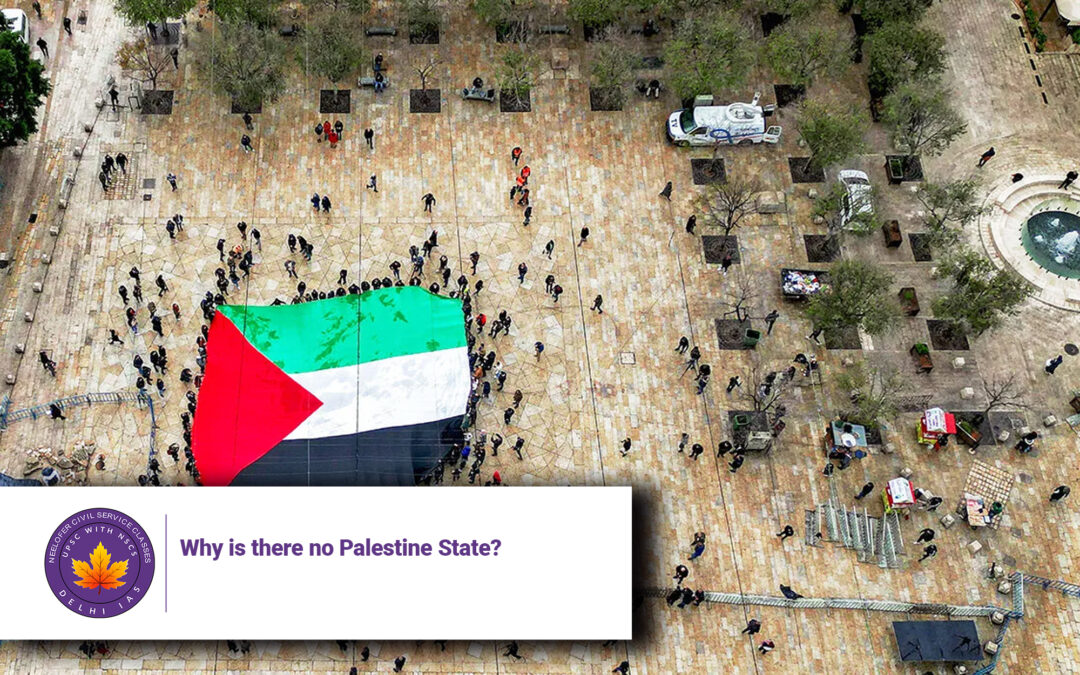
Why is there no Palestine State?
Why in News
The long-standing Israel-Palestine conflict has once again come into global focus after the October 7, 2023 Hamas attack on Israel, followed by Israel’s war on Gaza. This has reignited debates on the Palestinian question, the feasibility of a two-state solution, and why a sovereign Palestinian state has not yet been realized despite decades of negotiations and international efforts.
Introduction
The Palestinian statehood issue is one of the most protracted and complex conflicts in modern history. It dates back to the British Mandate period, the establishment of Israel in 1948, and the subsequent Arab-Israeli wars. Despite multiple attempts at mediation, peace accords, and international recognition, Palestine remains a stateless entity, with its population divided between the West Bank, Gaza Strip, refugee camps, and diaspora communities worldwide. The absence of a Palestinian state continues to fuel cycles of violence, displacement, and instability in West Asia.
Key Issues and Background
The Historical Context
The struggle for Palestinian statehood traces back to the end of British colonial rule. The 1947 UN Partition Plan proposed dividing British Mandate Palestine into separate Jewish and Arab states. While Jewish leaders accepted the plan, Arab leaders rejected it, viewing it as unjust. The declaration of the State of Israel on May 14, 1948, led to the first Arab-Israeli war, resulting in mass displacement of Palestinians (known as the Nakba, or “catastrophe”). Approximately 700,000 Palestinians fled or were expelled, creating one of the world’s largest refugee crises.
The Green Line and Occupation
Following the 1967 Six-Day War, Israel occupied the West Bank, Gaza Strip, and East Jerusalem, territories Palestinians claim for their future state. The “Green Line,” or the 1949 armistice line, remains central to debates about borders. However, decades of Israeli settlements in these territories have altered the demographic and political landscape, complicating the two-state framework.
The Oslo Accords and Unfulfilled Promises
The 1993 Oslo Accords marked the first direct agreement between Israel and the Palestine Liberation Organization (PLO), promising limited Palestinian self-rule in the West Bank and Gaza and laying groundwork for a future Palestinian state. However, disagreements over key issues—Jerusalem, refugees, settlements, and borders—prevented final resolution. The assassination of Israeli Prime Minister Yitzhak Rabin in 1995, the outbreak of the second intifada (2000), and shifting political leadership further stalled progress.
Attempts at Peace
U.S.-brokered initiatives, such as the 2000 Camp David Summit and the 2007 Annapolis Conference, failed to secure a lasting agreement. The 2002 Arab Peace Initiative, which offered normalization of ties between Israel and Arab states in exchange for a two-state solution, was also sidelined. Meanwhile, Israel continued expanding settlements in the West Bank, a move widely considered illegal under international law.
Division within Palestinian Leadership
Palestinian politics remain deeply divided between Fatah (dominant in the West Bank) and Hamas (ruling Gaza since 2007). This division has undermined unified Palestinian representation in negotiations, weakening their ability to press for statehood.
Specific Impacts or Effects
- Humanitarian Crisis: Repeated wars, particularly in Gaza, have devastated infrastructure, healthcare, and living standards. Civilians face displacement, unemployment, and poverty.
- Security Concerns: Israel cites security threats, including Hamas rocket attacks, as justification for military operations and continued occupation.
- Regional Stability: The conflict fuels broader instability in West Asia, impacting relations between Israel and Arab neighbors, as well as drawing in global powers.
- International Diplomacy: While over 130 UN member states recognize Palestine as a state, powerful countries like the U.S. and most of Western Europe support negotiations rather than unilateral recognition.
- Erosion of the Two-State Solution: Expanding Israeli settlements and shifting Israeli politics toward right-wing positions increasingly jeopardize the feasibility of creating a contiguous, sovereign Palestinian state.
Challenges and the Way Forward
- Settlement Expansion: Continuous construction in the West Bank undermines territorial integrity needed for a Palestinian state.
- Jerusalem Question: Both Israelis and Palestinians claim Jerusalem as their capital, making compromise extremely difficult.
- Security Dilemmas: Israel demands guarantees against future attacks, while Palestinians view heavy security measures and blockades as oppressive.
- Political Divisions: Intra-Palestinian rivalries and fragmented leadership hinder cohesive negotiations.
- International Inaction: Despite periodic diplomatic pushes, no major power has successfully compelled both sides to make the necessary compromises.
Possible Pathways:
- Renewed international mediation involving both regional and global powers.
- Palestinian political reconciliation between Hamas and Fatah to present a unified stance.
- Phased confidence-building measures, such as halting settlement expansion and easing blockades.
- Grassroots initiatives to build mutual trust and reduce hostility between communities.
Conclusion
The question of Palestinian statehood remains unresolved due to historical grievances, territorial disputes, political fragmentation, and international deadlock. Every failed peace attempt deepens mistrust, while continued violence worsens humanitarian suffering. Unless both sides make painful compromises—and the international community plays a more assertive role—the vision of a sovereign Palestinian state alongside Israel will remain elusive. The absence of such a solution not only perpetuates Palestinian statelessness but also ensures recurring instability in West Asia.
5 Questions and Answers
Q1. What was the UN Partition Plan of 1947, and why did it fail?
The plan aimed to divide British Mandate Palestine into separate Jewish and Arab states, with Jerusalem under international control. Jewish leaders accepted it, but Arab leaders rejected it, leading to war and the displacement of Palestinians.
Q2. How did the 1967 Six-Day War impact the Palestinian statehood question?
Israel’s victory resulted in the occupation of the West Bank, Gaza, and East Jerusalem—territories Palestinians claim for their state. This occupation remains central to the conflict.
Q3. Why did the Oslo Accords not lead to a Palestinian state?
Although they created limited Palestinian self-rule, disagreements over final status issues (refugees, Jerusalem, settlements, borders) and subsequent violence prevented the accords from delivering a lasting solution.
Q4. What role do Israeli settlements play in preventing a two-state solution?
Settlements fragment Palestinian territory, making a contiguous state difficult. They also symbolize Israel’s refusal to withdraw from occupied land, undermining trust in negotiations.
Q5. What steps are necessary to revive the possibility of a Palestinian state?
Key steps include halting settlement expansion, achieving Palestinian political unity, renewed international mediation, and phased measures to build trust and reduce hostilities.

