
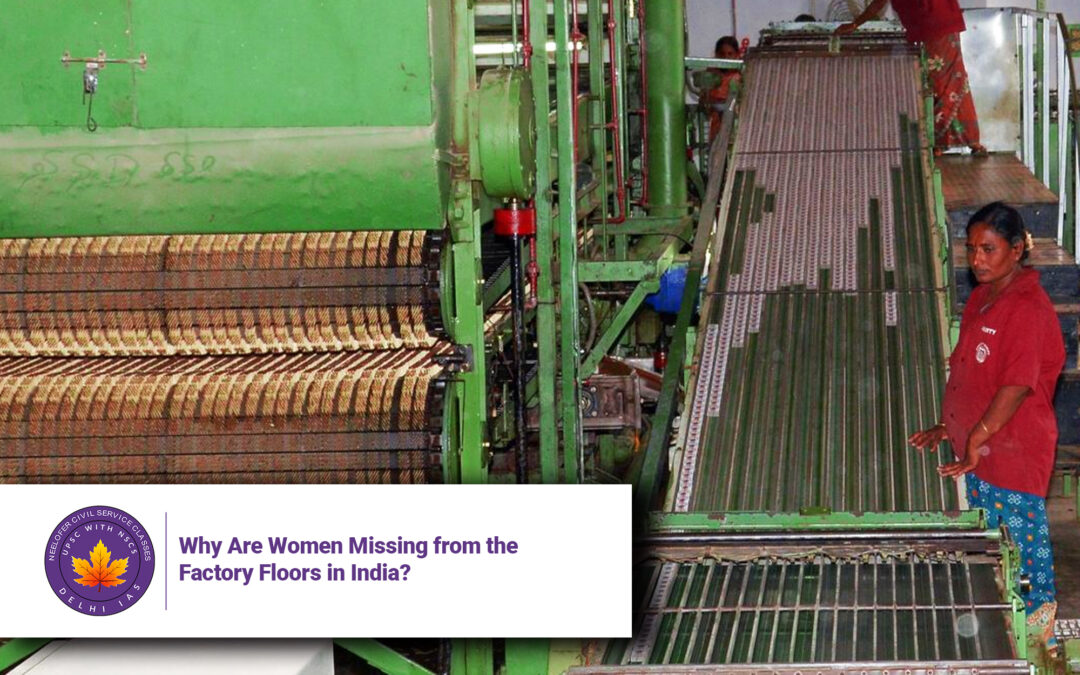
Why Are Women Missing from the Factory Floors in India?
Why in News?
Despite India’s focus on manufacturing-led growth under the vision of ‘Viksit Bharat’, women continue to be underrepresented in the formal manufacturing sector. Recent data highlights a concerning gender gap, with women predominantly concentrated in the informal sector. 
Introduction
Manufacturing is considered a key engine of economic development and a significant contributor to India’s GDP. Yet, women’s participation in the sector remains alarmingly low, especially in formal manufacturing roles. The issue is not just about lack of employment, but about the quality and security of jobs women are able to access.
Key Issues and Background
1. Employment Data Overview
-
Women made up only 18.9% of India’s formal manufacturing workforce in 2022–23 (1.57 million of 8.34 million workers), down from 20.9% in 2015–16.
-
Tamil Nadu alone accounts for 41% of all women in formal manufacturing, highlighting regional imbalance.
-
Uttar Pradesh has a large gender disparity, with only 1% female representation in formal manufacturing.
The Core of the Concern
1. Informal Sector Dominance
-
A majority of women in manufacturing are employed in the informal sector, which is low-paying and lacks social security benefits.
-
Over 60% of women are employed in textiles, apparel, and food processing, mostly informally.
-
In contrast, the tobacco sector is the only informal industry where women outnumber men.
2. Gender Gap in Formal vs Informal Sectors
-
High gender gaps exist in states like Gujarat, Maharashtra, and U.P., where industrial development is significant but women’s participation in formal jobs is low.
-
Chart 2 shows a negative gender gap in formal manufacturing for most states, with men dominating the sector.
Key Observations
1. Structural Issues
-
Low participation is partly due to lack of access to skill training, gender discrimination, and limited formal employment opportunities.
-
Only 30% of women have completed secondary or higher education, impacting job readiness.
2. Policy and Social Challenges
-
There’s poor implementation of gender-sensitive workplace policies.
-
The burden of unpaid domestic labor and mobility constraints further push women into the informal sector.
Conclusion
For India to truly realize the goals of Viksit Bharat, it must prioritize the integration of women into formal manufacturing jobs. This calls for better skilling programs, gender-equitable hiring, enforcement of labor laws, and support systems for women workers. Bridging the gender gap is not only a matter of equity but essential for economic progress.
Q&A Section
Q1. What percentage of India’s formal manufacturing workforce is made up of women as of 2022–23?
Ans: Only 18.9% of the formal manufacturing workforce consists of women.
Q2. Which Indian state contributes the most to women’s employment in formal manufacturing?
Ans: Tamil Nadu, with 41% of all women in formal manufacturing jobs.
Q3. What are the main sectors employing women informally in manufacturing?
Ans: Textiles, apparel, and food processing.
Q4. Why is the informal sector considered problematic for women workers?
Ans: It offers low pay, poor working conditions, no job security, and limited social protection.
Q5. What are the major barriers keeping women out of formal manufacturing roles?
Ans: Lack of skill training, education gaps, gender discrimination, and poor access to structured employment.
