
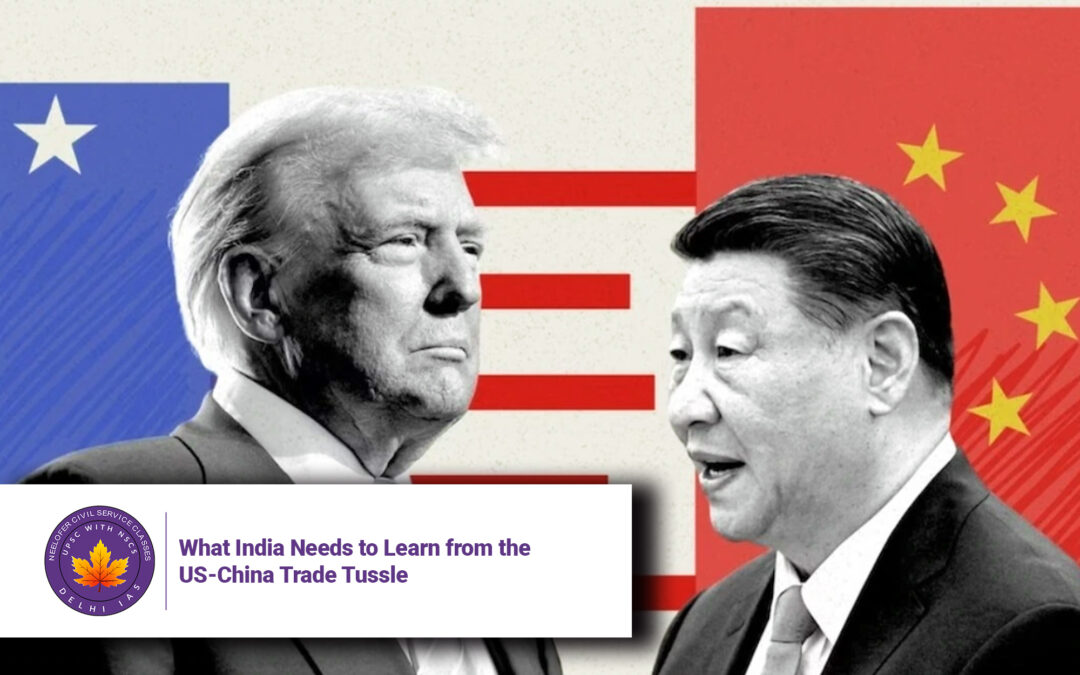
What India Needs to Learn from the US-China Trade Tussle
Why in News?
The ongoing trade tensions between the United States and China have highlighted key lessons for emerging economies like India, especially in areas of supply chain resilience, strategic autonomy, and global trade positioning. The article provides insights on how India can capitalize on geopolitical shifts by adopting a proactive and strategic economic stance. 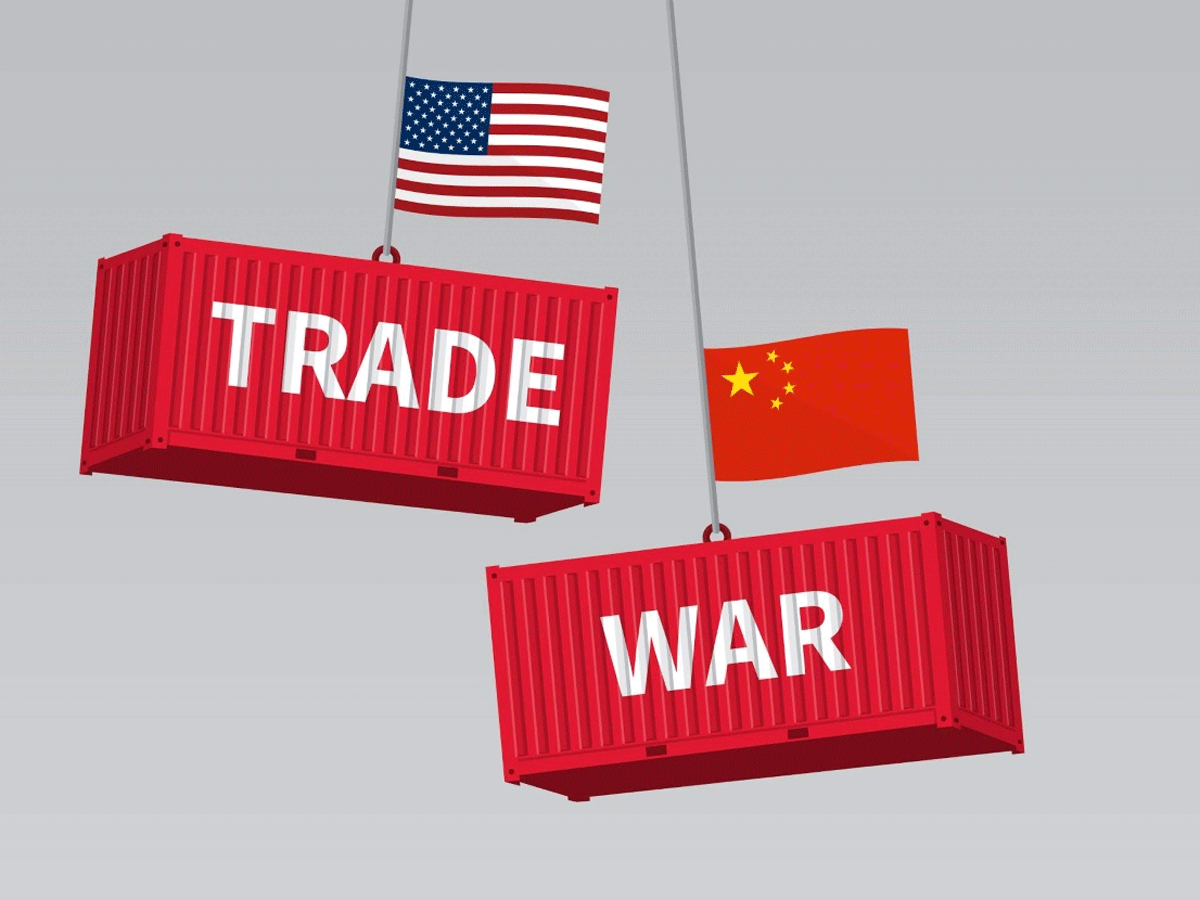
Introduction
The US-China trade war, initially triggered by President Trump’s 2018 decision to impose tariffs on Chinese goods, has evolved into a long-term geopolitical and economic confrontation. The key issue is not just trade imbalances but technology dominance, national security, and strategic leverage.
India stands at a critical juncture where it can learn and adapt strategies from this superpower tussle to strengthen its manufacturing, innovation, and global trade participation.
Key Developments in the US-China Trade War
-
The US imposed sanctions and tariffs on Chinese goods citing national security and unfair practices.
-
China retaliated, and negotiations stalled frequently.
-
Under Trump, the US blacklisted Chinese tech firms and curbed foreign investment in key sectors like Artificial Intelligence and semiconductors.
-
The focus shifted from trade deficits to technology supremacy and strategic decoupling.
-
The Biden administration, while less aggressive, has largely continued Trump-era policies, emphasizing semiconductor independence and supply chain diversification.
India’s Position and Opportunities
India can take key lessons from this economic confrontation:
1. Supply Chain Realignment
-
Global businesses are seeking to reduce their dependence on China.
-
India must position itself as a viable manufacturing and supply chain alternative.
-
Initiatives like ‘Make in India’, PLI schemes, and ease of doing business reforms must be aggressively promoted.
2. Strategic Economic Planning
-
Like the US, India must link national security with technological independence.
-
Investing in sectors like AI, semiconductors, telecom, and green energy will be crucial.
-
India’s National Security Strategy should explicitly address economic resilience.
3. Global Trade Diplomacy
-
India must play a more active role in multilateral forums like the WTO, G20, BRICS, and build coalitions to counter protectionism and techno-nationalism.
-
Partnerships with like-minded economies (e.g., Japan, Australia, EU) can bolster India’s trade leverage.
4. Ease of Doing Business
-
India must streamline bureaucracy, simplify tax policies, and provide investment security to attract global firms moving out of China.
Conclusion
The US-China trade tussle is more than a bilateral economic dispute — it’s a template for the future of global commerce. India must act strategically to enhance its global competitiveness, build economic resilience, and assert itself as a responsible economic power. The shift in global trade flows is a rare opportunity, and India must not miss this moment.
Q&A Section
Q1. What triggered the US-China trade war?
President Trump’s imposition of tariffs on Chinese imports and accusations of unfair trade practices triggered the conflict.
Q2. What was the broader concern beyond tariffs in the US-China dispute?
The dispute expanded into areas like technology dominance, national security, and global supply chain control.
Q3. How can India benefit from this trade war?
India can become a global manufacturing hub, attract companies shifting from China, and strengthen its role in global supply chains.
Q4. What lessons should India learn regarding economic security?
India should prioritize strategic autonomy in key sectors like AI, semiconductors, and digital technologies, linking them with national security goals.
Q5. What policy actions can India take to boost its trade potential?
India should enhance the ease of doing business, invest in R&D, foster innovation, and actively participate in global trade forums to build trust and attract investment.

