
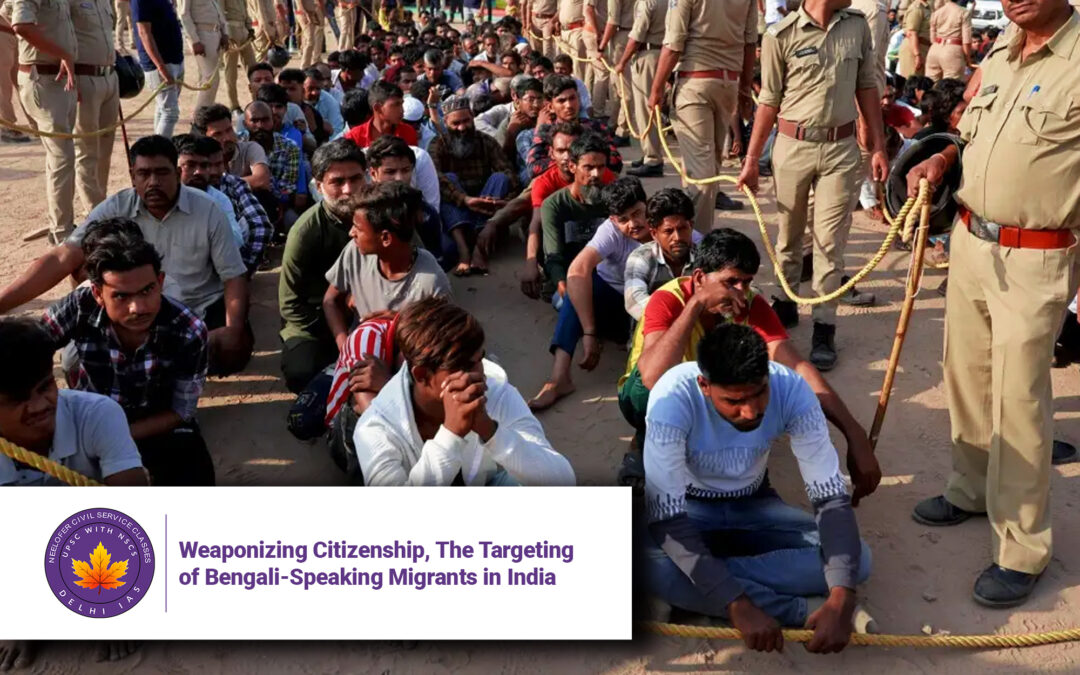
Weaponizing Citizenship, The Targeting of Bengali Speaking Migrants in India
Introduction: A Dangerous Slide into Exclusionary Politics
In recent months, the Indian political landscape has witnessed a resurgence of identity-based exclusion, particularly targeting Bengali-speaking Muslims under the garb of national security and immigration control. The Home Ministry’s directive to identify and deport illegal immigrants, especially those from Bangladesh and Myanmar, has triggered crackdowns in multiple states, including Haryana, Odisha, Maharashtra, Gujarat, and Chhattisgarh. However, what makes these actions deeply concerning is the tendency to bypass due process and the targeting of vulnerable communities, particularly those who are Indian citizens but are being arbitrarily labelled as “illegal Bangladeshis.”
Paromita Chakrabarti’s column offers a sharp critique of this phenomenon, describing it as a manifestation of cynical, pessimistic politics driven by majoritarian anxieties and electoral compulsions. The following analysis expands on this alarming trend and explores its implications for Indian democracy and constitutional values.
The Security Imperative or Political Expedience?
The aftermath of terror attacks, like the one in Pulwama or Pahalgam, has often seen an uptick in the invocation of “national security” to justify harsh immigration enforcement. While security remains a legitimate concern, the rhetoric of infiltration used by political actors seems more designed to mobilize support by invoking fear, rather than addressing actual risks.
This pattern has repeated itself across different BJP-led states. In Gurgaon, blue-collar Bengali-speaking workers were detained and asked to produce identity documents. In Delhi’s Jai Hind Camp, essential services were cut off to drive out “illegal settlers.” In Odisha, over 400 Bengali migrants were evicted on mere suspicion of being illegal Bangladeshis.
This selective targeting reveals a deeply embedded prejudice against Bengali-speaking Muslims, conflating language and religion with illegality.
The AAP and BJP’s Competing Narratives
While the BJP’s attacks are more overt — branding outsiders as infiltrators or terrorists — other political actors have engaged in similar dog-whistle politics. For instance, the AAP’s campaign in Delhi to identify “illegal Bangladeshis” in schools follows a comparable trajectory, even though it claims to represent alternative, progressive politics.
Assam Chief Minister Himanta Biswa Sarma’s statements routinely equating “outsiders” with threats of crime, flood, or jihad, and BJP’s IT cell head Amit Malviya calling Bengali a language of “non-Indian uniformity,” adds fuel to an already volatile discourse. These narratives otherize Bengali speakers, undermining their cultural and linguistic identity within the Indian Union.
A History of Exclusion: From Partition to Present
The politicization of Bengali identity has a long and painful history. During the Partition and again after the formation of Bangladesh in 1971, anti-Bengali sentiment took root in Assam and surrounding regions. The Bongal Kheda movement of the 1960s and the Assam Agitation (1979-1985) sought to identify and deport those considered outsiders. The subsequent Assam Accord (1985) tried to reconcile these tensions, yet left a vague middle ground around “foreigners” living in Assam.
The 2019 National Register of Citizens (NRC) exercise in Assam only deepened this crisis. Over 19 lakh people were excluded, most of them poor, Bengali-speaking Muslims and Hindus. The lack of transparency, inconsistent processes, and bureaucratic opacity led to widespread confusion and legal nightmares.
The situation was so Kafkaesque that many were left stateless despite having lived in India for generations.
Weaponizing Language and Religion
The article emphasizes how language and religion are now being weaponized in electoral politics. In West Bengal, Chief Minister Mamata Banerjee has accused the BJP of targeting Bengali speakers under the guise of implementing NRC and the Citizenship Amendment Act (CAA). She argues that this move is designed to create divisions, exclude minorities, and secure a communal vote bank.
However, Banerjee herself hasn’t always been immune to this rhetoric. She previously blamed the Border Security Force (BSF) for allowing illegal infiltration into Bengal, which some argue helped reinforce anti-Bangladeshi paranoia. Thus, both major parties have played the identity card at different times for political advantage.
Assam’s Unique Vulnerability
Assam’s history is crucial to understanding the present crisis. Post-colonial anxieties around land, jobs, and language created a fertile ground for anti-Bengali sentiment. The Assamese identity movement, though rooted in protecting indigenous culture, has often turned hostile toward Bengali migrants — irrespective of their citizenship status.
The Foreigners Tribunals established in Assam are often criticized for operating without adequate oversight, resulting in arbitrary detentions and a denial of due process. With the recent move by the Sarma government to invoke the Immigrants (Expulsion from Assam) Act, 1950, the fear is that any person labelled as a foreigner can be deported without fair hearing — a clear violation of constitutional protections.
The Dangers of Binary Thinking
One of the most critical takeaways from Chakrabarti’s article is that migration is not a binary. It is not a matter of “insider vs outsider” or “citizen vs infiltrator.” Migration is often driven by economic hardship, natural disasters, conflict, or historic dislocation. In a country as vast and pluralistic as India, mobility has always been a norm, not an exception.
Article 19 of the Constitution guarantees every citizen the freedom to move and reside across India. Targeting Bengali-speaking workers for merely speaking a different language or practicing a different religion violates these fundamental rights.
Political Gain vs National Harmony
The biggest risk in this campaign of exclusion is the erosion of Indian unity. Dividing people based on ethnic, linguistic, or religious lines threatens the very fabric of the republic. As seen in recent incidents, this can lead to mob violence, as in the Pune case where members of the Bajrang Dal attacked a family of Kargil War veterans, demanding ID proofs just because they were Bengali Muslims.
In the long run, such polarizing politics may yield electoral benefits, but they create deep social rifts that are hard to heal.
Conclusion: Reclaiming Citizenship and Humanity
The essence of Indian citizenship lies in its inclusivity, diversity, and plurality. The targeting of Bengali-speaking migrants — whether Hindu or Muslim — undermines these core values. As Chakrabarti rightly notes, when citizenship becomes a weapon, society shrinks into something fearful, brittle, and unjust.
India’s political leadership must resist the temptation to use identity for short-term gains and instead focus on upholding the rights of all citizens — regardless of their language, religion, or migration history.
If not, the promise of Indian democracy risks being hollowed out from within.
5 Key Questions & Answers
Q1: Why are Bengali-speaking migrants being targeted across India?
A: Bengali-speaking migrants are often suspected of being illegal immigrants from Bangladesh, especially following national security incidents. This has led to profiling, detentions, and evictions — even though many are Indian citizens.
Q2: What historical movements contributed to anti-Bengali sentiment in Assam?
A: Movements like Bongal Kheda, the Assam Agitation (1979-85), and the fallout from the Partition and 1971 Bangladesh Liberation War contributed to anti-Bengali sentiment, leading to exclusionary policies.
Q3: What are the criticisms against the NRC and Foreigners Tribunals in Assam?
A: Critics argue that these mechanisms are opaque, arbitrary, and lack due process, leading to the wrongful exclusion of genuine citizens. Over 19 lakh people were excluded from the NRC, many of whom are poor, Bengali-speaking individuals.
Q4: How are political parties using this issue for electoral advantage?
A: Both BJP and TMC have used the rhetoric of “infiltrators” to mobilize voters, stoke fear, and create cultural binaries. TMC’s “Bangla nijer meyekei chay” campaign appeals to Bengali pride, while BJP emphasizes national security and religious identity.
Q5: What are the broader implications of this exclusionary politics?
A: It threatens India’s constitutional values, fosters social division, leads to communal violence, and reduces the idea of Indian citizenship to a narrow and brittle identity, eroding the pluralistic fabric of the nation.
