
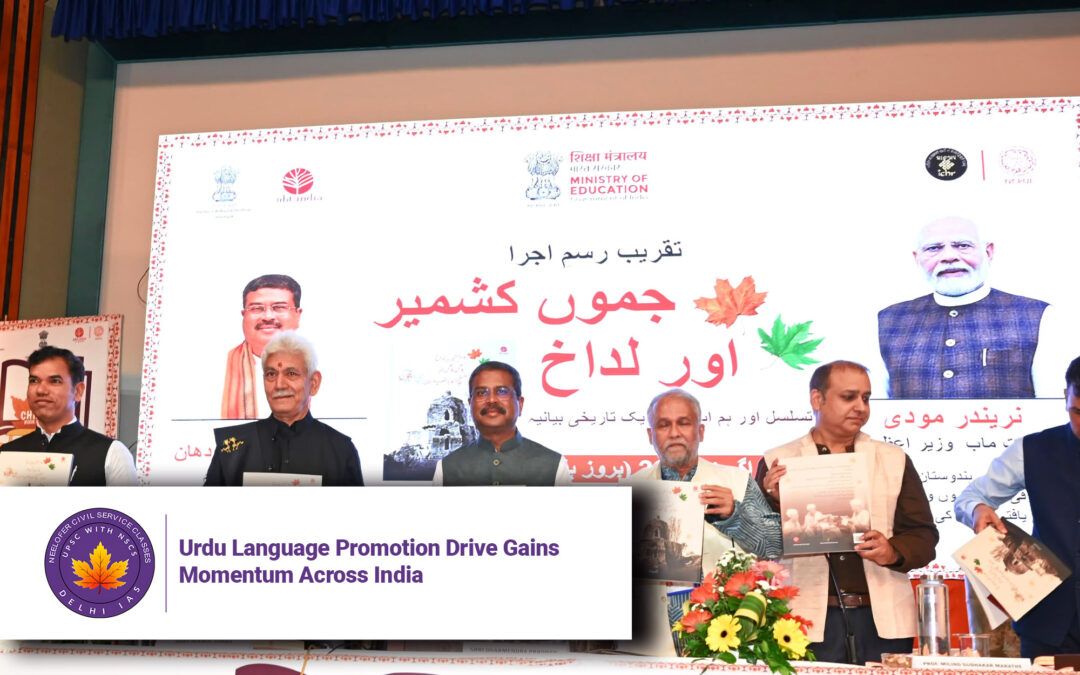
Urdu Language Promotion Drive Gains Momentum Across India
A Cultural and Educational Push for Linguistic Identity
Why in News?
The Urdu language, with its rich literary tradition and deep cultural roots in the Indian subcontinent, is receiving renewed institutional attention. Recent initiatives—driven by educational bodies, cultural organisations, and government-supported programmes—are aimed at preserving, promoting, and modernising Urdu. These efforts include curriculum reforms, digital learning resources, teacher training programmes, and state-level policy measures to integrate Urdu more fully into mainstream education and public life.
Introduction
Urdu is more than just a means of communication; it is a living archive of poetry, history, and Indo-Islamic heritage. Despite its prominence in literature and popular culture, Urdu faces declining usage in education and administration. The language’s future depends on targeted, sustained efforts to ensure that younger generations can read, write, and speak it fluently.
The latest push for Urdu promotion comes in the wake of growing recognition that India’s linguistic diversity is a cultural asset that must be safeguarded. Educational authorities, cultural activists, and literary figures are joining forces to enhance the teaching of Urdu in schools, expand learning materials, and create modern tools that make the language more accessible to students across the country.
Key Issues and Institutional Concerns
1. Decline in Urdu Literacy
Despite being spoken by millions, the number of students who can fluently read and write in Urdu is decreasing. This is partly due to changes in school curricula, limited access to Urdu-medium schools, and a general shift toward English and Hindi for professional advancement.
2. Shortage of Qualified Teachers
Many schools offering Urdu as a subject face a shortage of trained and certified Urdu teachers. Without well-qualified educators, the quality of instruction suffers, leading to further decline in student interest.
3. Limited Teaching Resources
Textbooks, reference materials, and supplementary reading resources in Urdu often lack updates. Modern digital tools, such as e-books and learning apps, are not widely available or integrated into classroom teaching.
4. Policy Gaps in Implementation
While several state governments have policies supporting Urdu, the actual implementation remains inconsistent. Teacher recruitment is slow, funding for Urdu promotion is uneven, and monitoring mechanisms are weak.
5. Societal Perception and Economic Relevance
Some parents perceive Urdu as having limited economic value compared to English or regional languages with strong job markets. This perception reduces enrolment in Urdu courses and affects its intergenerational transmission.
Current Initiatives
1. Urdu in School Curriculum
Educational boards in states like Uttar Pradesh, Telangana, and Jammu & Kashmir have introduced reforms to strengthen Urdu teaching from primary to senior secondary levels. Special focus is being placed on pronunciation, grammar, and creative writing.
2. Teacher Training and Recruitment
Teacher training institutes are rolling out refresher courses for Urdu educators, focusing on modern pedagogical methods. State-level competitive exams are being held to recruit qualified Urdu teachers.
3. Digital Learning Resources
Mobile applications and online portals are being developed to offer interactive Urdu lessons, dictionaries, and literature archives. This allows students from non-Urdu-medium schools to access the language easily.
4. Literary and Cultural Events
Urdu poetry festivals, mushairas, and literary seminars are being organised in various cities to popularise the language among the youth. These events aim to blend traditional literature with contemporary themes.
5. Government Schemes and Funding
Central and state governments have allocated funds to Urdu academies for the publication of books, translations, and educational material. Scholarships are being offered to students excelling in Urdu studies.
Challenges and the Way Forward
1. Bridging the Teacher Gap
Fast-tracking recruitment, offering competitive salaries, and creating fellowship programmes for Urdu educators can help attract talent to the teaching profession.
2. Integrating Urdu with Digital Platforms
Developing high-quality, interactive digital Urdu content—such as video lectures, AI-based grammar checkers, and mobile learning apps—can make the language more relevant for tech-savvy students.
3. Addressing Perception Barriers
Awareness campaigns highlighting Urdu’s cultural importance, career opportunities in translation, journalism, publishing, and academia can help parents and students see its practical value.
4. Encouraging Public-Private Partnerships
Publishing houses, ed-tech companies, and cultural organisations can collaborate to produce modern Urdu textbooks and learning resources.
5. National-Level Monitoring and Evaluation
A central monitoring framework can ensure that Urdu promotion programmes meet their objectives and that state-level policies are implemented effectively.
Conclusion
The renewed promotion of Urdu is a crucial step toward preserving India’s linguistic and cultural heritage. By addressing teacher shortages, modernising resources, and changing public perceptions, stakeholders can ensure Urdu remains vibrant for future generations. Its survival depends not just on government policy but on active participation from communities, educators, and cultural institutions.
Q&A Section
Q1. Why is Urdu promotion important in India today?
Urdu promotion preserves a rich cultural heritage, enhances linguistic diversity, and ensures that future generations have access to a language deeply embedded in the country’s literary and historical traditions.
Q2. What is the main challenge in teaching Urdu in schools?
The main challenge is the shortage of qualified Urdu teachers, which affects the quality and reach of instruction.
Q3. How are digital platforms helping in Urdu education?
Digital platforms offer interactive lessons, e-books, and online dictionaries, making Urdu learning accessible to students who might not have access to Urdu-medium schools.
Q4. What role do cultural events play in Urdu promotion?
Cultural events like mushairas and literary festivals engage young audiences, spark interest in Urdu poetry and prose, and bridge the gap between tradition and modern expression.
Q5. How can Urdu be made more relevant for today’s youth?
By integrating Urdu into digital media, highlighting career opportunities, and modernising teaching methods, the language can be made appealing and practical for contemporary learners.

