
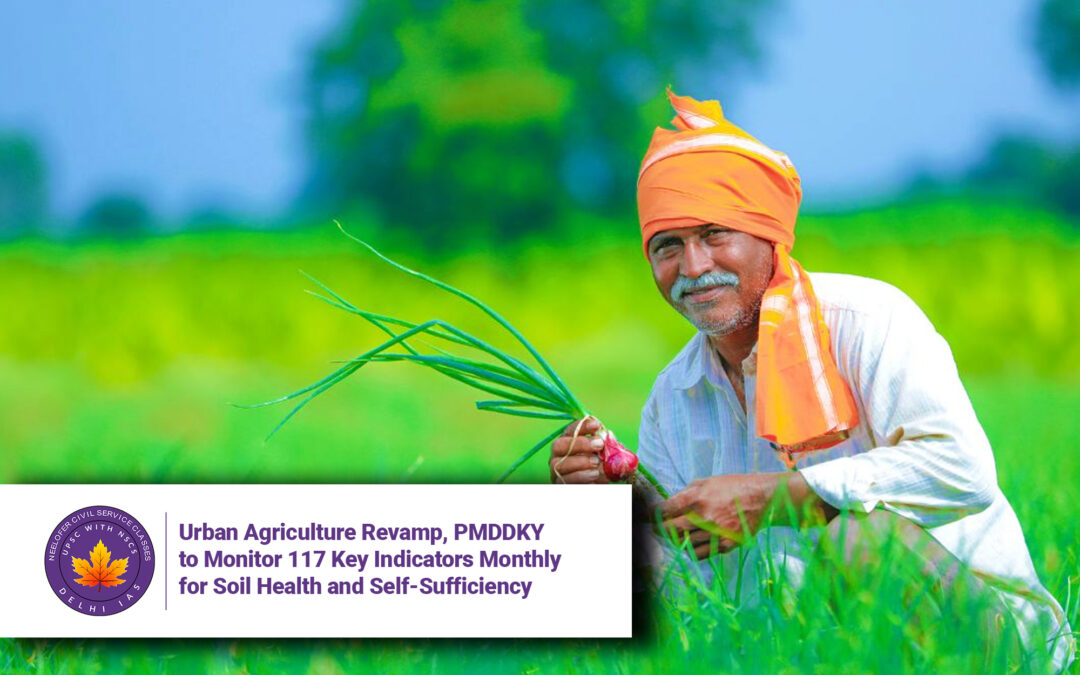
Urban Agriculture Revamp, PMDDKY to Monitor 117 Key Indicators Monthly for Soil Health and Self-Sufficiency
Why in News?
The Government of India has recently intensified its focus on agricultural reform and sustainability through the implementation of the Pradhan Mantri Deen Dayal Upadhyaya Krishi Yojana (PMDDKY). In a significant move, the Centre has announced that it will now monitor 117 key indicators on a monthly basis under this scheme. These indicators are designed to assess progress in critical areas such as soil and water health, self-sufficiency in agriculture, and the growth of allied sectors like animal husbandry, fisheries, and horticulture. 
However, recognizing that central monitoring alone is insufficient, the government has proposed a decentralized and participatory approach. It is calling for active involvement from States, local self-governments, primary agriculture cooperative societies, agriculture universities, and farmer-trader organizations to ensure the comprehensive success of the scheme. This development marks a significant policy shift towards grassroots agricultural governance, data-driven decision-making, and community-level accountability.
Introduction
India is a predominantly agrarian country, with over 50% of its population dependent on agriculture and allied sectors for livelihood. Despite its importance, the sector faces persistent challenges including soil degradation, water scarcity, low productivity, climate-related risks, and inefficient supply chains. To counter these issues, the Government of India has rolled out numerous schemes over the years. Among the latest and most ambitious is the Pradhan Mantri Deen Dayal Upadhyaya Krishi Yojana (PMDDKY).
What makes PMDDKY particularly noteworthy is its emphasis on monitoring progress through 117 key performance indicators (KPIs)—a move that aligns agriculture with modern management practices. The scheme also focuses on community participation, bringing together various stakeholders to ensure that the reforms are not only effective but also sustainable and inclusive.
Key Issues and Background
1. Declining Soil Health and Water Mismanagement
One of the most pressing concerns in Indian agriculture today is the rapid decline in soil fertility and organic content due to the excessive use of chemical fertilizers and unbalanced crop patterns. This has been further exacerbated by water misuse, particularly in water-intensive crops like paddy and sugarcane grown in unsuitable regions.
For example, Punjab—originally not a paddy-growing region—now suffers from falling groundwater levels due to the cultivation of rice. Similarly, the Deccan plateau, with limited rainfall, witnesses over-extraction of groundwater for cash crops, leading to long-term ecological damage. The lack of localized, climate-appropriate cropping strategies has worsened the crisis.
2. Lack of Real-Time Monitoring and Policy Feedback
Historically, most agricultural policies in India have relied on outdated or annual data sets. This has often led to mismatches between policy intentions and ground realities. The absence of real-time monitoring means that early signs of distress or inefficiency go unnoticed, leading to crop failure, input wastage, or inadequate market support.
The PMDDKY seeks to resolve this issue through monthly tracking of 117 indicators that cover a wide spectrum of metrics—ranging from input use and irrigation efficiency to market access, yield outcomes, and even livelihood parameters for farmers.
3. The Role of Allied Sectors
To ensure self-sufficiency and income security for farmers, India needs to strengthen not just crop cultivation but also allied sectors such as animal husbandry, poultry, beekeeping, and fisheries. These sectors contribute significantly to rural incomes but have historically received lesser attention compared to cereals and pulses.
PMDDKY recognizes the potential of these sectors and includes dedicated indicators to assess their growth, input efficiency, and market integration. By doing so, the scheme adopts a holistic approach to agriculture.
4. Lack of Participatory Governance
Top-down policies have limited effectiveness without local buy-in. The absence of real involvement by states, municipalities, cooperatives, and academia has often led to poor implementation on the ground. Local institutions are closest to the problems and hence best suited to provide timely solutions.
The PMDDKY seeks to correct this by emphasizing decentralization. It invites active involvement from a range of stakeholders:
-
State Governments to align regional policies with the national vision.
-
Local self-governments (Panchayats and Municipalities) to ensure last-mile implementation.
-
Primary Agriculture Cooperative Societies (PACS) to support aggregation and input management.
-
Agricultural Universities and Research Bodies to provide scientific inputs.
-
Farmer and Trader Organizations to build real-time feedback loops and market responsiveness.
Key Features of the Monitoring System
The 117 indicators monitored under PMDDKY cover a comprehensive range of themes, making it one of the most detailed agricultural monitoring mechanisms introduced in India so far. These indicators are categorized under the following heads:
-
Soil Health Indicators: Organic carbon levels, micronutrient presence, soil pH balance, crop-specific nutrient requirements.
-
Water Management Indicators: Availability of irrigation infrastructure, groundwater levels, adoption of micro-irrigation, canal efficiency.
-
Crop Performance Metrics: Yield per hectare, cropping intensity, use of certified seeds, fertilizer-pesticide balance.
-
Allied Sectors: Animal vaccination rates, fish catch volume, honey production, fodder availability.
-
Market Access: Price realization, distance to nearest mandi, cold storage availability, agri-logistics usage.
-
Input Support: Availability of fertilizers, seed supply chains, mechanization level, farmer training outreach.
-
Farmer Welfare: Access to crop insurance, income diversification, credit availability, SHG participation.
Each of these indicators will be monitored monthly, and dashboards will be created at the district, state, and central levels for timely alerts and performance evaluations.
Specific Impacts and Expected Benefits
-
Policy Calibration
With monthly data availability, both the Centre and the States can make real-time corrections to their schemes, subsidies, and advisories. For instance, if a district shows signs of nutrient deficiency in the soil, targeted fertilizer distribution can be planned immediately. -
Localized Decision-Making
Local self-governments and cooperatives will have access to timely data that allows them to customize extension services and support mechanisms. This could be a game-changer in reducing the information asymmetry that most small farmers face. -
Farmer Empowerment
By involving farmer organizations and cooperatives, the scheme ensures that the community has ownership of the reform process. Training, capacity building, and participation in data collection will help improve their understanding and trust in government initiatives. -
Boost to Allied Sectors
By tracking the performance of non-crop sectors, PMDDKY will help unlock the untapped income potential in rural areas. This aligns with the vision of Doubling Farmers’ Income, which cannot be achieved through crop cultivation alone. -
Academic and Research Engagement
Involving agriculture universities in the data analysis process will help bridge the gap between science and field implementation. Their insights can improve not only policy but also pedagogy for the next generation of agripreneurs.
Challenges and the Way Forward
Challenges
-
Infrastructure Gaps: Many regions, particularly in remote or tribal areas, lack the digital infrastructure to support real-time data collection and dashboard updates.
-
Capacity Constraints: Local self-governments and cooperative staff often lack the technical skills or manpower required for accurate data entry and interpretation.
-
Data Quality and Standardization: Ensuring the quality and standardization of data across districts and states is a complex task that requires rigorous training and centralized verification.
-
Coordination Issues: Aligning central objectives with state priorities and avoiding duplication with existing schemes could prove to be administratively challenging.
Steps Forward
-
Digital Infrastructure Investment: The government must prioritize investment in rural digital infrastructure, including handheld data collection devices, internet connectivity, and cloud-based servers.
-
Capacity Building Programs: Dedicated training modules should be developed for Panchayat staff, PACS members, and local NGOs to ensure data accuracy and local implementation.
-
Public-Private Partnerships: Encouraging private agri-tech startups to assist in dashboard creation, remote sensing, and predictive analytics could accelerate outcomes.
-
Incentive Mechanism: States and districts performing well on the 117 indicators should be incentivized with additional funding or recognition to promote competitive federalism.
-
Legal and Policy Framework: Laws should be amended or created to mandate regular audits, data sharing protocols, and accountability mechanisms for all stakeholders involved.
Conclusion
The PMDDKY’s framework to monitor 117 agricultural indicators on a monthly basis marks a watershed moment in India’s journey toward a data-driven, inclusive, and sustainable agricultural economy. The scheme rightly acknowledges that agricultural transformation cannot be achieved by the Centre alone—it requires a whole-of-government and whole-of-society approach.
By integrating scientific data, local governance, cooperative strength, and academic inputs, the scheme provides a 360-degree ecosystem for reform. But its success will ultimately depend on execution. If implemented well, PMDDKY has the potential to redefine the contours of Indian agriculture—making it more resilient, efficient, and equitable for future generations.
5 Questions and Answers
Q1: What is the main goal of the Pradhan Mantri Deen Dayal Upadhyaya Krishi Yojana (PMDDKY)?
A: The main goal of PMDDKY is to ensure sustainable and self-sufficient agriculture by improving soil and water health, strengthening allied sectors, and tracking progress through 117 key indicators on a monthly basis.
Q2: Why is the monitoring of 117 indicators significant?
A: Monitoring these indicators allows for real-time policy adjustments, efficient resource allocation, and localized support, leading to better outcomes for farmers and the ecosystem.
Q3: Who are the key stakeholders involved in this participatory model?
A: Key stakeholders include States, local self-governments, primary agriculture cooperative societies, agriculture universities, and farmer-trader organizations.
Q4: What are some of the challenges faced in implementing PMDDKY effectively?
A: Challenges include lack of digital infrastructure, limited technical training, coordination issues, and standardization of data collection across regions.
Q5: How can the success of PMDDKY be ensured?
A: By investing in digital tools, training local bodies, encouraging private partnerships, and creating accountability mechanisms through incentives and legal backing.

