
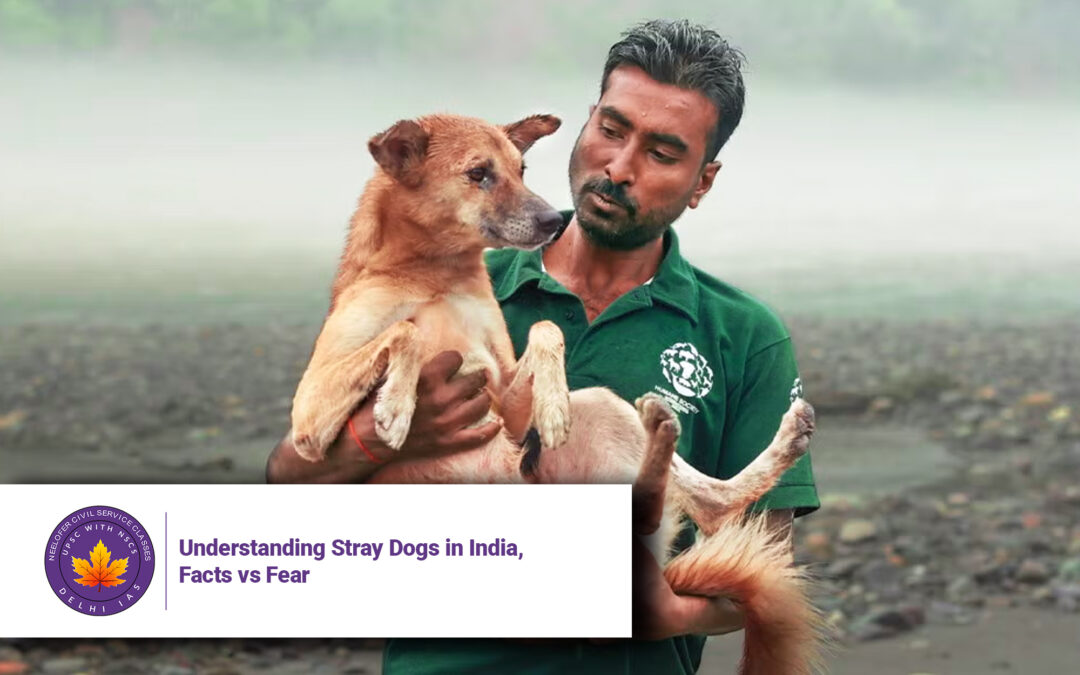
Understanding Stray Dogs in India, Facts vs Fear
Why in News?
Recent debates and sensational narratives have reignited discussions on street dogs in India. However, misconceptions, fear-mongering, and misinformation often dominate the discourse. This article emphasizes the importance of science, empathy, and data in addressing the stray dog issue effectively. 
Introduction
India has a long-standing relationship with community dogs. However, recent incidents and viral misinformation have stirred public fear, often resulting in demand for extreme measures like culling. But expert data suggests a more humane and effective solution — the Animal Birth Control (ABC) programme, which has shown success in reducing both stray dog populations and rabies cases.
Key Issues
1. Rise in Fear, Not in Numbers
-
Public perception often equates visibility with growth in numbers.
-
However, ABC programs have reduced stray dog populations significantly in cities like Jaipur, Chennai, and Mumbai.
-
Rabies deaths have also dropped due to widespread dog vaccinations.
2. Misinformation & Misguided Measures
-
Sensational reporting and non-scientific data promote fear and even hatred.
-
Proposals to eliminate dogs go against the World Health Organization’s guidelines, which advocate sterilization and vaccination as the only effective strategy.
3. The Role of Humans in Conflict
-
Dog-human conflicts arise primarily from human actions—poor waste management, cruelty towards dogs, or lack of public education.
-
Aggression in dogs often stems from fear or past trauma rather than inherent behavior.
Alternative Approaches
Instead of culling or relocation, which only create a vacuum and bring more dogs, experts suggest:
-
Expanding the ABC program across all municipalities.
-
Promoting public awareness campaigns about safe coexistence.
-
Training local animal control authorities with scientific and compassionate approaches.
Challenges and the Way Forward
Challenges:
-
Inconsistent ABC implementation across cities.
-
Spread of myths and fear-inducing narratives on social media.
-
Resistance from residents unaware of long-term humane solutions.
Way Forward:
-
Empower civic bodies with proper training, funding, and monitoring.
-
Encourage media responsibility in reporting.
-
Promote community-led solutions with support from NGOs and animal welfare groups.
Conclusion
India’s stray dog situation is not a crisis of numbers, but one of misinformation and poor implementation. Compassion, guided by data and science, is the only path forward for harmonious coexistence. Dogs are part of India’s urban ecosystem and need protection, not persecution.
Five Questions & Answers
1. What is the Animal Birth Control (ABC) program?
It is a government-supported initiative involving the sterilization and vaccination of stray dogs to control their population and reduce rabies.
2. Why is culling not an effective solution?
Culling creates a vacuum that is quickly filled by new dogs, and it violates international health guidelines. It is neither humane nor sustainable.
3. Has the ABC program shown results?
Yes, cities like Jaipur and Chennai have seen significant reductions in both stray dog populations and rabies cases due to consistent ABC efforts.
4. What fuels dog-human conflicts in urban areas?
Poor waste management, lack of public awareness, and cruelty or fear-triggered behavior from either side are major causes.
5. What should be the correct approach to managing stray dogs?
Invest in ABC programs, educate the public, implement better waste control, and adopt compassion-driven scientific strategies.

