
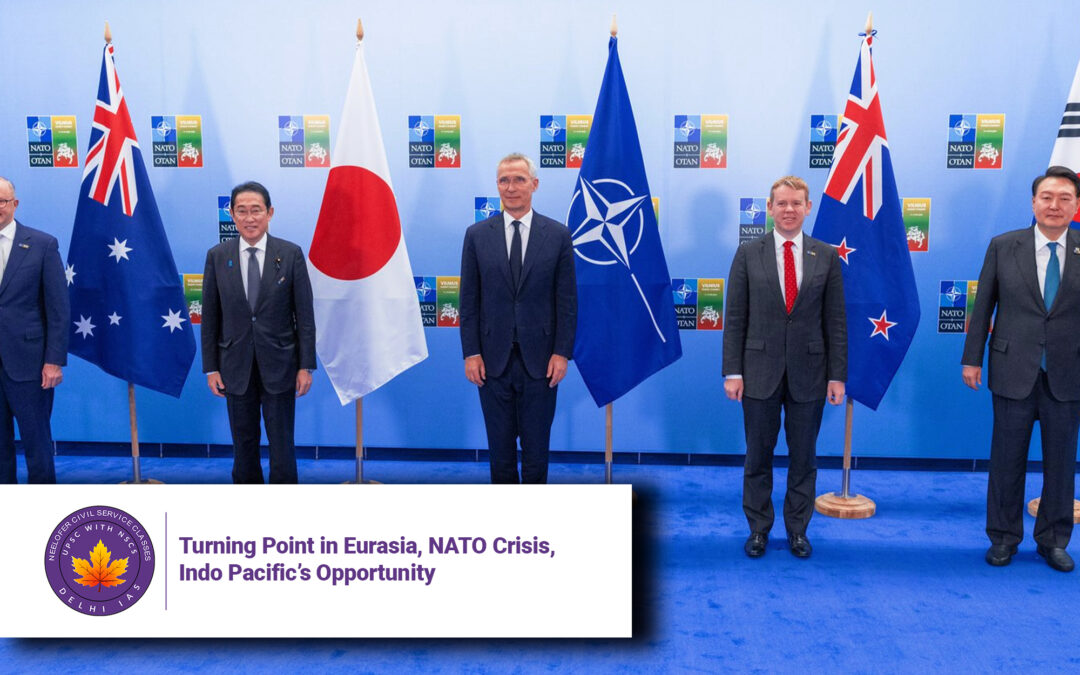
Turning Point in Eurasia, NATO Crisis, Indo Pacific’s Opportunity
Why in News?
A dramatic geopolitical shift is underway in Eurasia. US President Donald Trump’s skeptical stance on NATO, combined with unfolding crises in the Middle East and Ukraine, is forcing Europe to reassess its security structure. The Indo-Pacific region is watching closely, as this transformation may signal the emergence of a multipolar world order with new security alignments. 
Headline Insight: A Eurasian Realignment in Motion
C. Raja Mohan, in his analysis titled “Turning Point in Eurasia”, delves into the tremors shaking the current world order. The upcoming NATO summit in The Hague, amidst US criticism of NATO’s relevance, is expected to be a moment of reckoning for Western alliances.
Key Highlights
-
Trump’s Disruption of NATO Unity
-
President Trump has repeatedly called NATO “obsolete” and questions US commitments to defend Europe, especially in case of a Russian attack.
-
Trump’s support for disengagement, and demands for more European financial burden-sharing, have triggered deep anxieties across European capitals.
-
-
Germany’s Emerging Leadership
-
Under Defense Minister Boris Pistorius and Chancellor Olaf Scholz, Germany is moving from a pacifist post-WWII stance to a more assertive military role.
-
Forward deployment of German troops in Lithuania is symbolic of Germany’s commitment to NATO’s eastern flank.
-
-
Russia and the Ukraine Crisis
-
Russia’s 2022 invasion of Ukraine and prolonged conflict have shifted global perspectives on European security.
-
NATO’s growing strategic focus on deterring Russia has led to expanded missions, increasing support for Ukraine, and discussions on more permanent deployments.
-
-
Middle East Volatility and US Retreat
-
Simultaneously, Trump’s Middle East disengagement policy has emboldened actors like Iran, Russia, and China.
-
Power vacuums are encouraging new regional alignments, such as India-Israel-Gulf partnerships and strengthening ties between Saudi Arabia and China.
-
-
Indo-Pacific’s Critical Role
-
The Indo-Pacific is urged to recalibrate security frameworks independently of NATO.
-
Strategic partnerships among India, Japan, Australia, South Korea, and Southeast Asia are becoming crucial as new axes of power shift eastward.
-
5 Key Takeaways
-
NATO is under internal strain as US leadership becomes increasingly unpredictable.
-
Germany is stepping up as a potential security guarantor for Europe.
-
Russia’s war on Ukraine has permanently altered European security priorities.
-
Middle Eastern realignments are distancing themselves from sole reliance on US security.
-
The Indo-Pacific must explore independent alliances as NATO’s global relevance diminishes.
Challenges and the Way Forward
-
Challenge 1: NATO’s Long-Term Sustainability
European states must prepare for a future where American leadership is unreliable. -
Challenge 2: Eurasian Regional Conflicts
From Ukraine to Gaza, evolving security threats demand robust regional partnerships. -
Challenge 3: Balancing China and Russia
Eurasian and Indo-Pacific nations must balance rising Chinese and Russian assertiveness while maintaining strategic autonomy. -
Way Forward: Building Alternative Alliances
The Indo-Pacific, particularly India, must lead efforts in creating a multipolar security architecture, including collaborations with ASEAN, Quad, and EU. -
Way Forward: Rethinking Dependence on the US
Countries should invest in defense capabilities and foster bilateral/multilateral strategic dialogues.
Q&A Section
1. Why is the NATO summit in The Hague considered significant?
Because it may redefine NATO’s role amidst US disengagement and growing European fears of Russia’s aggression.
2. What is Germany’s new role in Europe’s security architecture?
Germany is shifting toward active defense leadership by deploying troops in Eastern Europe and investing in military modernization.
3. How has the Ukraine war impacted global geopolitics?
It has reshaped threat perceptions, solidified NATO’s Eastern focus, and forced global powers to rethink military alliances.
4. What does Trump’s NATO stance mean for Europe?
His skepticism weakens alliance cohesion and signals to Europe that it must prepare for strategic autonomy in defense.
5. What should the Indo-Pacific region do in response to this Eurasian shift?
Develop independent security strategies, deepen partnerships like the Quad, and reduce over-reliance on NATO or US-driven alliances.
Conclusion
This pivotal moment in Eurasia calls for urgent global introspection. As NATO falters under internal strains, the Indo-Pacific has a chance to redefine 21st-century security through self-reliant partnerships and strategic cooperation.

