
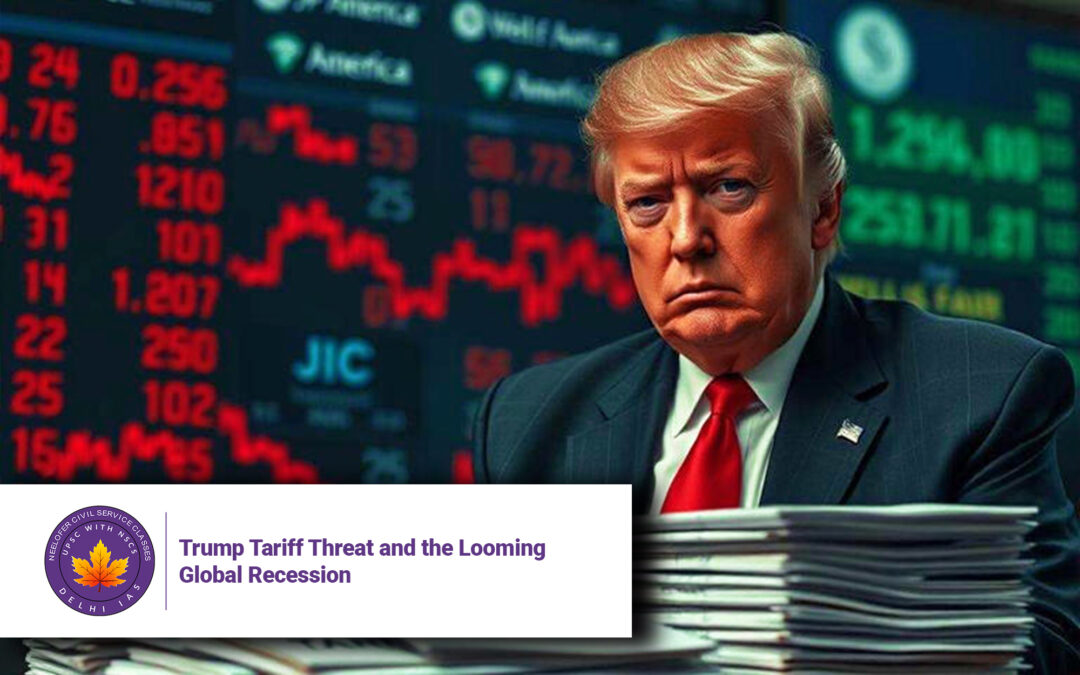
Trump Tariff Threat and the Looming Global Recession
Why in News?
Donald Trump’s announcement of a new wave of tariffs, unveiled on April 2, 2025, as part of his 2024 re-election campaign, has raised serious global economic concerns. A temporary pause gave hope, but if Trump revokes the pause and proceeds with his proposed tariffs, experts predict a global recession. This has major implications for countries like India, which now faces the challenge of protecting its economy amidst rising protectionism. /theprobe/media/media_files/2025/04/06/onjMQyeQIYGN5Xac7v1N.jpg)
Introduction
The term “tariff,” usually a noun, is now being used as a political verb thanks to Donald Trump, who has aggressively imposed tariffs on multiple countries. His recent proposal to tax imports heavily is part of his “Make America Great Again (MAGA)” doctrine. However, critics argue that such policies will destabilize international trade, affect global growth, and harm even the U.S. economy.
Key Issues and Background
Seven-State Strategy
Trump’s political calculations revolve around seven swing states — Arizona, Georgia, Michigan, Nevada, North Carolina, Pennsylvania, and Wisconsin. These states suffer from high unemployment, deindustrialization, and rising populist sentiments. Trump tailors his economic policies to appeal to these regions, often at the cost of sound global strategy.
Tariff Calculation Flaws
The tariff model Trump introduced is based on a simplistic formula:
Tariff Rate = ½ the U.S. trade deficit with a country ÷ value of U.S. exports to that country
Economists warn this formula is misleading, as it ignores complex trade realities and economic interdependence.
Impact on U.S. and Global Trade
If implemented:
-
Imports will be taxed heavily, raising costs for U.S. consumers.
-
Global supply chains will be disrupted.
-
Services, capital flows, and immigration will be affected.
-
Inflation and unemployment in the U.S. may rise sharply.
The Core of the Concern
Global Reaction
-
China is determined not to retreat and has prepared for counter-tariffs.
-
Canada and Europe have responded with calm but firm resistance.
-
India has not yet commented but is advised to avoid appearing passive.
India’s Position
India faces a dangerous mix of recession, inflation, lower FDI, and reduced exports. The best response would be to:
-
Expand trade alliances
-
Strengthen its economic diplomacy
-
Push back against U.S. unilateralism
Key Observations
-
Many developed nations have shown restraint, but they are prepared to retaliate.
-
Trump’s tariff plans are seen as delusional and driven by politics over economics.
-
If implemented, these policies could cripple the world’s economy, especially developing nations.
Conclusion
Donald Trump’s obsession with tariffs and populist economic strategies might work politically in the short term, but they are widely expected to fail in the long run. For India and the global community, unity and strategic partnerships are the best defense. Eventually, economic logic and global cooperation will prevail, not populism. As the article notes, when Trump is finally defeated, India should not be seen standing with the loser.
Q&A Section
Q1. What is the core problem with Trump’s new tariff plan?
His tariff model is overly simplistic and ignores the complexity of global trade. It risks triggering a global recession.
Q2. Why is India concerned about these tariffs?
India could face lower exports, reduced foreign investment, inflation, and a potential recession if global trade slows.
Q3. How have other countries reacted?
China has vowed to retaliate, while Canada and the EU have responded with determination and restraint.
Q4. What should India do in response?
India must choose allies, expand trade relations, and actively oppose unilateral economic policies.
Q5. What does the article predict about the outcome of Trump’s economic strategy?
The article predicts Trump will eventually lose politically and that economic logic will triumph over his flawed policies.
